

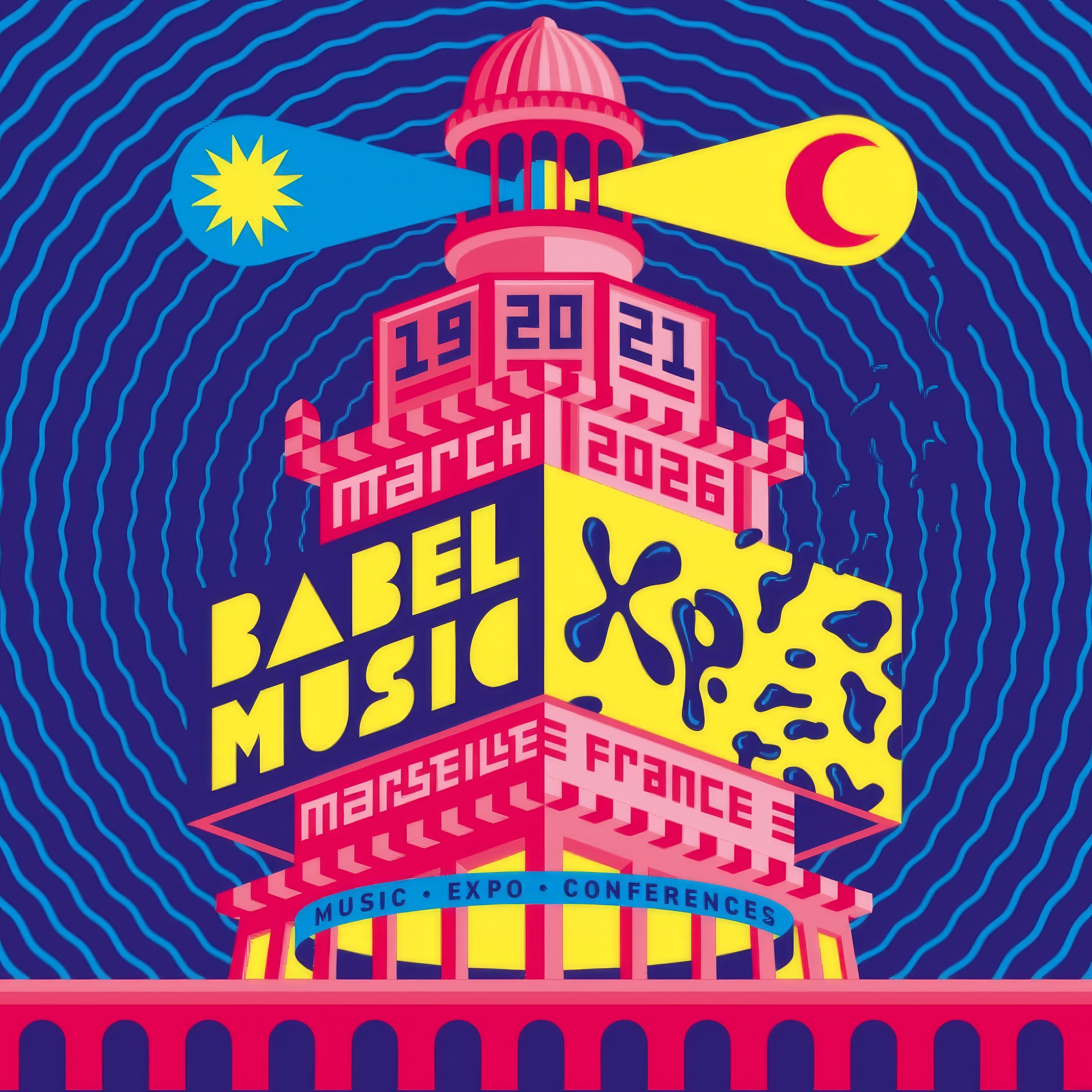
Marseille was voting, the far right was closing in, and Babel Music XP moved through a city with all of that already in the air.
This year’s edition ran from 19 to 21 March, with the mayoral runoff due the next day, so the festival never felt detached from the week around it. Marseille did not feel like a neutral host either. Posters, canvassing, impromptu sit-ins and demos, pettier but heated bar talks: the public mood had politics in it, and the festival’s day-to-night split tracked that reality.
You felt that first at La Friche, where Babel spent its days among meetings, talks and market rounds inside the former Seita tobacco factory in Belle de Mai. La Friche is a social space as much as a cultural one: a reused industrial complex in a working-class neighbourhood shaped by immigration, which people already use in everyday Marseille life, with studios and workspaces alongside exhibition areas and performance rooms, plus community gardens, a playground, food and childcare. That is why Babel’s professional side sits naturally there, with delegates, artists, programmers, labels and agents arriving from across the world to talk routes and dates in a place that belongs to the neighbourhood as well as the cultural calendar.
As the daytime schedule thins out, the festival moves into venues across the city, from Le Makeda to the Cité de la Musique, Alcazar, Espace Julien and the former Dock des Suds site, now operating as La Plateforme.
The Wednesday pre-party at Le Makeda set Babel’s first night in a Marseille room where the stage feels level with the floor and the air changes as soon as the crowd settles. It’s narrow, close, built for contact. You hear the front edge of a voice, the click of stick on rim, the way bass vibrates through bodies before it turns into sound, and you hear the room answering back: laughter, heckles, the small waves of attention you only get when everyone is packed in.
That closeness suited the bill. Bashar Murad opened with Palestinian electro-pop that names its subjects plainly: occupation, patriarchal social rules, gender equality and gender diversity, carried in the lyric lines and the delivery, not separated out into stage talk. Maya Kamaty followed from Réunion with Sovaz, a direction she frames through the Creole idea of “sovez”: insolent, unapologetic, gloves off. The set lives up to that framing, with syncopated maloya patterns under urban textures and a vocal that flips between control and contained anger. Adil Smaali & Elements of Baraka then pushed the room into a longer trance build, taking gnawa and hadra ritual charge into psy-trance. Smaali leads with Lakay on trumpet and electronics and Miloon on percussion, the guembri holding the low end while the grid stays locked tight. As the set thickens, the trumpet takes the lead line and cuts across the bass.
Thursday officially inaugurated Babel at La Friche, in full daylight. The conference rooms and meeting tables were already running by late morning, after the launch with festival director Olivier Rey, with trade fair traffic moving through the site long before the first showcase note was played. By early afternoon, the emphasis moved from talk to sound, and the showcases started pulling people out of corridors and into conference rooms.
The first afternoon turned towards Estonia with Kuula Hetke. The Estonian flute duo, Kärt Pihlap and Katariina Tirmaste, work with two flutes, voice and electronics, leaning on repetition and live reshaping more than “songs” in the usual sense. It began with flute tone and breath detail up front, then let electronics thicken the air underneath, with older melodic folk fragments returning and shifting as the set moved. Under the stage, a small knot of people started dancing mid-set, lanyards still on, falling into a loose folk-dance step as the flutes kept circling.
By early evening, Babel pulled its crowd to the Cité de la Musique for Tengerton, a Mongolian group built around morin khuur, the horsehead fiddle whose bowed drone can sound like wind and engine noise at the same time, and throat singing that splits the voice into a low growl and a higher overtone line. They played with weight left in the sound: long bowed phrases, pauses that let the room hear the string buzz and bow scrape, then the vocals coming back in with that two-level sensation, chest tone underneath and a whistling harmonic above. They also brought out two female guests, which changed the colour of the set, opening the vocal and melodic range and pulling the music away from the familiar one-man-one-drone image people often carry of Mongolian throat singing. The long song singer Erdenetsetseg Khenmedekh, billed as the “Gobi Desert diva”, carried a sustained high line above the morin khuur drone in a completely different register from throat singing. Flautist Erkhes Otgonbayar, only 18 and already known for her circular breathing technique, kept the limbe line unbroken as it ran through the ensemble texture.
By the time the sun was down, Thursday’s audience had split into its first proper night choices, and one of the main pulls was Espace Julien, standing room at Cours Julien. The bill started with Broua, a Tunisian-Dutch group based in the Netherlands, working a Mediterranean folk language through an ensemble that can carry both weight and detail: oud and violin against double bass, percussion shifting the centre of gravity, with wind parts appearing as another colour.
Célia Wa followed with a set built from Guadeloupean gwo ka as a rhythmic spine, opening out through a more soulful urban palette without dropping the weight. Her debut album Fasadé was made between Guadeloupe, metropolitan France and Marseille, and the live show kept that same sense of multiple locations held inside one band sound. Flute lines sat high and clear, dub-heavy low end kept the room anchored, and her vocal moved between sung lines and a more spoken hip-hop cadence without feeling like a switch into a different project.
Etenesh Wassié closed the Espace Julien night from a different angle again, taking the legacy of Ethiopian azmari song into a harsher, more experimental setting. The voice did the work. Dark, forceful, pushed right to the front, with the band sound built to keep it abrasive rather than pretty.
Later, Le Makeda picked up another side of the night with Ahmed Eid & ILYF, a Ramallah–Berlin project that keeps Arabic melodic phrasing at the centre while letting the groove shape the scaffolding around it. The set leaned into groove, with funk pressure in the rhythm section and a stage presence that did not need extra talk to hold the room.
Across Friday 20 March and Saturday 21, Babel Music XP found its real shape when the music hit La Plateforme. The venue stands on the old Dock des Suds site in Arenc, long tied to Marseille’s live music history through Latinissimo, Fiesta des Suds and Babel itself. Dock des Suds stayed open through March 2025 for a final Babel before closing, and La Plateforme has since reused the warehouse as a temporary campus for digital training, public events and culture. That recent shift gave the 2026 showcases their edge. The music landed in rooms with memory still hanging in them.
Friday opened with Grenoble-based Algerian Djazia Satour in duo with pianist Pierre-Luc Jamain. On stage, the setup was bare by design: she stood at the mic, he held the songs in place on piano, then she broke the stillness with the bendir, its hard knock cutting across the keys and changing the balance of the room. Satour’s live work in this format is built on that contrast. Her voice can sit low and close to the line, then rise cleanly above the piano without needing a band behind it, while the drum gives the songs their rough edge and forward drive.
By the time Isam Elias arrived, Friday had fully shifted into night. The Nazareth-born Palestinian pianist, producer and Zenobia co-founder took Arabic melodic phrasing, dabke relentless rhythm, keys and electronics and bent them into a darker club language, leaner, heavier and more reduced than what had come before. The rhythmic drive stayed constant, but the atmosphere changed: less uplift, more pressure, with synths and beats pulling the room inward. It was a strong closing move for the night, taking forms rooted in social dance and recasting them for a much later hour.
Saturday showcases found its first anchor in Occitan polyphony tied to dance as much as to recital listening. That was the ground Cocanha worked from, and in the room their songs functioned collectively before anything else. Two voices, tambourins à cordes, claps and foot percussion were enough to make that clear. The voices locked together, the percussion kept the floor in play, and the use of Occitan carried more than colour or texture. In a country where regional languages are still pushed to the margins, singing these songs like this, in public, as shared social music, gave them both force and function.
Bandua followed with a tighter, more inward set. The duo, Bernardo D’Addario and Edgar Valente, both from Beira Baixa in inland eastern Portugal, build from a regional song tradition closely tied to the adufe, the square frame drum long associated with women’s singing groups in the area. D’Addario brings the electronic frame and low-end weight, with traces of drum & bass, breakbeat and jungle in the mix, while Valente carries the vocal line and the pull of the traditional material. The adufe is not there as a sign of origin set beside a contemporary structure. It is the beating heart of the set, driving the music from inside, with guitar and electronics repeatedly circling back to its beats, so even when the sound darkens or stretches out, the songs stay tied to the hand-played rhythm underneath.
Then the voltage changed. Article15 came in like a live wire. At the front was Wilfried “Lova Lova” Luzele, the Kinshasa-born Paris-based singer at the centre of the duo, with masked producer Grigri driving the electro-congorock machinery beside him. The sound was loud, frontal and overdriven, with rap pushed through distorted electronics, industrial techno and a punk force that never let the room settle. People danced straight away. Lova Lova kept moving at full stretch, throwing voice and body into the set, while Grigri held everything together from behind the mask, locking the tracks into a hard, abrasive drive. Mid-set, Lova Lova raised a torch and swept it across the crowd. The crowd answered with their phone lights, throwing the beam back at the stage until the whole room seemed to close into the same circuit.
Salwa Jaradat changed the night by putting the sung word back at the centre. Originally billed with Etyen, she appeared instead with last-minute replacement Zeid Hamdan, the Beirut producer, songwriter and Soap Kills co-founder whose work has helped shape alternative Arabic music for more than two decades. Palestinian folk poetry, coded wedding-song material and electronics stayed in tension, but what really carried through was more than the songs themselves: history, dispossession, occupation and the long violence pressing on the region, all kept clear inside the mix.
Vitu Valera took the closing slot with Chepe opposite him on visuals. The Peru-born, Barcelona-based producer, DJ and percussionist works where electronic club music meets Afro-Latin diasporic rhythm, and that came through clearly: bass peruano, dembow, merengue, baile funk and guaracha all feeding into live production, digital percussion and quijada’s dry rattle, while the screen carried as much momentum as the sound. Facing each other, image and rhythm kept pushing the set forward together. By the end, sound, bass and light were moving as one, making it the right final turn for the weekend.