
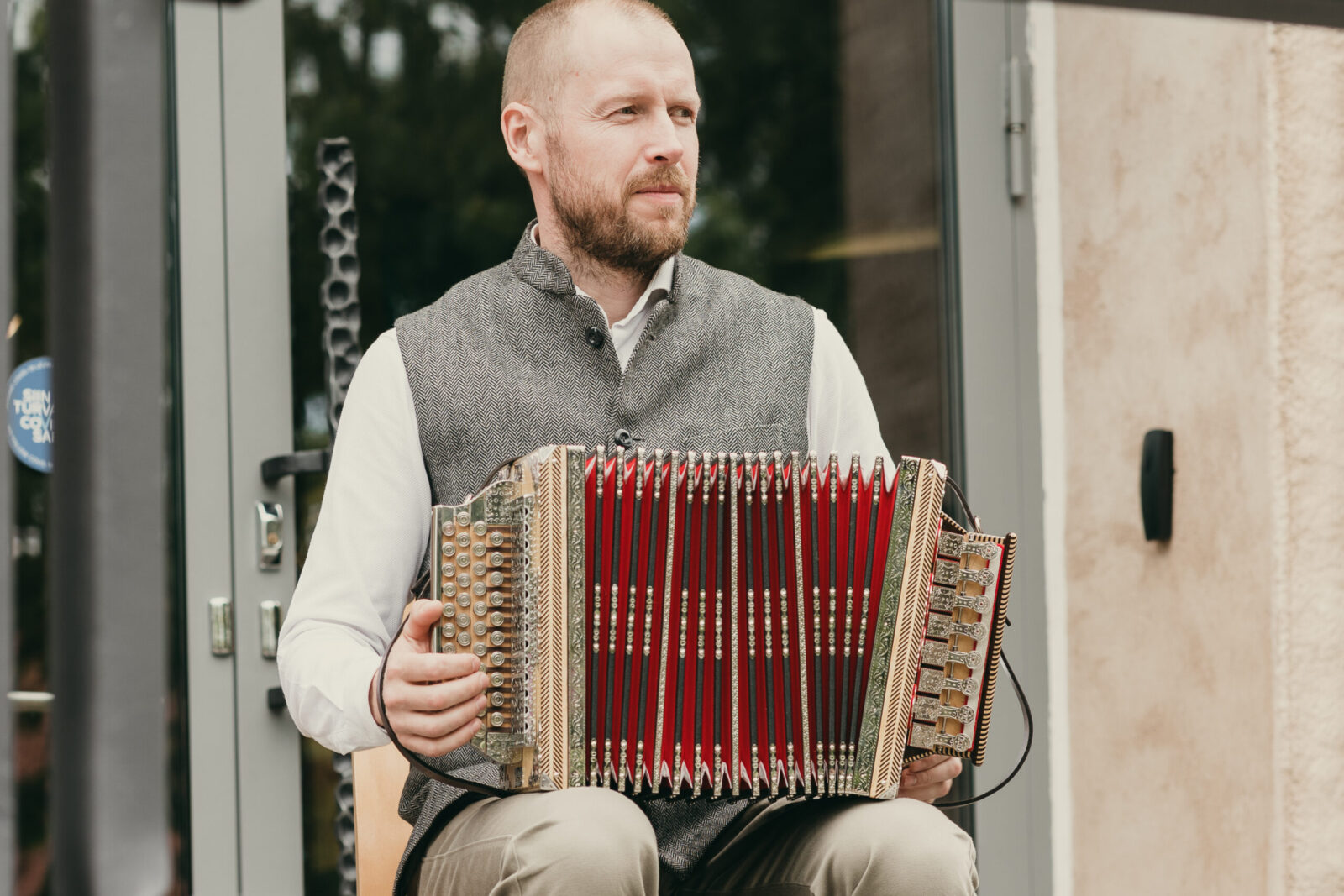
The Estonian diatonic accordion (lõõtspill) has four rows of keys and can play only in major. Tarmo Noormaa studied it for five years at the University of Tartu Viljandi Culture Academy, then spent an exchange year at the Sibelius Academy in Helsinki, where the Finnish accordion virtuoso Antti Paalanen was one of his teachers, alongside the Norwegian player Tom Willy Rustad. The instrument is native to one specific corner of the Baltic, a tradition entirely its own. Estonia built its modern cultural identity the same way: a country of one and a half million that spent fifty years under Soviet occupation and came back to itself in 1991 by going back to what was specifically its own. The instrument is also the reason a 24-year-old was handed the programming of Viljandi Folk Music Festival in 2006, and the reason he is still there now, twenty years on, with the 33rd edition due to run from 23 to 26 July.
The route to that role was a roundabout one. Noormaa came to music late, and almost studied philosophy instead, as he put it when we spoke by phone in late April, a little more than three months before the festival opens, with his curated line-up days old and just shared to the world. “I started playing music in my teens, late teens only. Before that, I was not so interested. I started because of my friends and the community I had in high school. That’s when I became interested and started playing, and understood that I didn’t want to do anything else, just play music. Then I went to university to study philosophy. But I thought, no, it’s not for me, it’s a waste of time. I need to study music!” So he did, in the Folk Music Department at the Viljandi Culture Academy.
The academy sits at the centre of Estonia’s largest annual music festival, one of the biggest folk gatherings in northern Europe, and Noormaa first came to it as a teenage attendee, not a programmer. “First time I participated, I think I was 17 or 18. Back then I didn’t know much about folk music or anything. I remember climbing over the fence with my friends to get in, because I didn’t want to pay money for the ticket. A few years later, I was the Programme Head of the festival.” The team had spotted him as a driven student who already organised masterclasses inside the Academy, and they brought him on to run it. The prospect was daunting. “I felt like my leg was shaking, let’s say.” He learned with the team behind him. “They helped me a lot in this process.”
The legs have long since stopped shaking, and twenty years into the role, the process is entirely his own. Noormaa builds each edition in layers. A theme is set first, then a description of what that theme means musically. A national call for ideas opens in August. Around sixty or seventy proposals come in from Estonian performers, and roughly twenty to thirty are picked. After that, Noormaa approaches the artists he wants beyond the open call, and starts the conversation about whether they can do something extraordinary in Viljandi. Commissions are part of this layer. “Most Estonian folk music artists want to perform at the Viljandi Folk Music Festival, because this is their home festival. This is where they meet the core audience, where they launch their albums and present new projects, because this is where they get the most attention.” The trust that comes with that runs both ways. “I feel special about it, that they put us in this place and they want to come out. But it is also a great responsibility to present their music in the best way possible.” He brings the same attention to the international programme, travelling to festivals abroad and bringing favourites back.
The festival grew out of the Estonian national revival of the early 1990s, the same period that restored independence. The question of what it meant to be Estonian after fifty years of Soviet occupation ran through everything, and folk music carried some of the weight of the answer. “It came with the idea of creating some special musical expression that is based on roots, but it is relevant nowadays, it lives nowadays. It’s not a copy of history, it’s not a museum. It’s not even a genre for us, not a musical genre. It’s the way how we experience the world.” It is a definition wide enough to contain almost anything, and the programme reflects that.
For Estonian artists, the bar is the link to historical tradition. They can work from archival material, play revived folk instruments, or build crossover projects, but the core must hold. “Basically, when we listen to the music, we want to understand where this band is from, based on the sound. When you eat food, we want the staple to be folk music and all the additions can be whatever. The staple have to be very clearly folk music.” While, for foreign artists, the bar is different and stricter. They must be representative of their culture or virtuoso players within it, and they must be culturally significant at home. “People from that country or region tell you: this is the band you should invite. This is the band we want to invite to our wedding. Then we bring them here, and it is a good comparison point.”
A booking, however, can always go wrong. When Noormaa has seen the act himself, or a colleague he trusts has, the call is clear. Otherwise he goes on what he can find, a YouTube clip, whatever the band sends over. “But I haven’t seen them live. So then it’s a risk.” That has happened a couple of times. Once, an act vetted off its album turned up as a different band entirely. “One band, on their album, they were very nice. They played their traditional music, but when they came to the concert, it seemed they had released another album in the meantime. They did covers of rock music. They said, oh, didn’t you know, this is our latest music?”
The artists who understand what Viljandi is and stands for don’t just turn up and play. Most stay three or four days, giving workshops, jamming in the castle grounds, playing for dancing until four in the morning, sitting on the grass with audience members between sets. “It’s very important for us that they are not only great musicians, but they are also open to communicate and create interpersonal relationships.” Most of the time it works. “Usually we ask them to give a workshop. Then you already understand if they are ready to give one, which means they are ready to share. Some artists are not ready, but they are still great. So we compromise on that. But most of our artists, we want them to be able to create contact with the audience. They have to be great communicators. They have to create a participatory space, whether through dancing, singing, storytelling, or somehow engaging.” The festival’s own purpose sits underneath this. “The goal is not just to organise the festival. The festival is a tool to achieve a certain goal. It is the best tool to influence people to like folk music. We think that folk music is really very good for community building. You get a sense of belonging, of identity. It fits the revival narrative of re-independence in the 90s. People were looking for identity. What shall we do? Who are we now?”
Each edition turns on a theme. For 2026 it is To Each Their Own Instrument, which Noormaa frames as two questions. “This year’s topic is folk music instruments, the instrument as a means to make this music, like a tool. You can compare the cultures: the same instrument in different cultures, how does it sound. Or different instruments, how do they differ.” For a festival built on the idea that music carries cultural identity, the instrument is a natural place to look. It tells you where something comes from, who shaped it, what survives in the way it is played.
It is also the lens through which Noormaa introduces this year’s line-up. When he talks about the theme, he starts with Manhu. Sani people from the Stone Forest region of Yunnan in southwest China, a subgroup of the Yi minority, playing together since 2003, their sound is built on instruments found almost nowhere else. “They come from a minority in West China, from Yunnan, and they have these very particular instruments. They have found a way to make it work, and it is all based on folk music instruments. There are a couple of Western instruments in the band, but the core is folk music instruments.” Their international debut Voices of the Sani, released on Riverboat Records in 2020, sets the gourd-pipe lusheng and the three-string adiza lute against electric bass and drum kit.
He also brings up Amy Laurenson from Shetland, where the piano made its way into folk music in a way it never quite did elsewhere, used to accompany dances where on the mainland a fiddle would play. She grew up in that tradition. Her debut album Strands was longlisted for the Scottish Album of the Year Award in 2024, the year after she was named BBC Radio Scotland’s Young Traditional Musician of the Year. “She plays piano. In Estonia, we don’t have piano in folk music. Piano is usually associated with other styles of music. But in Shetland, as well as Scotland or Denmark, even this piano is in folk music and it’s played differently. It is the same instrument, but it’s played differently, and the way it’s played, I think it’s really fascinating. You can play for a dance with piano.”
From Cape Verde comes Nancy Vieira, one of the leading living voices of morna, the country’s defining song form and a fixture on UNESCO’s intangible cultural heritage list since 2019. By the standard Noormaa sets for foreign artists she belongs easily, a singer who carries real cultural weight at home, and morna is a first for the festival’s programme. Part of the point is to widen what Estonian audiences hear. With Vieira, though, he reaches for a simpler reason. “She’s an amazing singer, just pure gold. You just listen and you just like it.” The comparison-point logic that shapes most of the international programme gives way here to plain pleasure. “Sometimes it’s not only about introducing your tradition. It’s also about having an aesthetic experience.”
The domestic programme shows what twenty years of community-building looks like in practice. “There are many new bands coming up. You can see them in Viljandi.” Trifoor are among the newest, opening Thursday fresh from the Young Folk Band 2025 title: “young girls playing this folk rock type of music.” Nova Lyre, on Friday, have been in the community longer, a string ensemble whose academic musicians found folk music through the Ethno camps and stayed. “How they do it is really cool, how they play. They have their own sound.” He also points to Sounds and Stories from Ruhnu Island, a trio reviving the fiddle music and hymn tunes of Ruhnu, a small island in the Gulf of Riga whose Swedish-speaking community left for Sweden in 1944. The trio pairs the fiddling of Karoliina Kreintaal and Lee Taul with Kairi Leivo‘s singing and storytelling. “I think they have a very good concept and very good players there.” On Saturday, Keelepeksjad come from somewhere else entirely: jazz musicians whose grandfathers played folk music. “They remember these songs from their childhood and bring it out in their own new way. I think it’s really cool.” The longest story belongs to OOPUS, whose third album Reivlender arrived in early 2026, more than a decade after they started. “I’m very proud of them. They have put full life into this music. They deserve it. They are really, really focused, dedicated to what they are doing.”
OOPUS are reaching what Noormaa calls “superstar status” in Estonia. That kind of sustained career was rare when he started. “When I started, there were a couple of bands that had this international capacity, let’s say. But they had few concerts, couldn’t sustain their careers, and split up. What we have done over the years is we have tried to make this ecosystem of artist creation.” It begins with baby workshops. It runs through folk music competitions, three age-graded Ethno camps with the oldest going up to 29, a biennial band competition with mentoring on technical riders, marketing and stage positioning, and the festival itself as the proving ground. “All these musicians performing abroad in showcase festivals have come from that ecosystem through the Ethno experience, through the competitions.” At the camps they meet others from home and abroad, form bands, and earn slots across the calendar, learning as they go. The ones who break through return as mentors, Maarja Nuut among them, sharing what they learned.
The pie is visibly bigger than it was. Over his twenty years the audience has changed in two ways, both of which bear out the approach. “People are more music focused nowadays, really enjoy the music. Before it was more about party and people drinking and not ending up in the concerts so much.” The shift shows the moment a set begins. “When the concert starts, the food area is empty. Everybody’s in front of the stage.” They are also readier to take part. “People are very engaged. They want to dance, they want to sing, they are pretty much ready to learn.” The second change is age: the share of teenagers, roughly 15 to 22, has grown alongside the festival’s long-standing family crowd. “They are full of energy. When you have a concert and young people start to party, they make the concert a party.”
All of it runs on a year-round institution. Around 15 permanent staff run the Estonian Traditional Music Center from a renovated granary in Viljandi Castle Hills, with a venue, a library, and concert and educational programmes through the year, and the festival is about half its work. Across the four days the team grows to roughly 400, including 250 volunteers and outside firms for security and stage production, and the weekend draws around 27,000 visits, with 10,000 to 12,000 people a day.
How much further it should grow is the open question. Noormaa and his team are drawing up a strategy for 2027 to 2029, and the first decision is whether to expand at all. He points to the Korrö Folkmusic Festival in Sweden. “They have decided that they don’t want to grow. They want to preserve how they are, because if they grow, they have to compromise on something. And then it’s not the same festival again.” Viljandi has held within about five per cent for years, and he is content to hold there. “We would like it to be bigger. But in order to make it bigger, we have to fulfil the space right now, then we can grow. We haven’t been able to fulfil the current space fully.”
What the festival is ultimately for sits underneath that caution, and the answer runs deeper than size. Noormaa is now doing a master’s on his own tradition, the diatonic accordion, asking why people take it up. “The main motivation is the sense of belonging: they want to belong to the cool group that plays this music. Folk music is open to anybody. Whatever instrument you play, whatever level you play at, you will find your place in our community.” He came up the same way, and the welcome is what held him. “I felt very welcomed, very appreciated. Whatever I did, I got a lot of acknowledgement. It kept me going.” The players following him now move faster than he did, with teachers and a community he lacked. “I was here. They stepped on me, and now they are here. When I hear that they are better than me, it makes me very proud.”
That belief shapes what he tells a newcomer. He trusts the festival to make its own case. “Just show up. I tell my friends: go and see the concert, let them be open and they will impress you. They will impress you for sure. I guarantee you that. I give you a money back guarantee. That’s why there are a lot of free events. It’s not only about what happens on the stage. The festival is always about what is between the stages: the jam session, the mood, how the audience is dressed up, how they communicate, what is happening. And you will be surprised positively for sure.”
The 33rd edition of Viljandi Folk Music Festival runs from 23 to 26 July 2026
while much of it free, passes for the ticketed concerts are available through viljandifolk.ee & Sviby