

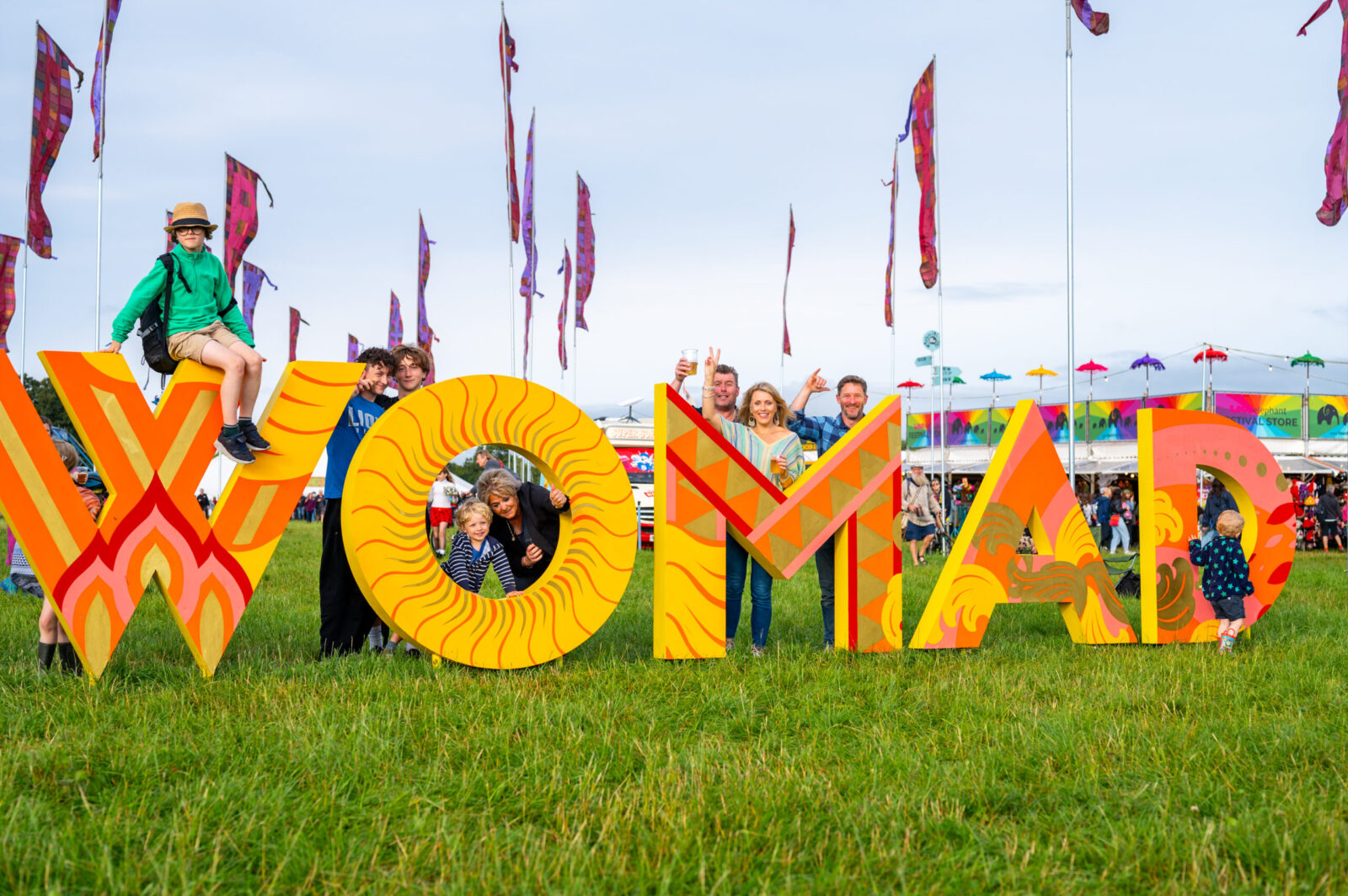
After a fallow year and seventeen summers at Charlton Park, WOMAD moves to Neston Park near Corsham in north Wiltshire, running Thursday 23 to Sunday 26 July. Three miles up the road, Peter Gabriel built Real World Studios into an eighteenth-century watermill on the By Brook in 1987, and WOMAD’s own offices have been based there. The festival grew out of what Gabriel was doing at Real World, pulling musicians from across the world into the same building to record together. Forty-four years and two permanent homes later — Reading from 1990 to 2006 and Charlton Park from 2007 to 2024 — the new chapter has clearly landed well with the audience: Tier 1 weekend tickets sold out in under an hour when sales opened.
This year’s programme cements some of the strongest partnerships the festival has built in recent years. NTS Radio, the London-based independent broadcaster that has spent fifteen years building a global network of DJs and selectors across more than forty cities, runs a dedicated after-dark stage across all four nights. Bristol’s Saffron, the non-profit that has spent a decade building pathways for women, non-binary and trans artists into music technology and production, takes over one strand of the programme, as does Jam Jar, the independent venue in St Judes that has become one of the city’s most reliable homes for global sounds. Twende, a grassroots collective whose nights pull together selectors from across the Bristol diaspora, and VP Productions, who bring two decades of carnival and Afro-Caribbean club culture, complete the picture.
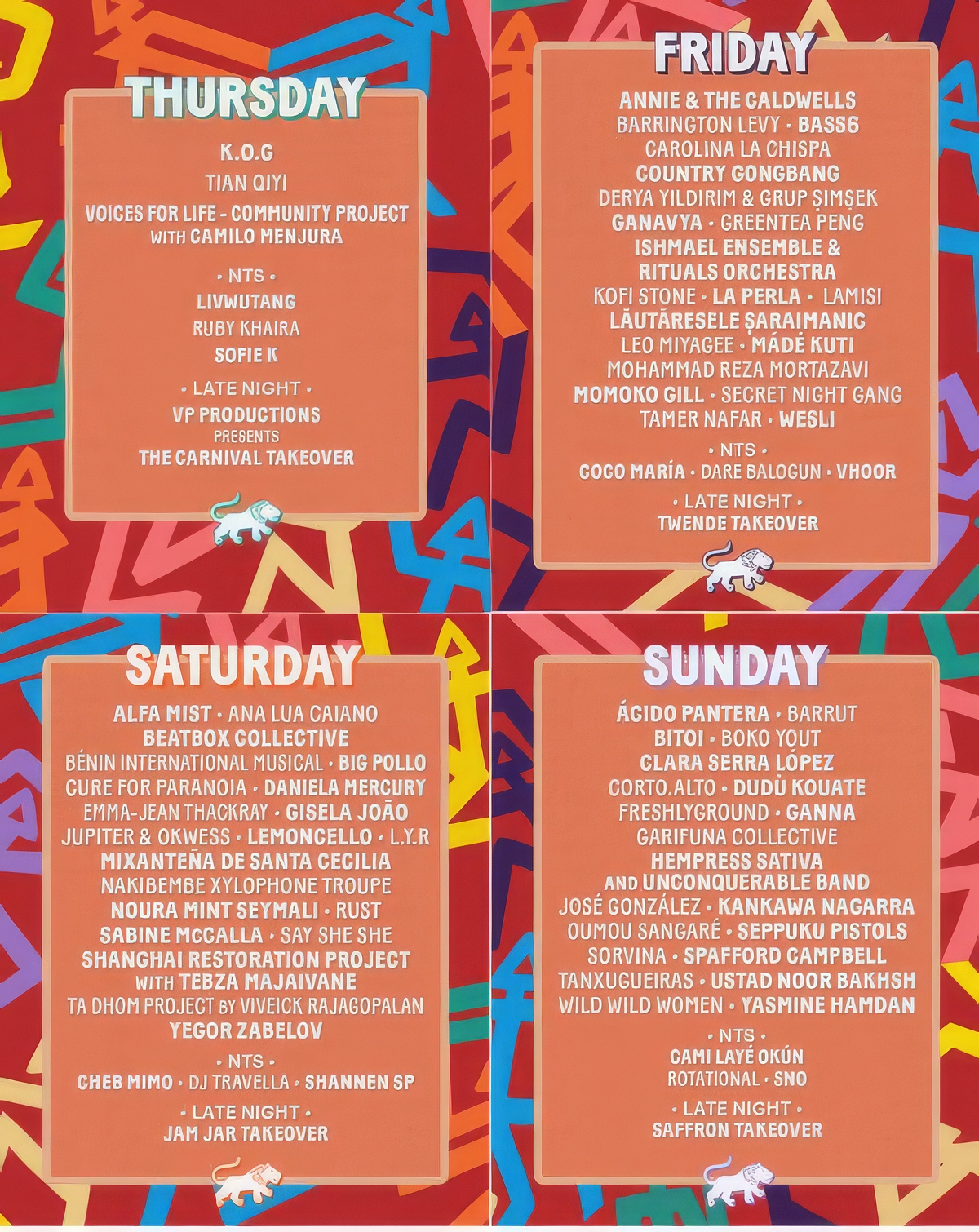
To open its 2026 edition, WOMAD hands Thursday night to Afro-fusionist limewire K.O.G. Kweku Sackey moved from Accra to Sheffield to study in 2008 and built the Zongo Brigade around him, an eight-piece that pulls highlife, hip-hop and soukous together, with Sackey rapping across English, Pidgin and Ga. He also fronts Onipa alongside Tom Excell of Nubiyan Twist, the Afro-futurist project that put out Off The Grid on Strut in 2024. His 2022 album Zone 6, Agege, named after the coastal suburb of Accra where he grew up, and its 2024 follow-up Don’t Take My Soul, both produced by Guts and Excell, draw on his Ghanaian roots and the women who raised him; last year he featured on Africa Express‘ Bahidorá, recorded in Mexico with Damon Albarn and Fatoumata Diawara among thirty-plus collaborators.
Tian Qiyi, playing the same night, are brothers John and Charlie Wardle, who grew up inside the Pagoda Chinese Youth Orchestra in Liverpool, founded by their maternal grandfather and now run by their mother Zi Lan Liao. On their 2025 album Songs For Workers, they set the yangqin (a hammered dulcimer), the erhu (a two-stringed fiddle) and Mongolian strings against the dub bass and post-punk their father Jah Wobble built his name on.
After dark the NTS stage opens, running Italo disco and synth-pop into UK bhangra, Desi folk and deep dubby techno across three sets.
Greentea Peng headlines the Friday. Born Aria Wells in South London, she calls what she does psychedelic R&B, and it comes out as neo-soul run through dub: heavy on bass, loose in the pocket, her voice moving somewhere between speech and song. Live she works with the Seng Seng Family, a band big enough to stretch songs from her latest album Tell Dem It’s Sunny well past their recorded length. Barrington Levy brings the other end of the reggae lineage. He cut “Here I Come” and “Under Me Sensi” before he was twenty-five, records still pointed to as the foundations of digital dancehall, and forty-odd years on the voice remains the draw, that high, cracked delivery he can still hold a field with.
Mádé Kuti arrives with the weight of the family name and enough of his own to carry it. He played every instrument on his 2021 debut For(e)ward and returned last year with Where Does Happiness Come From?, taking the afrobeat his father Femi and grandfather Fela built somewhere quieter and more searching, less confrontation, more doubt. Wesli draws on that same afrobeat and pushes it further out. Born Wesley Louissaint in Port-au-Prince, he built his first guitar at eight from an oil can and nylon fishing line, and now leads a Montreal band folding Haitian Vodou chant and carnival rara into afrobeat, reggae and hip-hop; his Rapadou Kreyol took the Juno for World Music Album of the Year in 2019, and his latest, Makaya, is named for the mountains that hid the maroons who won Haiti its independence, turns that history of resistance into dance music.
Elsewhere on the Friday, Bristol’s Ishmael Ensemble bring the Rituals Orchestra with them, saxophonist Pete Cunningham’s group folding astral jazz into twenty years of the city’s club music, and expanding the five-piece with a string quartet, harp and guest vocalists to reinterpret the 2024 album Rituals.
While, after dark, VHOOR takes the NTS stage, Victor Hugo Rodrigues from Belo Horizonte, one of the producers who took chill baile out of SoundCloud and pushed baile funk somewhere between Miami bass, freestyle and afro-house. He is followed by Coco María, Ana Lucia from Saltillo in northern Mexico, now based in Amsterdam, who runs the fortnightly Club Coco show on NTS and digs cumbia, charanga and Latin funk out of Colombia, Mexico, Peru and wherever else the record shops take her.
Saturday is built around instruments with histories as articulate as the hands that play them. The ardin, the harp the Moorish griot tradition reserves for women, sits at the centre of everything Noura Mint Seymali does, her husband Jeiche Ould Chighaly answering it on an amplified tidinit lute beside her. The embaire, a log xylophone from Busoga in Uganda, needs six players seated along its two sides, and the Nakibembe Xylophone Troupe lock their parts together so tightly that no single line can be picked out of the pattern. Yegor Zabelov, Belarusian and now based in Poland, takes the accordion somewhere its folk past never pointed, pulling drones and walls of noise from the bellows, and has been known to bite them to force the sound out.
Few sets on the Saturday hit as hard as Jupiter & Okwess. Bokondji started the band in Kinshasa in 1990, after a childhood split between the capital and East Berlin where his father served as a diplomat, then spent years travelling Congo learning the rhythms of its hundreds of ethnic groups while the capital’s orchestras stuck to rumba. He calls the result bofenia rock, and it comes with lyrics those bands avoid: poverty, war, corruption, sung in six languages. Their fourth album Ekoya, partly recorded in Mexico with producer Camilo Lara, arrived last year.
The Saturday’s line-up makes room for jazz as well, through two players who came to it from outside. Alfa Mist grew up in Newham and found jazz through the samples buried in the hip-hop he was making as a teenager, then taught himself piano to chase where they came from; the records since keep that double origin audible, boom-bap drums under voicings borrowed from Ahmad Jamal, verses he raps himself dropped between instrumentals. Leeds-born Emma-Jean Thackray came up through the London scene but her 2021 debut Yellow pulled in Afrofuturism, spiritual jazz and electronic production alongside it, and she has a MOBO and a Mercury nomination behind her.
The Sunday belongs to the ‘Songbird of Wassoulou’. Oumou Sangaré has spent forty years turning the music of southern Mali into a platform against polygamy, forced marriage and female genital cutting. She was twenty-one when Moussolou came out in 1990, selling by the cassette-load across West Africa, and the arguments in her lyrics have not softened since, carried in the same voice over the kamelengoni harp.
Others take a tradition they were handed and drag it somewhere new. Dudù Kouate, born in Senegal into a griot family and long based in Bergamo, plays over two hundred traditional African instruments and has been a permanent member of the Art Ensemble of Chicago since 2017, carrying West African oral music into free jazz. Clara Serra López, London-based and of Catalan and Cuban heritage, works the other end of the same idea, a trained jazz singer threading Mediterranean ornamentation and Iberian rhythm through modular synths; her two Lengua Materna EPs on Real World turn on colonialism, migration and the cost-of-living squeeze her generation grew up inside.
The pull between root and machine sharpens in two more of the day’s voices. Lebanese singer Yasmine Hamdan helped invent Arabic indie in the late nineties with the Beirut duo Soapkills, whispering classical Arabic over trip-hop beats; solo and now in Paris, she sings across Lebanese, Kuwaiti, Palestinian and Egyptian dialects in a spare, hypnotic register that owes as much to Portishead as to the Arab songbook. Galician trio Tanxugueiras, Aida Tarrío and the twins Olaia and Sabela Maneiro, do the same to the pandeireta singing of northern Spain, three voices over frame drums set against trap production; their song ‘Terra’ won the public vote at Spain’s 2022 Benidorm Fest and took a near-lost Galician tradition to a national television audience.
The last day of WOMAD 26 has far more to give. Jamaica’s Hempress Sativa was grew up inside reggae. Her father, the selector Ilawi Malawi, sat her in front of the mic at his Jah Love sound-system sessions before she was five, and she grew up to sing and toast in equal measure, roots reggae in substance with a DJ’s delivery on top. Her songs run on Rastafari and resistance: African unity, Babylon and Black struggle, the sacrament of ganja, her own command of the mic.
Glasgow’s corto.alto is one of the most sought-after names in UK jazz right now. Trombonist Liam Shortall leads it, writing at the desk as much as on the stand, running jazz through hip-hop, dub and club production, and his debut Bad With Names was shortlisted for the 2024 Mercury Prize. Around him he keeps a rotating Glasgow crew, the band changing shape from gig to gig, so the set is as much a snapshot of the city’s young jazz scene as a showcase of his own.
Nothing on the day sounds like Japan’s Seppuku Pistols. They started as an electric punk band and, after the 2011 Fukushima disaster left them, in their words, ashamed of needing electricity to make noise, threw out their amps and switched to taiko drums, shamisen and bamboo flute. What comes out is punk played entirely on traditional instruments, a full troupe in Edo-era farm dress, as much a protest against the modern world as a gig.
And after dark, Cuba’s Cami Layé Okún sees the festival out on the NTS stage. A vinyl-only selector, she runs the monthly Insolar show on NTS from Havana, where she’s the only DJ putting on all-vinyl nights, digging out Cuban disco, Afro-Caribbean rarities and tropical Amazonian grooves, records that take real effort to find on an island cut off from the global trade.
Four days, a site never used for this before, and a bill running from Balochi zahirok to Japanese taiko-punk, Beninese Vodun to Peruvian chichafunky, and the world in between. That has always been the WOMAD wager, that the stranger a booking looks on paper the better it plays in a Wiltshire field, and the 2026 edition, already among the fastest-selling in the festival’s history, is that bet laid down one more time on new ground.
Weekend passes, day tickets and camping are at womad.co.uk
with the 2026 edition already among the fastest-selling in the festival's history
Cover Photo ©: Ryley Morton