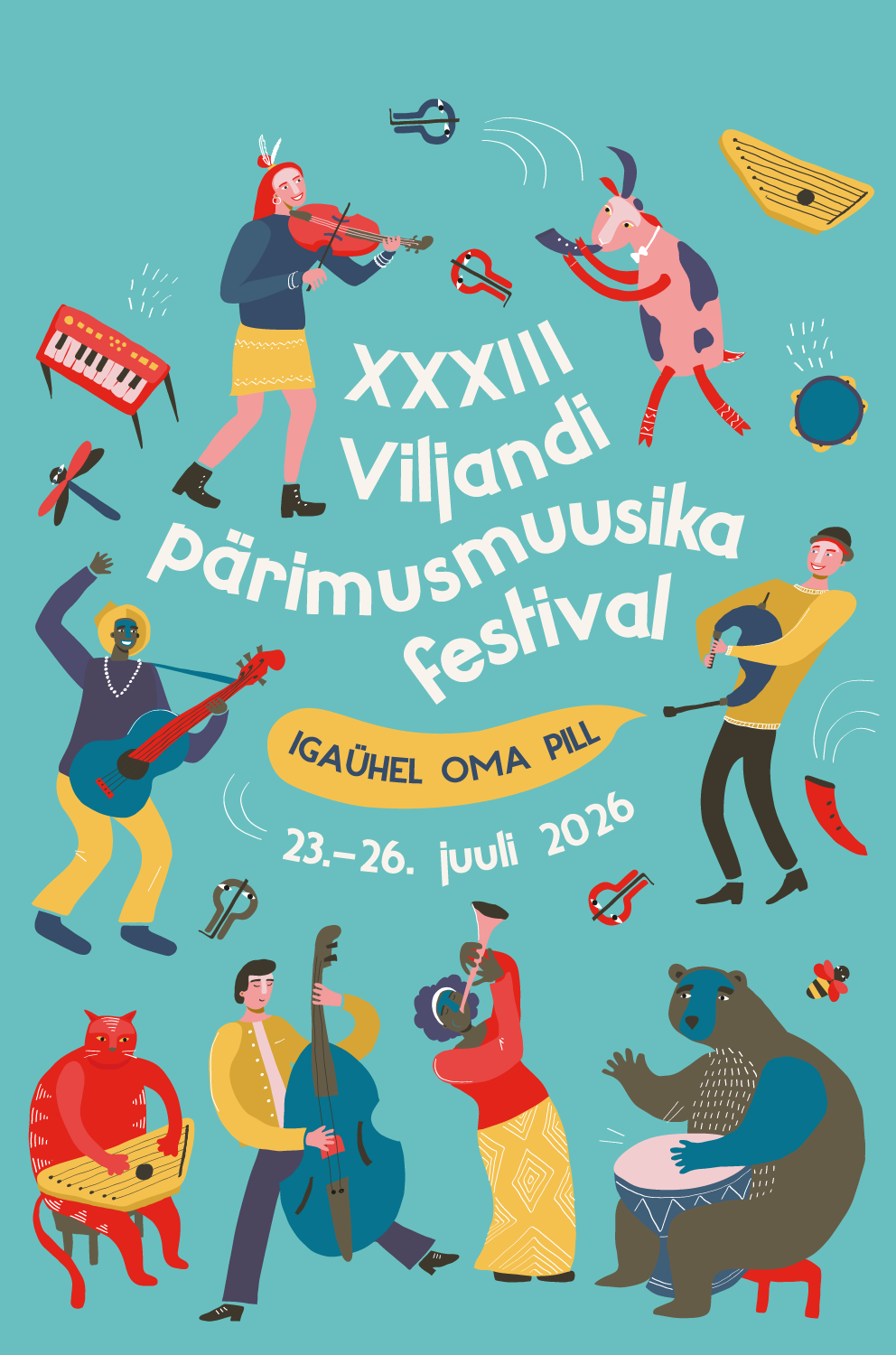

There is a historic town in southern Estonia, population 17000, that every July transforms into a global cultural hub. For four days, the ruins of its 13th-century Livonian Order Castle fill with tens of thousands of people who have come, some of them from the other side of the world, to listen to music that in some cases nearly ceased to exist. The Viljandi Folk Music Festival has become one of the largest events of its kind in the Baltic and Nordic countries, and the 33rd edition, running 23 to 26 July, may be the most internationally ambitious yet.
The festival did not end up there by accident. Viljandi is where the Viljandi Culture Academy is based, the only institution in Estonia that trains folk musicians at degree level, and where the Estonian Traditional Music Centre operates year-round. The festival was founded in 1993 by the generation that had lived through Soviet occupation and understood, from experience, what song had meant in that period: it was music that carried the language and identity through fifty years of occupation, and it was mass singing that fuelled the restoration of independence in 1991. Thirty-three editions later, festival director Ando Kiviberg has said that the popularity of traditional music among Estonian youth is remarkable even by international standards, and the 2025 edition, which drew 38000 visits across four days, bore that out.
Ask anyone who has been and they talk about the crowd before they talk about the line-up. A stranger gets pulled into a chain dance within minutes of arriving. Someone who has never held a kannel or a set of bagpipes can be playing one by lunchtime. A child plays violin on a street corner while the crowd moves around them. Every Estonian president since independence has attended every edition.
The setting does the rest. The main stage occupies the shell of the Livonian Order fortress begun in 1224, the open-air auditorium sitting where the inner courtyard once was, with Lake Viljandi visible through gaps in the medieval masonry and a rope bridge from 1931 swaying above the 13-metre defensive trench at the hill’s edge. Nine stages across nine hectares: some outdoors on the hills, some in indoor venues through the town. The procession from the town centre to the castle on Thursday afternoon has opened every edition since the beginning.
The 2026 theme, “To Each Their Own Instrument” (Igaühel oma pill), has shaped a programme of 60 artists, 65 ticketed concerts and 85 free shows across two open-access stages, plus more than 30 workshops. Festival director Kiviberg and programme director Tarmo Noormaa have pulled in artists whose work is built around a specific traditional instrument or regional playing tradition, and this year’s international reach is wider than usual.
The 2026 programme reaches further than any previous edition, and some of the instruments it carries with it are ones rarely heard in the Baltics. Starting with The Zawose Queens from Tanzania. The duo, composed of Pendo Zawose and her niece Leah, performs wagogo music with the chizeze, a one-stringed fiddle, the ilimba, a wooden-board lamellophone, and ngoma drums, instruments carried through the tradition of Hukwe Zawose. Manhu, from the Stone Forest region of Yunnan in southwest China, bring a related depth of inheritance: the lusheng gourd pipes, the adiza three-string lute, the moon lute and the sanhu, a bowed instrument traditionally played to accompany storytelling, sit alongside electric bass and drums, carrying the traditions of the Sani people, a community geographically isolated from other Yi populations for long enough to develop its own distinct musical identity. Orkesta Mendoza from Tucson, Arizona, fold brass, accordion and marimba into a sound built from the border cultures of the US Southwest and northern Mexico, and Nancy Vieira introduces morna to the festival for the first time, the slow song style of Cape Verde inscribed on UNESCO’s Intangible Cultural Heritage list, built around guitar, cavaquinho and violin and most associated internationally with the late Cesária Évora. Vieira, born in Guinea-Bissau and raised in Lisbon, has spent two decades keeping the music close to its roots in the port towns of São Vicente
That attachment to a community’s specific instruments runs through the European contingent too. Karolina Cicha from Poland performs the music of the country’s minority cultures, Tatar, Karaim and Lemko, on accordion and Polish dudy bagpipes. The Polish-Ukrainian ensemble HrayBery draw on fiddle, hammered dulcimer and frame drum to play cossacks, kolomyikas, mazurkas and polkas recovered from nearly forgotten archival scores of the Galician border region where Poles, Ukrainians, Jews and Roma have lived alongside each other for centuries; their set at Tallinn Music Week 2025 convinced Noormaa to book them immediately. They were not the only act from recent Tallinn bills to make the journey to Viljandi. Hungarian family band Amaro Duho closed the Fenno-Ugria Night at Tallinn Music Week 2026 with traditional Hungarian Oláh Roma music; the band was founded in 2021 by Matild Dobi, a co-founder of Ando Drom, when she decided the time had come to pass four decades of Roma musical experience to her children, threading their own melodies through the inherited material on guitar, tambura and accordion.
From eastern Europe, the programme reaches into Scandinavia and the North Sea, where the same archival instinct takes a different form. Groupa, the Swedish-Norwegian trio active since 1981, play old Nordic melodies tuned outside equal temperament, with improvised passages and percussion cut from stone and wood. Gangar push that archival instinct harder: the Oslo five-piece dig rare tunes out of Norwegian folk archives and drive them through rock, metal and jazz, a combination their second album, released in April, extends further still. Shetland pianist Amy Laurenson, BBC Radio Scotland Young Traditional Musician of the Year 2023, whose debut album Strands was longlisted for the Scottish Album of the Year Award in 2024, brings a playing style built on an island where the piano became central to folk playing in a way it never did on the Scottish mainland, used to accompany dances and sessions in a role elsewhere taken by the fiddle or accordion.
The international bill, however, is only half the story. Viljandi is, at its core, an Estonian folk festival, and the home acts show why. The clearest demonstration is Puuluup, the duo of Ramo Teder and Marko Veisson, return to the festival where they arguably belong most. Their instrument is the talharpa, a four-stringed bowed lyre that had nearly disappeared from use by the late 19th century, now run through loopers and effect pedals to produce something both archaic and completely alive. They call it zombie-folk, and it has made them the most unlikely stars in Estonian music: a collaboration with hip-hop duo 5MIINUST that reached the Eurovision grand final in 2024, two US tours, an East Asia run through Japan, Hong Kong and Taiwan, and a feature-length documentary opening DocPoint Tallinn in February this year.
Curly Strings work from a different angle, building arrangements in mandolin, fiddle, double bass and guitar around vocalist Eeva Talsi, drawing on bluegrass structure and Estonian song in equal measure, and Zetod arrive with 23 years of repertoire from Setomaa in southeastern Estonia, the same corner of the country that Kiiora call home, the trio performing century-old Seto dance tunes alongside Finno-Ugric material from neighbouring traditions.
That question of what survives and how runs through the Estonian programme. OOPUS have spent two decades answering it one way: feeding bagpipes and archaic runic songs through analog acid synthesizers, movement-triggered lights and visuals, building one of the most distinctive live shows in Estonian music. Their third album Reivlender, out earlier this year, pushes that further, the title itself a compound of the Estonian word for “travel” and the English word for “rave”.
Sounds and Stories from Ruhnu Island answer it another way entirely. Fiddlers Karoliina Kreintaal and Lee Taul and storyteller Kairi Leivo perform the traditional fiddle music of Ruhnu, a small Baltic island whose entire Swedish-speaking population fled to Sweden when Soviet forces arrived in 1944, taking the music with them. Their 2025 album Mere Mälu (“Echoes of the Sea“), built from archive recordings made on the island in 1938 and in Sweden after the exodus, won Authentic Folk Music of the Year at last year’s Estonian Folk Music Awards. Untsakad, the Viljandi ensemble formed in 1992, performed at the inaugural 1993 festival and return this year with Nõiduvad Huuled behind them, named Folk Album of the Year. Kuula Hetke, the duo of Kärt Pihlap and Katariina Tirmaste, took Debut Album of the Year at the same ceremony. They work with two flutes, voices and electronics, pulling apart folk melodies from the regions where each player’s family comes from and rebuilding them in the moment through improvisation. At this year’s festival they perform alongside visual artist Okeiko, who creates a live video backdrop in real time as the duo plays.
One of the weekend’s most anticipated sets exists only because of this festival. Duo Ruut, Ann-Lisett Rebane and Katariina Kivi, have spent the past five years turning a single kannel into a full sonic argument: the two sit face to face across one instrument, four hands producing plucked lines, percussive rhythms and close harmonies, a setup that has taken them to Glastonbury, WOMEX, Roskilde and more than twenty countries, earned them Folk Album of the Month in The Guardian for their 2025 record Ilmateade, and made them Estonian Artist of the Year at last year’s folk music awards. For this festival only they expand into Duo Ruut³, joined by electric guitar, bass and percussion.
Two projects that push the Baltic string tradition across the Estonian-Latvian border round out our look at the bill. Mari Kalkun, the Estonian singer, kannel player and composer whose album Stoonia Lood (Stories Of Stonia) came out on Peter Gabriel’s Real World Records in 2023 and has since been performed in twenty countries, meets Latvian kokle virtuoso Laima Jansone, whose work moves between meditative solo improvisation and rhythm-driven contemporary composition. The kannel and the kokle are cousins, box zithers that developed on either side of the Estonian-Latvian border from the same ancient instrument, whose playing traditions have been largely separate ever since. Tell Your Birds take that Baltic string tradition somewhere else entirely: Vija Moore on percussion, balafon and voice, Kärt Tambet on violin and voice, Kristīne Tukre on concert kokle, and Simone Spampinato on synthesizer and live electronics, setting the kokle‘s Baltic roots against West African balafon rhythms and electronic processing in the same room.
Thirty-three years ago a generation that had spent decades being told what to sing built a festival to sing what they wanted. Some of the music on the bill this year would not exist if they hadn’t.
All the essentials, from programme to tickets and camping to glamping, can be found at viljandifolk.ee