

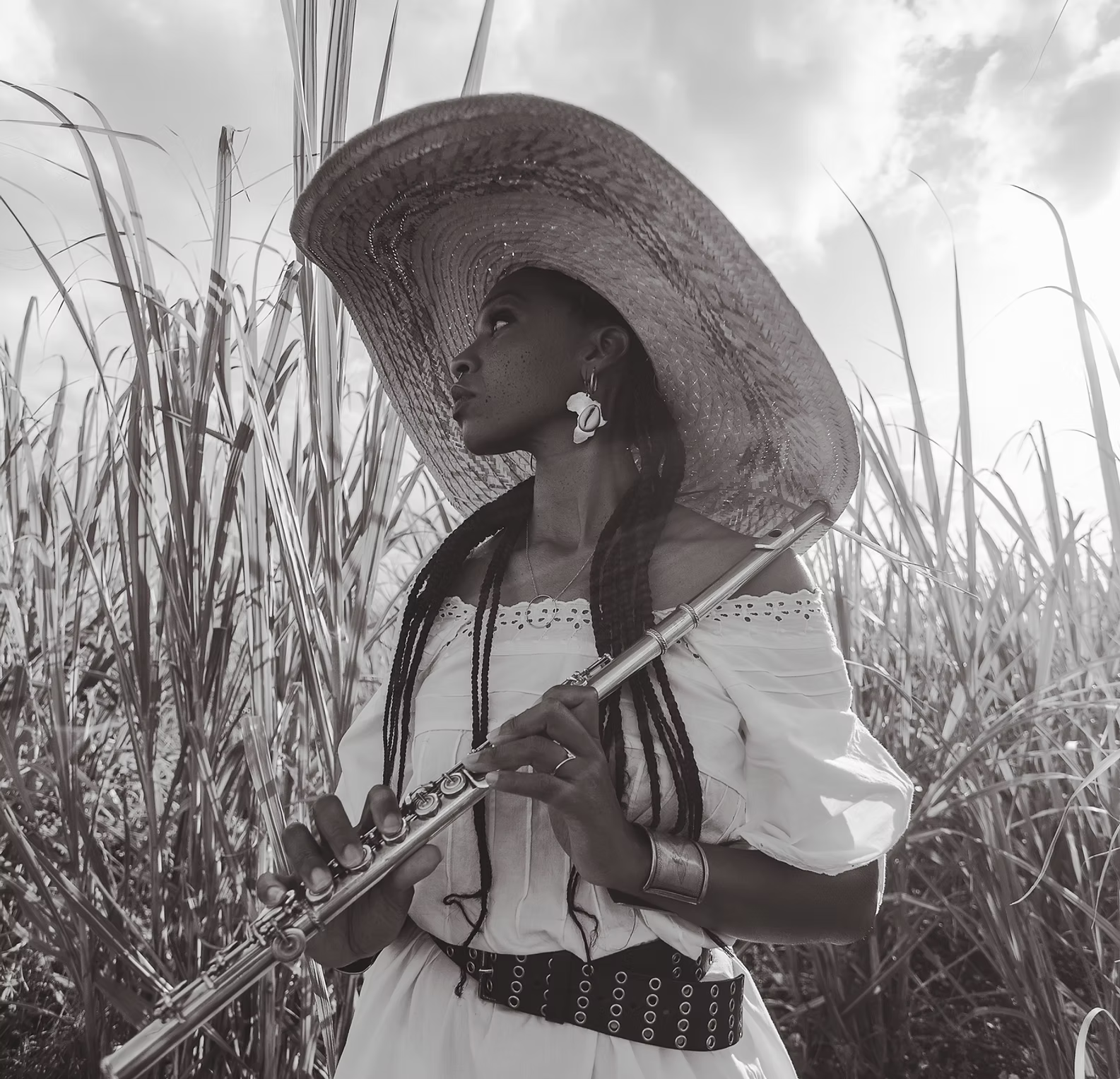
The ka drum holds the centre of gwo ka practice in Guadeloupe: one player leads, the circle answers, and the whole room moves. Célia Wa learned that exchange as a child, studying percussion and flute at the École de Musique Marcel Lollia under the saxophonist Georges Troupé. Two decades later, at her Espace Julien showcase during Babel Music XP in Marseille this March, the same call and answer filled the room, the crowd singing her lines back to her.
She had played Marseille the year before, but with the collective Expéka; this time she came under her own name. The morning after, at La Friche Belle de Mai, the cultural complex that hosts the festival’s conferences, three interviews were already behind her and five more waited. “For my project it’s the first time in Marseille. I love when I perform with a public like this, singing with me. I come with a lot of energy, so I give. And it’s good to receive.”
What she brought to Marseille goes by a name she coined herself: Karibfutursound. It took shape across a run of EPs, among them Wastral, released in 2021 on the Paris label Heavenly Sweetness, and in February 2025 her debut album Fasadé followed on the same label. The foundations of the music, though, go back to a childhood spent between Paris and Guadeloupe, where her father is from.
On the island, the ka came first. “I started with traditional music. My first instrument was a drum, the ka, the traditional drum from gwo ka. So I started with this music. And after, I discovered other music, and the flute, but always in the traditional gwo ka. And this is why, when I compose, it’s natural for me to start with this root.”
Back in Paris, she enrolled at the American School of Modern Music for four years of jazz training. “And that’s where I discovered everything about harmony. And then I started to compose with all this background: the traditional music and all the influences, jazz, but also soul, hip-hop and house music. Because I did dance, hip-hop and house.”
That dancing was a profession, pursued seriously. She joined the hip-hop company Deepside and was cast as a replacement dancer in the stage musical Kirikou et Karaba. The house she danced to came out of Detroit. “I discovered the Detroit scene. When I learned house, it was really from Detroit, the deep house. And I heard the similarity with the traditional music from Guadeloupe, because it’s the same process.”
The steps matched, too. “In the dancing, the step is the same. You can mix traditional steps into house. So I think this is the thing that made the bridge. Talking about it now, dance and house music, I think it helped the process of mixing everything ancestral with what is modern.”
In Guadeloupe, the line between traditional and contemporary music made little sense to begin with. “Often people will oppose traditional music with modern music. But for me it’s part of the same family. So it was just logical to mix. And that’s why it doesn’t oppose, on the contrary, it feeds.” The island received everything: jazz, salsa, hip-hop, afrobeat. “We are a little island, we got our music. But all the music from outside came to us. The world doesn’t know us, but we know the world.” In 2024 she travelled to Nigeria for an artistic event. When a friend came to visit Guadeloupe, turned on the radio and heard afrobeat, he asked her if she knew it. “Yes, we know everything. Because we have this global vision.”
Her influences come from everywhere, too. Miles Davis’s Kind of Blue and John Coltrane’s A Love Supreme shaped her years at the jazz school. From Guadeloupe, she cites Guy Konkèt, the gwo ka master who died in May 2012, and whose recordings expanded the gwo ka ensemble format. “Guy Konkèt has a recording that was made in Paris, where he brought the Rhodes, guitars and bass into the band ka. And I listened to this album a lot.” Konkèt opened gwo ka to jazz and electric instrumentation a generation before Karibfutursound. More recently, Wa names the Australian band Hiatus Kaiyote. “One of the bands that inspired me a lot, in the way they arrange hip-hop, a little jazz version, a little bit of research.”
On stage, the songs stretch out. “Because I come from jazz and improvised music, so the songs can last a long time. But in studio I force myself to keep the formats not too long, so it goes on the radio. On stage we can extend. And it’s cool to go with the mood of the moment, and to exchange with the audience. It’s an exercise that I love on stage.”
The studio works the other way. “In studio it’s sometimes difficult because you have to give a lot of energy but you don’t get a response. But it’s cool too because you have the time to focus. If you want to do it again, it’s a different kind of work.”
One song carries more weight than the rest. “Huey” is named after her son. “When I left, I told him: even if he’s not here, he’s with me. Because when I sing this song, everybody sings his name. Even if he’s not here, I tell him: maybe you will feel a moment. It’s because we sing for you.” It was the song that brought the room together at Espace Julien the night before.
The calendar after Marseille is filling: UK dates in June, and a place on a BBC 6 Music mixtape connected to the presenter Jamz Supernova, to be released via Mr Bongo. “The music there is well received. I had several interviews with BBC 6, with Worldwide FM.” Whether a second album will follow, she cannot say yet. “For now it’s still in my head. But it will happen.”
Asked what she wants a first-time listener to take from Karibfutursound, she keeps it plain. “Just listen to it. You will hear something you know but you don’t know. But you know.”
A final question, about what matters beyond the music. “Strength. Wealth. And freedom.”
Célia Wa's latest album Fasadé is out on Heavenly Sweetness, read our review here
with more on her music and live dates at celiawa.com