

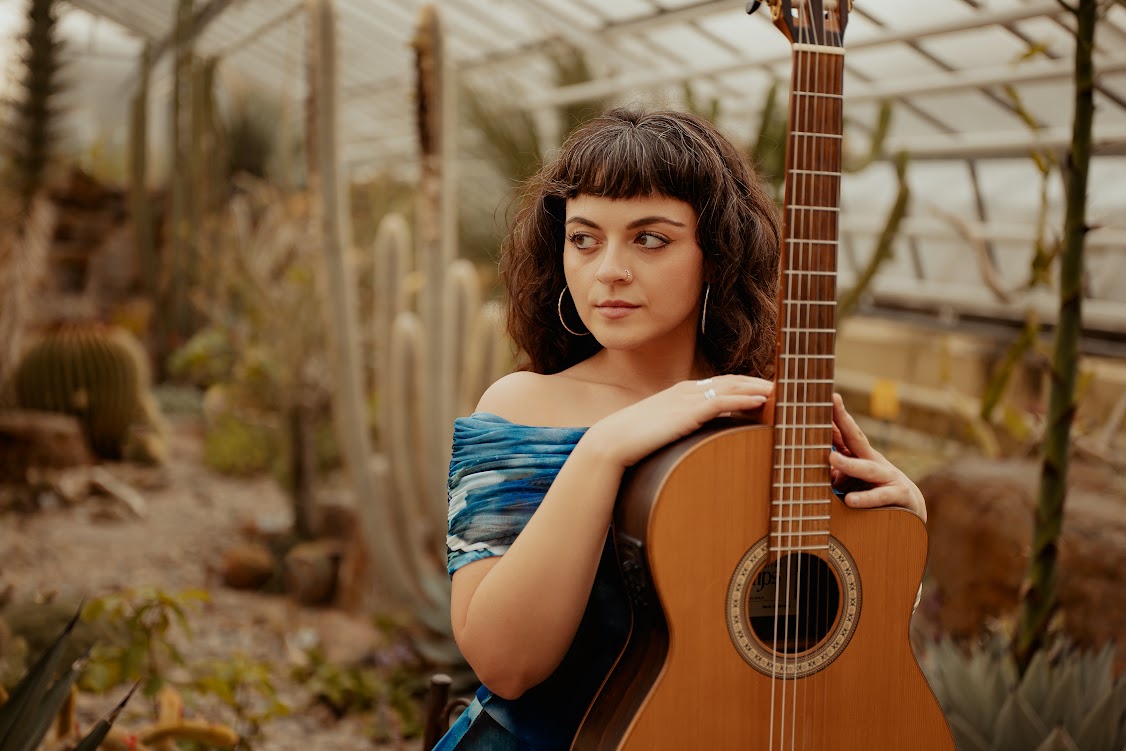
Amanda Muñoz Hüttl has a habit her mother spotted when she was a small child: whenever she liked what was on her plate, she started to sing, and she still does. Her mother always read the signal the same way: “Ok, Amanda is enjoying the food because she’s singing”. Years later, that habit and her love of the Spanish expression me encanta, with the verb cantar inside it, gave her solo project its name: Encantada.
This weekend she plays Italy for the first time, with two house concerts in Matera and Taranto for Hauskonzerte, run by the Altamura-based association Xilema to promote independent music. Xilema’s other project, Migrasom, is a programme of meetings backed by the Puglia regional council’s gender-equality scheme, bringing artists, students and residents of Bari, Taranto and Lecce together to look at music, images and gender from an anthropological angle.
Rhythm Passport’s new section on both projects will introduce the artists who play for Xilema, starting with Amanda. She spoke to us by phone from Matera, two days after arriving. We talked about growing up between Argentina and Germany, the song that led her to cumbia and the album she is about to release.
Her singing goes back even further than the dinner table. “I always say that I sang before I was born, because I grew in the womb of a mother who sang, so from the very first moment I was surrounded by music”. Her mother, a former school music teacher, is a classical singer, and her father sings too. “They even met through music, because my dad sang in the choir that my mum conducted”. She came along from the start: “There was always music, and my parents took me to concerts. I was always there, in the pushchair, always going along with my mum to her concerts. And I learnt very young: they made me play the piano, even though I hated it”. At home there was classical music and her father’s tango, and Argentinian folk was always present too, from the singer Mercedes Sosa to the composer Ariel Ramírez. As a young woman, her mother had even written a small book about music in Argentina.
Born in Buenos Aires, she was almost three when the family moved to Munich, and Argentina came with them. “We never lost the tie to Argentina. We always travelled there, and my grandparents came to Germany. Either we went to Argentina or we brought Argentina to Germany”. Those trips have since grown rarer. “In theory I want to go back every year, but now it’s been about two years since I’ve been able to go”. What she misses first is the food, “a completely different way of living, you can’t compare it”, though she knows a visit shows her only part of the picture: “At the same time I’m also aware that if I’m in Argentina, I’m a bit on a ‘time off’, because it’s not my daily life, and that changes things too. I’m basically visiting family, or travelling, you could say”. Then there is her family. “Of course I miss my family. I’m missing the whole childhood of my nephews and nieces”.
She also misses the city itself: “the diversity in cultural life, as it is in Buenos Aires, which I don’t see in Munich, for example. Obviously Buenos Aires is a metropolis”. She is quick to give Munich its due. “Munich is also very diverse, because many cultures live together: Germans, but also people with roots in Turkey, Italy, Greece, Poland, Serbia. It’s another diversity”. Growing up there left more of a mark on her outlook than on her sound: “Musically, I would say it has no influence. It influences my worldview more, maybe. Obviously, I grew up in Germany. But at the level of music I don’t think it influences me, because German folk is very different from Latin American folk”.
Germany reaches her through its books instead. “What does influence me is more the literature, maybe, like Goethe”. Even that stays mostly below the surface: “Obviously it influences me, but I don’t see it reflected in my music, but surely something stays in my subconscious”. For once, it will show on record. “In my new album I’ve decided to quote, in a song, a passage in German, a part of Goethe’s Faust. And there I think, yes, that’s very… I see it as very German”.
Her songs, though, come out in Spanish. She speaks German in Germany and Spanish with her many Spanish-speaking friends, and what she has written in German has stayed unpublished. Her reason is practical. “Composing and writing is practice, at the end of the day, and I’ve practised writing in Spanish much more than in German. If I want to start composing in German, it feels a bit like starting from zero”. Rhyme is another obstacle: “I wouldn’t say I’m a genius with rhymes in Spanish either, but I feel that in German it would be even harder”.
Her recordings go back to 2019. “The first songs I released, for example, still had parts in English. They were often collaborations with friends in Munich”. One of those friends was XavTheArtist, with whom she released ‘Real’ and ‘Stay in the Dark’. Spanish soon took over from English, and in 2021 she moved to Salamanca, in Spain, for a master’s in Latin American studies. She stayed until 2024, singing in the city’s streets, museums and bars.
There she was still performing under her first name. “At the beginning my artist name was simply Amanda, and that was a bit of a problem, because there are lots of Amandas. Lots of people recommended I change it”. Adding her surname seemed the simple fix, until she thought about whose name that really was: “Obviously one option was Amanda Muñoz, but… The thing is that I carry the names of both my grandmothers. Amanda is my Argentinian grandmother and Katarina is my German grandmother. And Amanda Muñoz is literally my grandmother’s name as well. And something in me didn’t feel it”. She also considered a nickname meaning ‘the German woman’. “At one point I thought of calling myself La Alemana, but I didn’t want that either”.
The answer came after a concert. “I was talking with two friends about my name, and I told them there’s an expression I really like in Spanish, when you say ‘me encanta’… above all because I feel it carries the verb ‘cantar'”. She told them about the singing at the table, which she sums up in one sentence: “When I like doing something, I’ll do it singing”. One of the friends did the rest: “And my friend looked at me and said: why don’t you just call yourself Encantada? And I said, well, why not, and that’s how the name stayed. Of course, at that moment I didn’t think that there are two Disney films with the same name”.
With the name came a clearer sense of direction. “Once I became Encantada, I feel I started putting much more of my own vision of what I want Encantada to be into it. More personal”. Audiences, meanwhile, kept asking the same question: “I’d been singing on stages for years already and, of course, people would say to me: well, where can I listen to your music?” Her answer was La Búsqueda (2023), eight songs recorded with a friend in Munich, “very singer-songwriter, because it’s only guitar and voice and nothing else”. She keeps her claims for it modest. “It wasn’t a big concept, they’re songs I wrote between 2018 and ’23. It was simply the idea of having the songs I’d been playing somewhere people could listen to them”. The title, ‘the search’, refers to those years, and to “songs that came out during the search for Encantada”.
Those songs carry the music she was absorbing at the time: “When I wrote those songs, I had lots of influences. One song, for example, is a bit more bossa nova, because there was a time when I was singing a lot of bossa nova. Another one is a zamba, an Argentinian folk rhythm. Back then I was very influenced by a Spanish singer-songwriter called Rupatrupa, and La Muchacha from Colombia and Natalia Lafourcade too. They have always been people who influenced the way I compose and write”.
Salamanca ended with a decision. “I finished the master’s and then I said: I want to make music. I went through a lot of personal things that, in the end, helped me find the strength to dedicate myself completely to music”. So she moved back to Munich, where her family has given her a lot of support. There was a practical side too: “Basically, I went back to Germany so I could save on rent and put that money into the music”.
Much of that music traces back to a song she wrote in Salamanca in 2023, ‘El Ritmo No Se Muere’ (the rhythm doesn’t die). After one of her shows, a Chilean friend living in the city, Cote Campusano, came to her with an idea: “Let’s work on it, let’s take that song and make it a cumbia”. He also worked on the production, bringing his own musical background to it. She ended up loving the result. “I think lots of new cumbias were born through that song. It was the first time I played cumbia”. Its subject is “all the people who keep fighting even when the world seems to be burning around them”, and “finding the strength to carry on and always being able to come back to the inner rhythm we carry everywhere”. One line, porque bailar es mi lucha (because dancing is my fight), now gives her forthcoming album its title, with singing in place of dancing: Porque Cantar Es Mi Lucha. Released in 2025, the single went with her to more than 80 concerts that year, across Germany, Spain, Puerto Rico and Argentina: “I’m really grateful and happy about that song, honestly”.
She has kept playing cumbia ever since. “I love it. I think it’s spectacular how cumbia travels all over Latin America, how every country adapts its own version. It’s like a way of communicating between us, and I find that very, very beautiful. Argentinian cumbia, for example, is different: we have cumbia villera”. Her latest single, ‘Cumbia Pa’l Arte’, released in March 2026, is a cumbia for art, “a bit like my manifesto for art, and above all for how art can be a space of resilience and resistance”. She means it quite literally: “I always say being a human being is a bit complicated, I’d rather be art. Ideally, art that transforms and creates new things”.
Living from art is a struggle in Germany, where cities from Berlin to her own Munich have been cutting their culture budgets: “It’s very sad to see how they’re taking money away. States don’t invest as much in art any more, and it’s getting harder and harder to survive as an artist. There are no grants, or very few, and they’re hard-fought”. A different pressure has brought people out in art’s defence. “At the same time I see, above all because of AI, more and more voices speaking out against it and standing up for human art. And I find that very beautiful too. Obviously it’s ugly that something like that has to come along for us to start valuing art”.
She keeps going all the same, and in 2026 the stages got bigger. Winning Bayern 2’s BR Pop Radar competition earned her the opening slot at the Heimatsound Festival in Oberammergau in July. In March she supported KeTeKalles, the Barcelona five-piece whose punk-charged mix of Latin American rhythms and Catalan rumba carries songs about feminism, migration and machismo, at Gretchen in Berlin. She also shared a bill with La Muchacha, the Colombian songwriter Isabel Ramírez, who writes about her country’s social conflicts and violence against women over the folk rhythms of home. Both are important names for the Latin American communities in Germany, where their concerts draw people who share those concerns, and those nights meant more than exposure: “For me they were very, very important experiences, above all because they’re artists that I name as my influences. So that was one of my biggest milestones of the year, really”.
Berlin was one stop among many. “I’ve been travelling almost constantly for the last two years. It’s a miracle if I’m in Munich for any length of time”. Those journeys feed her songs: “The first country I think of is Mexico. When I was in Mexico, I didn’t compose anything, but I’m quite sure it left some seeds. Travelling always opens your mind. You see new stuff, new people, different ways to think and to treat each other”. The seeds grow slowly, though. “I don’t remember now that I wrote one specific song after a trip. I think it’s more something which happens more organically”.
Her music ranges just as widely: “I always love to explore new genres, and I think I always mix a lot of genres. If people ask me, ‘What’s your genre?’, it’s always really hard to answer. Lately I’m saying I make canción latinoamericana”, Latin American song in the widest sense. Porque Cantar Es Mi Lucha spans cumbias, a zamba, boleros, a newly written ranchera and a few songs closer to reggae. “You see, I have a mix, a really crazy mix of everything”. A first single, a candombe, the Afro-Uruguayan rhythm, is due at the end of January or early in February 2027, and the full album should follow by May.
One sound is still missing from her cumbias. They run on something “more like an organ” where an accordion could be, and what she really dreams of is its German-born cousin, the bandoneón, the bellows instrument at the heart of tango: “I’d love to learn to play the bandoneón, I think it’s an impressive instrument. And that would actually be a really beautiful way to connect German culture with Argentinian culture, because in the end the accordion is an instrument that was taken from Germany or Austria to Latin America. But accordions and bandoneóns are very expensive. I have to save to buy one”. Her mother helps with the hunt. “We’re always looking to see if someone is selling a used bandoneón”. One song on the new album already features one, and the instrument leads her back to her father’s music. “To some extent I grew up with tango. I love tango”. Writing one of her own is next: “That’s really on my bucket list. I need to write a tango”, or perhaps a milonga, another form she is fond of.
Before any tango comes Italy this weekend, a trip with family history of its own: “It’s my first time playing in Italy… It’s something special for me because, in a way, it feels like a little bit going back to the country of my ancestors also: part of my family was from Italy”. Her hopes for the concerts are simple. “I’m really happy to play this concert and hopefully get to meet new people”. Those who come will find themselves part of the show: “I would say something which is special for my concerts, it’s like I really often interact with the people. So we sing together. I always say it’s like a place to lose yourself a little bit and to dream, but to not forget what’s happening in the world”.
Encantada plays Hauskonzerte Matera tonight and Hauskonzerte Taranto tomorrow (29 November)
Her songs, including ‘El Ritmo No Se Muere’ and ‘Cumbia Pa'l Arte’, are on Apple Music
Photo ©: Inna Gurova