

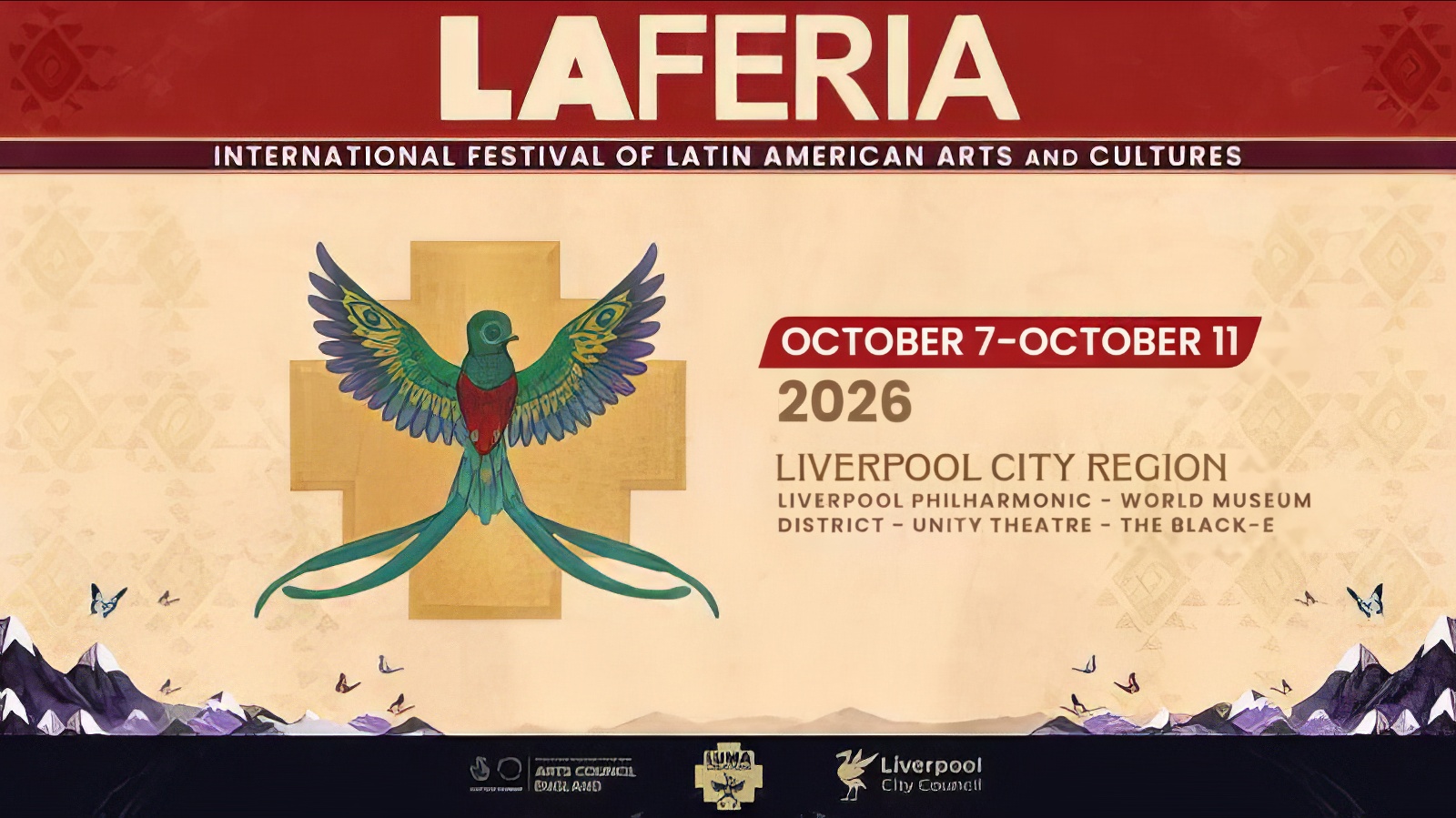
La Feria returns to Liverpool this October for its eighth edition, spreading five days of Latin American music, theatre, dance, visual art and food from Hope Street down to Chinatown. The festival was launched in 2018 by Luma Creations, the Liverpool organisation led by Chilean-born songwriter Francisco Carrasco, to put artists from across Latin America and its British diaspora on the city’s stages.
This year’s music starts in Chile, with songs built on the Andean rhythms of huayno and tinku and with folk tunes opened up through jazz improvisation. From there it moves to the brass-heavy mambo and salsa dura of a 13-piece Latin big band, to Afro-Colombian gaita flute set over electronic beats and deep bass, and to Brazilian forró and coco rhythms reworked as pop. Around the evening concerts and theatre performances, the week also brings a visual art exhibition, free workshops led by visiting artists, and two free family days to close the festival at the weekend.
On Wednesday, Unity Theatre opens the festival with Manuelita, a one-woman show from Popelei in which Tamsin Hurtado Clarke takes on Manuela Sáenz. The Quito-born revolutionary fought through the independence wars at Simón Bolívar’s side, and in 1828 she helped him escape an attempt on his life in Bogotá. Hurtado Clarke tells her story through comedy and physical theatre to music by Colombian guitarist Camilo Menjura. Before the play, 18-year-old Argentine-British musician Eli Rowley plays Argentine and Andean tunes on the ronroco, a big-bodied, low-tuned relative of the charango, taking his cues from Gustavo Santaolalla and Jaime Torres.
A short walk from Unity Theatre, the Music Room at Liverpool Philharmonic Hall takes over on Thursday, when Camila y Silvio return after selling out at La Feria in 2022. Camila Soria and Silvio Rozzi met during Chile’s student protests in 2011, and in 2015 they toured Argentina at length, learning the traditional styles of that country and the Andes. Their music moves between huayno, tinku, chacarera and vidala, with two voices over Rozzi’s guitar and charango and the deep thump of Soria’s bombo legüero. Fellow Chileans Peregrinos open the night. Guitarist Raimundo Santander and New York-based drummer Rodrigo Recabarren cut their first record together in Brooklyn in 2013, and they have used Chilean folk material as a starting point for improvisation ever since.
By Friday the Music Room’s stage has to make space for thirteen musicians. Orchestra Mambo International came together in 2022 around Leeds salsa DJ Lubi Jovanovic and trombonist Jonny Enright to play the mambo of Tito Puente, Machito and Eddie Palmieri with a full big-band sound. Trumpets, trombone and baritone sax are stacked over piano, bass, vibraphone and a percussion section of bongos, congas and timbales. Since then they have written their own material, from mambos to cha-cha-chás, much of it gathered on their debut album Apúntalo. Up front, Venezuelan singer Carlos Peña, once a featured vocalist in Oscar D’León‘s orchestra, shares the vocals with Cuban singer Claritzel Miyares. It is the band’s first Liverpool show, and Cuban singer-songwriter George Peguero, returning to La Feria, opens the evening.
Saturday night belongs to District, the club on Jordan Street in the Baltic Triangle, where Medellín producer Killabeatmaker sets Afro-Colombian and traditional Colombian rhythms over electronic beats and deep bass. His music keeps returning to the wildlife and landscapes of Colombia and the threats they face. On stage he beatboxes, raps and sings over live beats while Guadalupe Giraldo plays percussion and the gaita, the long, breathy duct flute of Colombia’s Caribbean coast.
Opening the night, Mari Merenda plays her first ever UK show. The São Paulo singer/songwriter and producer built her name on videos of the asalato, a West African pair of seed-pod shakers knocked together on a cord. Her songs set forró and coco grooves against pop and R&B with electronic touches, most of them from her 2025 EP Reverbero. In Liverpool she switches between piano and asalato, with Guilherme Monteiro on bass, guitar and vocals, before moving on to Brighton and London.
Before District opens its doors on Saturday night, World Museum on William Brown Street hands its galleries over to the festival for a free family day of music, dance, storytelling and workshops. The take-over is part of Cuerpos del Tiempo, a project with the museum’s Global Cultures Collections team to reimagine its Americas Gallery. Artists from eleven countries, from Argentina to Venezuela, perform among the displays. At midday Tamachij Chihuatl, a collective of more than 100 Indigenous Nahua women from Hueyapan in Puebla, Mexico, lead a food workshop. For forty years they have kept their village’s textile tradition alive, weaving wool and colouring it with natural dyes, and their name means “handmade”.
La Feria’s free finale takes over The Black-E, the community arts centre on Great George Street, on Sunday. There, Orkney fiddler Catriona Price plays with El Guapo, a Buenos Aires duo on guitar, drums, percussion and vocals who mix Latin American roots with rock and funk. Together they run Routes to Roots, a project that brings musicians from different cultures together to write new music and rework traditional tunes, and which took them to the Edinburgh International Festival in August. Three dance companies share the day. London’s ArtPer UK bring Peruvian folk dances from the coast, the Andes and the Amazon, including the marinera norteña, a courtship dance in which couples circle each other waving handkerchiefs. Colibrí, a Manchester troupe of Mexican dancers led by Guerrero-born choreographer Magaly Flores, perform regional dances in traditional costume, from Veracruz and the Huasteca down to Oaxaca and Chiapas. Inti Tusuy, whose name is Quechua for “sun dance”, bring together dancers with roots in Bolivia, Mexico, Peru and the UK. Latin American food, DJs and dance workshops fill out the afternoon.
Once the music stops at The Black-E on Sunday afternoon, the festival’s 2026 theme stays on the walls at Unity Theatre. Belonging, an exhibition by UK-based artists of Latin American heritage, runs there until 6th November, with work drawn from diaspora, ancestry and the places its makers call home.