

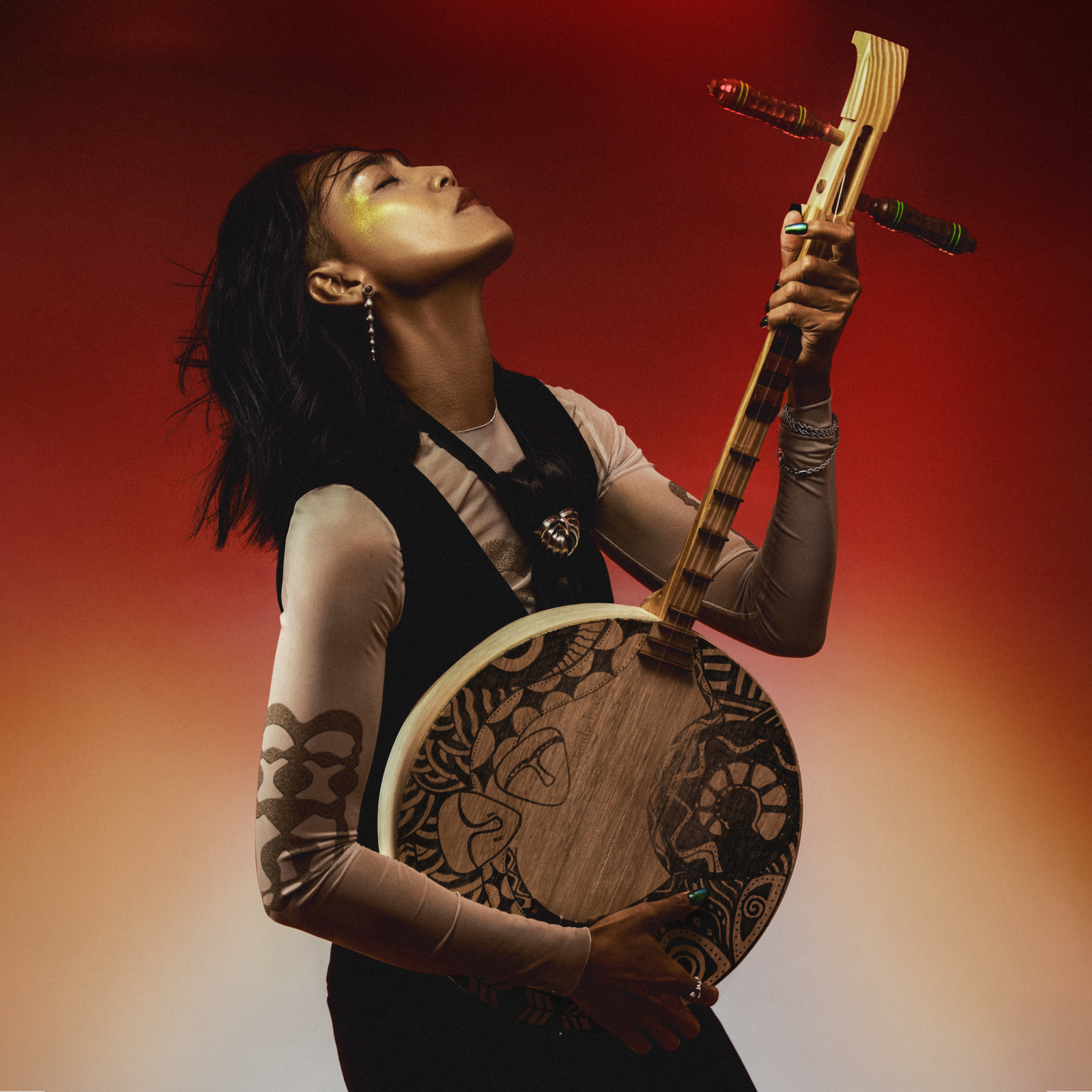
For the fourth episode of our Musical Road to WOMEX, we head to a village room in southern Taiwan, where a group of Paiwan elders usually gather to sing their own folk songs. Into that room, one afternoon, walked a young metal drummer who had just moved home.
Sauljaljui was back in Kapanan, her village in the Hengchun peninsula at Taiwan’s southern tip. Behind her were the university years, a nu-metal band, and a pile of rejected applications to Spring Scream, the festival every Taiwanese underground musician dreams of playing. She mentioned to an auntie that she still wanted to make music. The auntie said she knew somewhere…
Old people’s music, she thought when the door opened onto a dozen elderly villagers with yueqin in their laps, the two-stringed Chinese moon lute, working through Paiwan songs she had never bothered to learn. She stayed anyway, pulled up a cajón, started holding the rhythm for them, and found they sang steadier for it. Soon she was playing every session, then performing with them, and they began treating her as one of their own grandchildren. It was only then, deep into that company, that she thought to ask one of the old women what she was actually singing about, and got back a memory from the woman’s childhood: a flower she’d spotted high on a cliff while playing hide-and-seek, too far up to pick, so she just stood and looked at it until the spring wind carried its scent down to her.
She has said she felt ashamed and warmed at once. Folk music, it turned out, could be a way of singing the land itself, and she had been sitting in the room where it happened without hearing it. So she stopped keeping time for the elders and started learning from them, taking up the yueqin alongside the children of the village. Two strings, an instrument that had never belonged to her people, and somehow enough: she found her own idiom inside those constraints, folding in Austronesian rhythms gathered on tour and playing the lute as a rhythm section rather than a melodic voice. She sings mostly in Paiwan, a language spoken by fewer than 200,000 people and outlawed for years under colonial rule. And it was the elders, in the end, who put her on the Spring Scream stage her own band had never reached.
That path led out of the village and a long way from it. Her self-produced 2025 album VAIVAIK, a title that means both searching and embarking in Paiwan, took Best Indigenous Language Album at Taiwan’s Golden Melody Awards, and its opening track “Dipin Kari Tang” took Best Arrangement. That one came out of a month she spent living and playing with musicians in Mauritius, and she recorded it with the Taiwu Ballads Troupe back home. She has worked for years inside Small Island Big Song too, which links Austronesian musicians across the Indo-Pacific around the ocean they hold in common.
This October she brings all of it to WOMEX in Las Palmas de Gran Canaria, another island a long way from Kapanan. Below, she talks about the elders who taught her to sing, about carrying a language most of her audience will not understand, and about what she hopes to find on the island itself. She also curates a playlist of the tracks that shaped her sound, exclusively for Rhythm Passport.
You’re bringing music that moved from heavy metal in college to Paiwan melodies rooted in your home village. For a WOMEX audience meeting you for the first time, how would you introduce that journey and the sound it led to?
When I moved back to my hometown from the city to work, I met an auntie. I told her that I wanted to start a band and make music, so she took me somewhere. When I opened the door, I was surprised to see that everyone inside was elderly. They were playing the yueqin and singing traditional songs. At that time, I was honestly a little confused, because to me, it sounded like boring “old people’s music.” But after I joined them, I started playing the cajón to accompany them. In fact, with the rhythm of the cajón, they were able to sing together more steadily and in sync.
Eventually, I started performing with them and accompanying their songs. One experience that really stayed with me was when we were invited to perform at Spring Scream, one of Taiwan’s most well-known music festivals. It’s a festival that almost every Taiwanese underground band dreams of playing. My own band had applied to Spring Scream many times, but we were never selected. Yet after I returned to my hometown, it was my grandparents from the village who brought me onto that stage. I remember standing backstage and teaching one of the grandpas how to make the “rocker” hand gesture when he went on stage. But when he got up there, he got it wrong and shouted, “Local!” instead. And somehow, the audience went even crazier! (Laughs)
One day, I became curious and asked one of the grandmas, “What are the lyrics you’re singing about?” She told me about something that happened when she was a child. One day, while she was playing hide-and-seek, she saw a flower growing high up on a cliff. She wanted to pick it, but it was too far away. So she just kept looking at that flower. When the spring wind came, its fragrance carried into her heart. At that moment, I felt a little ashamed, but also deeply warmed. I realized that folk music could be a way of singing the land itself.
As I spent more time with these elders, they began treating me like their own granddaughter. Being around them also made me softer and more gentle as a person. When I sang these songs with them, I felt like I was finally hearing my own true voice. It was as if I had found myself.
You’ve said hearing your grandmother sing, a memory of flowers and spring wind carried in the words, changed how you understood what music could do. Does that moment still shape what you want a WOMEX showcase, and a room of strangers, to feel?
I hope that when people listen to my music, they can imagine the place where I grew up, the land, the environment, the people, and the culture that have nurtured me. I believe they can hear that my music comes from somewhere real. It carries a kind of life force that has grown directly from the land.
You brought the yueqin into Paiwan music by learning it alongside children in your village, even though it isn’t a traditional instrument for your people. Will it be part of what you bring to the WOMEX stage, and what does it let you do that a purely traditional set-up wouldn’t?
The yueqin helped me break through creatively. It only has two strings, so there are obviously limitations to what you can do with it. But because of those limitations, I started asking myself how I could express who I am within that restricted space. I began combining the unique melodies of my own culture with the rhythms of Austronesian cultures that I encountered while traveling around the world. Over time, that became my own way of playing. So the yueqin is not just an instrument for me. It has become an important part of my musical language, and it will also be one of the main instruments I use in my performances.
VAIVAIK means searching, or embarking, and the album is really about your own journey back to your language and your roots. What do you want a WOMEX audience, most of whom won’t know that story, to understand about that search when they hear it at your showcase?
My culture has given me confidence. It taught me to truly believe that “tradition can be invented.” When I became brave enough to respond to my culture with my own ideas, rather than simply following what already existed, I finally felt a sense of openness within myself. It made my soul want to see the world. And now, I want to share that energy with the world without holding anything back.
You’ve spoken about your father criticising your Paiwan, and feeling empty after your first award because you didn’t fully understand your own lyrics. Carrying the language to a WOMEX audience who won’t understand a word of it either, does that history change how you’ll sing it?
Creating music in my native language naturally comes with its own challenges, especially because we have experienced colonization and the loss of our culture and language. But those difficulties don’t make me feel defeated. Instead, they give me strength. It’s okay if the audience doesn’t understand my language. When I stand on stage, I believe they can still feel the conviction and energy that I carry. Sometimes I think about what the world would be like if there were no language barriers. I believe what would remain is energy. And I believe the energy that my culture has given me can cross those language barriers and allow people to feel that life force.
Small Island Big Song connected you with musicians across island cultures of the Indo-Pacific around the shared subject of the ocean. Las Palmas de Gran Canaria is an island too, out in the Atlantic. Is there something about performing on another island, so far from your own, that you’re curious to explore there?
I want to learn more about the history, people, culture, and environment of Las Palmas de Gran Canaria. I’m also looking forward to experiencing the place beyond simply being there as a performer. I want to walk through the city, meet the people, and understand how this land lives and breathes.
Your records fold Mauritian rhythms and jazz and rock in next to Paiwan tradition. In a WOMEX programme full of the world’s traditions, how do you want that mix to land, and what do you hope people take from your showcase?
In the past, when I created music that involved cultural fusion, it was mostly about combining different musical styles. But “Dipin Kari Tang” was different. I lived there for a month, spending every day with local people, living together and jamming together. So this song wasn’t something I imagined from a distance. It came from a real experience and became part of me. In my culture, recognition and belonging can sometimes be more important than blood relations. If we recognize one another, then we are brothers and sisters. That’s the feeling I hope “Dipin Kari Tang” can bring to people. Even if we come from different places and different cultures, if we are willing to recognize and accept one another, we can become family.
You’ve said people don’t need to remember your name, only your culture. WOMEX is built around industry attention on individual artists and their catalogues. How do you hold onto that idea in a room like that?
I never imagined that one day I would step outside of myself through my music. For me, I’m really just a messenger, a person who carries and shares the things I believe in. And strangely, that gives me a sense of freedom. It’s something that exists on a spiritual level. At the same time, in the commercial world, I hope I can bring these two sides together, the spirit I believe in and my identity as a musician. I am Sauljaljui. I come from the Indigenous people of Taiwan.
You wear a lot of different hats, singer, songwriter, teacher, festival organiser with KAPANAN back home. Beyond WOMEX, and maybe thanks to WOMEX, what’s next for you?
This year, I bought a new van, and in September I’m going to start a van tour. I’ll be traveling to different Indigenous communities, spending about a month in each one, and sharing how my culture has guided me around the world and influenced my creative journey. I’ve been inspired by many people along the way, so now I want to walk into these communities myself and share what I’ve learned and experienced. I especially hope I can bring new ideas and courage to young people in the communities, and let them know that their culture doesn’t have to be a limitation. It can actually become the strength that allows us to go out into the world.
If you could write a short, personal invitation to the people of Las Palmas to come and find your showcase, what would you want them to know before they arrive?
I’m Sauljaljui. Your long-lost half-sibling from another mother and another father. Come and listen to what I have to say 👂
On Saturday 24 October, from 22:30,
Sauljaljui carries the songs of the Paiwan elders who taught her,
and the two-stringed moon lute she learned beside them,
onto the Borondón Stage at WOMEX 2026 in Las Palmas de Gran Canaria.
PLAYLIST: SAULJALJUJ X RHYTHM PASSPORT
You can find all the previous episodes of Musical Road to Womex HERE