

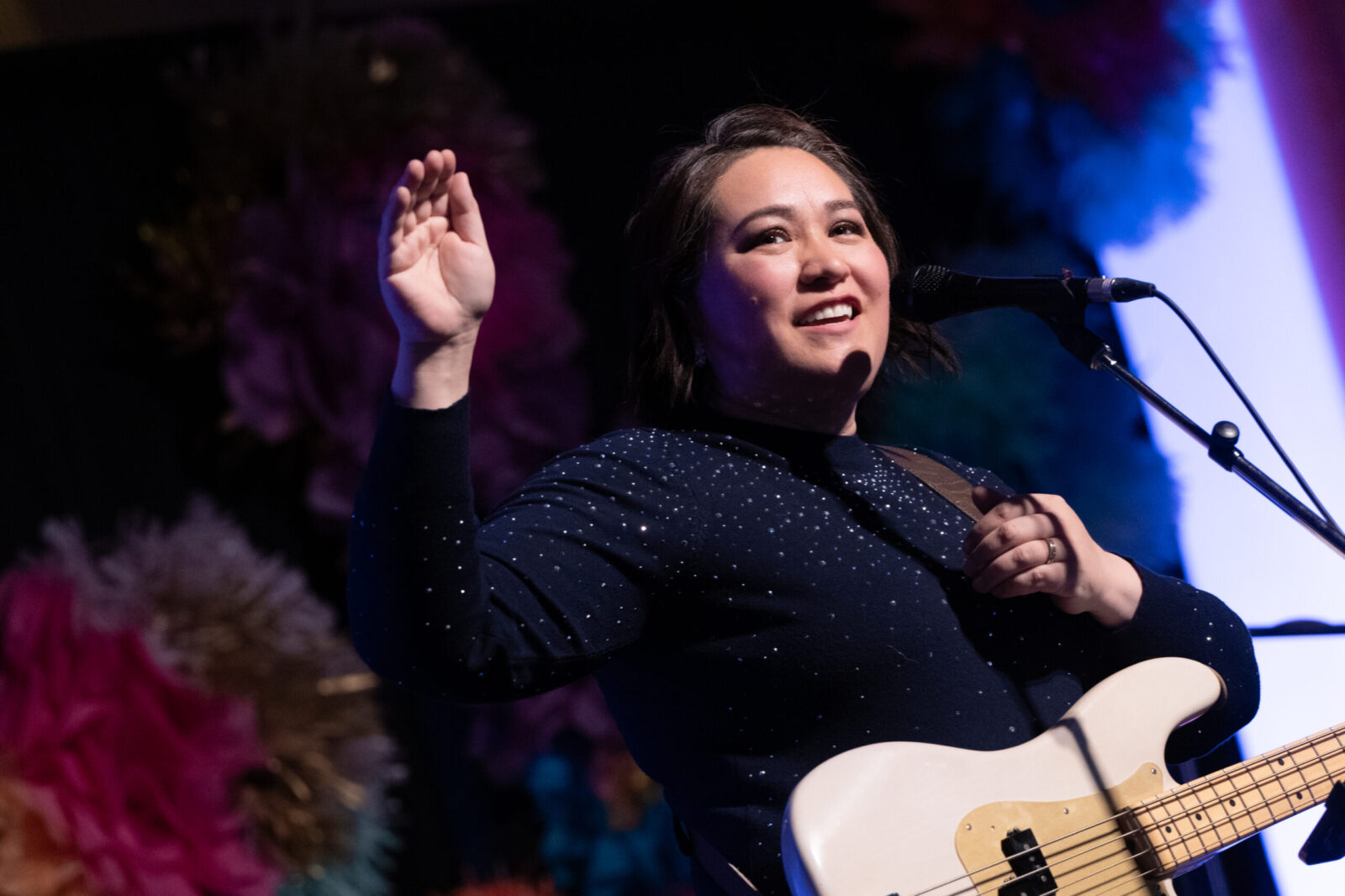
Kluane Lake sits two hours from the Alaska border, ringed by mountains, under a midnight sun in summer and months of darkness in winter. Diyet van Lieshout was born in a tent on the ancestral lands of the Kluane First Nation, in a community of ninety people whose families have lived in that country for more than ten thousand years. She discovered she had a voice at ten, by accident, as a shy kid. She took a degree in voice performance, wrote songs for a publishing house in Vancouver, taught voice in the Netherlands. The pull north won in the end. She went home with her Dutch husband to a village with no venue to play in, and only then started writing for herself.
Diyet & The Love Soldiers came together there soon after: her husband Robert van Lieshout on acoustic guitar, drums and percussion, and Juno-winning producer Bob Hamilton on electric guitar, pedal steel and mandolin. The three of them make alt-country, folk and roots threaded with Southern Tutchone, Diyet’s own language. Her heritage runs Southern Tutchone, Tlingit, Japanese and Scottish, and she describes the work as living in two worlds at once: fishing for dinner on the ice one day, on a stage the next.
Wherever the road takes them, the songs keep turning back to the lake. Last year’s Seeds of Dreaming was written across five years of touring from Alaska to Europe, and every song on it points home: “8th Wonder” is for her mother, a residential school survivor, and “Grandfather’s Country” is built on the Southern Tutchone phrase Ásì Keyi, my grandfather’s country, the land she grew up on.
It is that home she wants to bring to Las Palmas, turning a showcase room into a small piece of Kluane for forty-five minutes. Ahead of the festival she joined our Musical Road to WOMEX for a Q&A about the lake she writes from, singing in a language most of the room won’t understand, and the Guanche history she only discovered through our questions.
Your songs move between English and Southern Tutchone, and between alt-country, folk and traditional forms. For a first-time listener, how would you describe the world your music lives in?
My music lives in the North. It comes from the mountains, the water, the long winters, the midnight sun, and from growing up in a place where the land is always present in your life.
I’ve never worried too much about my music fitting into one genre. I grew up surrounded by traditional Southern Tutchone songs, but also country, folk, rock and all kinds of other music, so naturally all of those things find their way into what I do.
I think of the music as a meeting place between worlds, Southern Tutchone and English, traditional and contemporary, Indigenous and non-Indigenous. There’s a lot of the North in it, but you don’t have to be from the North to understand the stories. They’re about family, identity, love, loss, humour, healing and figuring out where you belong.
Mostly, I hope when people hear the music they feel like they’ve been invited into my home for a little while.
You were born in a tent and raised on a glacial lake in Kluane, in a family steeped in music. What in that upbringing continues to shape the songs you write today?
Pretty much all of it.
I grew up on the shores of Kluane Lake, surrounded by mountains and a huge amount of space. When you grow up in a place like that, the land isn’t scenery, it’s part of who you are. You learn to pay attention to weather, water, animals, seasons and the people around you.
Music was also just part of life. It wasn’t something separate that happened on a stage. People sang, told stories, gathered and shared music.
That still shapes how I write. I’m interested in songs that tell you something and take you somewhere. Even after travelling around the world, Kluane is still the place I write from. It is my centre.
WOMEX lands this year in Las Palmas de Gran Canaria, an island with its own Indigenous history: the Guanches, whose culture and language were largely lost after the Spanish conquest. As someone who sings in Southern Tutchone and works to keep it alive, what are you most curious to find there?
I didn’t know that! I’m really interested in that history. Coming from a small Indigenous Nation and being involved in the work of keeping Southern Tutchone alive, I understand how fragile language can become when it stops being passed naturally from one generation to another.
Language carries so much more than words. It carries humour, worldview, relationships to land and ways of understanding who you are.
So I’m curious about the people of Gran Canaria today and how they understand that history. What remains? What has been remembered? What has been reclaimed?
There’s something meaningful about bringing Southern Tutchone songs from my home in the Yukon all the way to an island on the other side of the world that has its own complicated history of language and culture.
You’ve spoken about walking in two worlds as an Indigenous woman. In a WOMEX programme full of traditions, what makes your storytelling distinctive, and what do you hope people take from your showcase?
I think my storytelling comes from the fact that I really do live in two worlds. I’m a contemporary Indigenous woman, but I come from a very small northern community where our language, land, family and traditional ways of knowing remain incredibly important.
I don’t see tradition and contemporary life as opposites. They exist together. That’s reflected in my music. A song might contain Southern Tutchone language or come from a very specific Indigenous experience, but musically it might sit somewhere between folk, roots, country and pop.
At WOMEX, I want people to meet us as we actually are, not as some idea of what Indigenous music is supposed to sound like.
If people leave our showcase feeling like they have travelled north for 45 minutes, met some people they didn’t know before and maybe understand our part of the world a little differently, then I think we’ve done our job.
WOMEX always sparks unexpected meetings. Are there particular artists or showcases you’re looking forward to in Las Palmas?
One of my favourite things about WOMEX is that I don’t know yet.
There will be artists there from places and traditions I may know very little about, and those are often the performances that stay with you. I love hearing music where I may not understand the language but completely understand what the artist is communicating.
I’m especially interested in meeting other Indigenous artists and artists working with endangered languages.
Your live shows are built around story, you talk about taking an audience on a journey. How does a room of delegates and music professionals like WOMEX change the way you build a set?
It definitely changes things because we have a short amount of time and everyone in the room is seeing a lot of music.
The best way for people to understand what we do is to actually experience the show. I approach it the same way we approach any performance: bring people into the story, give them some context about where we come from, and then let the music take the listener where they want to go.
For our 45 minutes, I want that room in Las Palmas to feel a little bit like my home in Kluane.
Your songs come out of the land and water around Kluane. What’s it like to sing them somewhere as far from that as Gran Canaria, in front of people who’ve never seen the place they come from?
I actually love it. There’s something powerful about standing thousands of kilometres from home and singing about Kluane Lake, the mountains, our people and our language.
Those places are incredibly specific to me, but the feelings attached to them aren’t. Everybody understands what it means to have a home. Everybody understands belonging, family, loss, change and the places that shape us.
Sometimes the farther away I travel, the more clearly I understand where I come from.
The idea that someone in Gran Canaria might hear one of our songs and suddenly have a picture of this enormous glacial lake surrounded by mountains in the Yukon is pretty cool.
Your songwriting explores Indigenous perspectives on tradition, trauma and healing. Is there a message you feel especially compelled to carry to an international audience through this showcase?
For me, the important message is that Indigenous people are still here, our cultures are alive, and we are creating new things.
Healing isn’t about pretending difficult things didn’t happen. It’s about carrying that history while still moving forward.
When I sing in Southern Tutchone on an international stage, that in itself means something to me. The language is being heard. It is travelling. It is being used to create something new.
Seeds of Dreaming is one year old and you’ve taken it around the world. Beyond WOMEX, what’s next for the trio: new recordings, more touring, a direction you haven’t tried yet?
I’m definitely entering a new chapter.
After years of touring as Diyet & The Love Soldiers, I’m starting to think more broadly about what the next version of the music can be. There is an intimacy of the trio and the relationship Robert, Bob and I have built together, but I’m also interested in bringing more of my language onto a musical landscape.
One direction I’m particularly excited about is orchestral work. We’ve already started exploring what these songs can sound like with an orchestra, and hearing music that comes from Kluane expanded into that scale has opened up a whole new world for me.
Writing in Southern Tutchone and thinking about how language can live inside contemporary music without becoming something separate or ceremonial.
If you could write a personal invitation to the people of Las Palmas to come and discover your showcase, what would it say?
Come north with us. For 45 minutes, we’ll take you from Las Palmas to Kluane in the Yukon, a place of mountains, glacial water, midnight sun, long winters, big stories and a language that has been spoken on that land for generations.
You don’t need to know anything about the Yukon. You don’t need to understand Southern Tutchone. Just come ready to listen.
Hopefully when you leave, true North won’t feel quite so far away.
The journey north begins just after midnight on Friday 23 October
when Diyet & The Love Soldiers play the Borondón Stage at the Sala San Borondón, 00:00 to 00:45.
You can find all the previous episodes of Musical Road to Womex HERE