

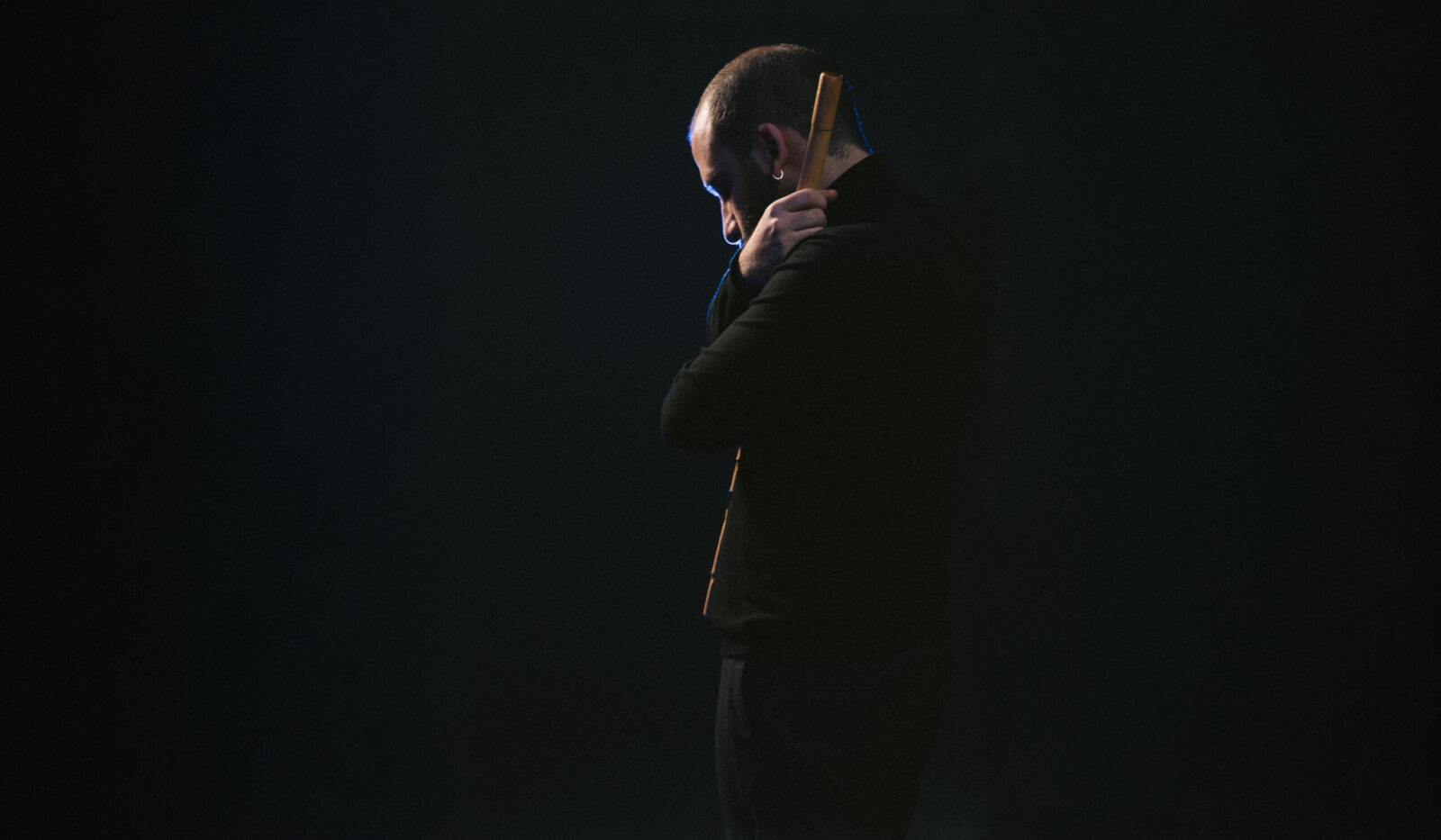
Faris Ishaq‘s uncle had got hold of some reed cane from Jericho and asked Faris’s older brother to cut holes in it so he could play it. The brother made the flute. Faris, sixteen at the time, picked it up before his uncle got the chance and kept it. He was four years into euphonium lessons at the Edward Said National Conservatory, but the sound of that homemade nay took hold of him completely.
Nobody taught him what to do with it. There was nothing to teach, really: no mouthpiece, no keys, nothing mechanical to explain, just cane, breath, and whatever he could find by trial. Then he saw Dhafer Youssef play live and understood how far it could go. The nay is a Middle Eastern flute with 5,000 years behind it, answering to breath and nothing else. That is either a severe limitation or the entire point, and Ishaq has spent twenty years proving it’s the second.
For the fifth episode of our Musical Road to WOMEX, we follow Faris Ishaq from that room in Bethlehem to Berklee’s Global Jazz programme, where a full scholarship took him and he was named top student for running Arabic maqam through jazz harmony. He has since released three albums, recorded with Grammy-winning bassist John Patitucci, featured the nay on the BAFTA-nominated Assassin’s Creed Mirage soundtrack, and premiered his own concerto for the instrument, A Wildscape, at Southwark Cathedral. Ishaq also trained as a music therapist, which shapes how he builds a piece from the ground up—meant to hold and heal as much as to perform.
His new work takes all of that and strips it back to where he started. JASAD (Arabic for body) was recorded live in his own Bethlehem studio with no band and no overdubs: just the nay and a frame drum strapped to his leg. Coltrane runs through it via Arabic maqam. Palestinian dabke footwork, learned while dancing professionally at school, translates directly onto the drum. Underneath it all is tashbib, the melodic-percussive Arabic woodwind tradition he grew up with. He refuses to call what he does a “revival”, to him, the tradition never went anywhere.
On 24 October, he brings all of it to WOMEX in Las Palmas de Gran Canaria, one stop on a tour running from Istanbul in September to the EFG London Jazz Festival in November. Below, he talks about breath, borders, and a living heritage, alongside an exclusive playlist of the tracks that shaped his sound.
You play the nay while accompanying yourself on leg-percussion: one body producing melody and rhythm at once. For a first-time listener, how would you describe the sound and the setup?
My sound is rooted in Palestinian and the broader Arabic musical tradition, while also drawing from Global Jazz and cross-cultural musical dialogue.
I play the Nay flute and a leg-mounted frame drum at the same time. I sometimes describe what I do as similar to what an electronic music producer does, except my only playground is the Nay and the frame drum. I use them to build a live, layered and immersive sound, combining melodies, rhythms and acoustic effects in real time.
I describe the frame drum as a natural extension of how I play the Nay, which involves a lot of percussive tonguing and playing with and around the rhythm. I also grew up dancing Palestinian Dabke professionally at school, which involves rhythmic stomping and movement. I translate some of the rhythmic footwork of Dabke onto the leg-mounted frame drum. It’s my own way of connecting movement to music.
You were largely self-taught before Berklee, drawn to a reed flute dating back thousands of years. Was there a turning point that told you this instrument, and this path, were yours?
The sound of the Nay was the turning point. I am largely self-taught on the Nay, but I started playing the euphonium at the Edward Said National Conservatory of Music in Palestine at the age of 12.
When I was 16, my uncle had recently got some reed cane from Jericho and asked my older brother to make some holes in it so he could play. My brother made that flute, and my uncle never saw it again! This is how it started and I became obsessed with its sound.
The other turning point was listening to Dhafer Youssef play live. His powerful presence and exploration of the voice touched me on a deep level, and I wanted to explore the Nay in a similar way.
Your nay grows out of a shepherd’s music: you’ve revived the Palestinian tashbib. The Canaries have their own pastoral inheritance, including silbo gomero, the whistled language shepherds used to carry messages across the ravines of La Gomera. Is there anything in that shared open-air, herding root you’re curious to seek out while you’re in the islands?
I wouldn’t say I revived Palestinian Tashbib. It was always there.
The Nay has a long history across many cultures and countries, and similar reed flutes have taken many different forms and roles. I’m not sure the Nay grew only from shepherds’ music. I can definitely imagine that they started from that human desire to resonate with the natural beauty around us, open spaces, rivers and mountains.
It’s fascinating how we developed such technologies through sound and our connection to the land. As you mentioned, silbo gomero is a beautiful example of this.
In a similar way, Palestinian Tashbib is a melodic-percussive way of playing traditional woodwind instruments that goes by different names in Arab countries. In Palestine, we call it Tashbib, which literally means “to become young,” and it’s full of joy, rhythm and earthiness.
Musically, it leaves space for improvisation and percussive interplay with and around the rhythms of traditional Palestinian songs and Dabke dance stomps. Essentially, to me, the rhythmic energy of Tashbib and the Dabke stomps are a way of showing dignity and our connection to the land and its soil.
You bring the tashbib and jazz together on the nay. In a WOMEX line-up full of the world’s traditions, what makes yours stand out, and what do you hope people take from your showcase?
I was particularly drawn to combining Tashbib and jazz because they both share an improvisational spirit connected with identity, as well as the rhythmic interplay of playing in and around the beat.
But my album is not only about bringing Tashbib and jazz together. It’s about creating an immersive experience with the Nay that honours its roots and expansive musical potential, while also offering a grounding and healing space after the madness humanity has experienced in the past years.
What stands out musically is that I create a complete world of musical expressions and sounds on the spot, using only the Nay and a leg-mounted frame drum. From that place, I combine Tashbib and Global Jazz influences with rich Arabic maqam modalities, Dabke and other rhythms, together with my original acoustic nay effects that have taken years to develop. All of these elements come together to create a singular musical language.
The nay responds only to breath and intention: it’s an intimate instrument. How does playing to an attentive, close-listening delegate and music professional audience shape the way you perform?
It will be an honour to share my music with music professionals from around the world.
The very first thing the audience hears is how I feel in that moment, rather than a planned musical sentence. I shape my repertoire, improvisations, and textures according to how I feel at the start of the show and throughout the performance. For example, playing in a cathedral is very different from playing in a seated concert hall or to a standing audience. I enjoy resonating with the type of venue, atmosphere, and, most importantly, the audience, who mostly shape the musical journey.
Playing for delegates and music professionals is the same. In the end, I want to create an immersive sonic journey that honours the sound of the Nay.
You’re also a trained music therapist. Has that shaped how you think about what music is for, beyond the stage?
Being trained as a music therapist has set the foundation for how I create music, helping me create work that is both musically and culturally rich, while carrying a sense of healing and grounding.
Beyond WOMEX, what lies ahead: the JASAD project, new recordings, the concerto and orchestral directions you’ve been exploring?
JASAD is currently set for an international tour, including the London Jazz Festival on November 14th, Melbourne Jazz Festival on October 18th, Arter in Istanbul on September 13th, and many other dates this autumn.
Beyond this, I am working to expand my musical concerto A Wildscape, which premiered at Southwark Cathedral two years ago, while also working on a new album for jazz quartet. https://www.youtube.com/watch?v=VT4Tbz0gm3A
Faris Ishaq carries the memory of a homemade Jericho flute straight to the WOMEX stage in Las Palmas,
weaving Palestinian tashbib and global jazz into a live set
built from breath and a leg-mounted frame drum, nothing else.
He plays the Daycase Stage (Sala Gabriel Rodó) on 24 October, from 14:15.
PLAYLIST: FARIS ISHAQ X RHYTHM PASSPORT
You can find all the previous episodes of Musical Road to Womex HERE
Cover Photo ©: Fadi Dahabreh