

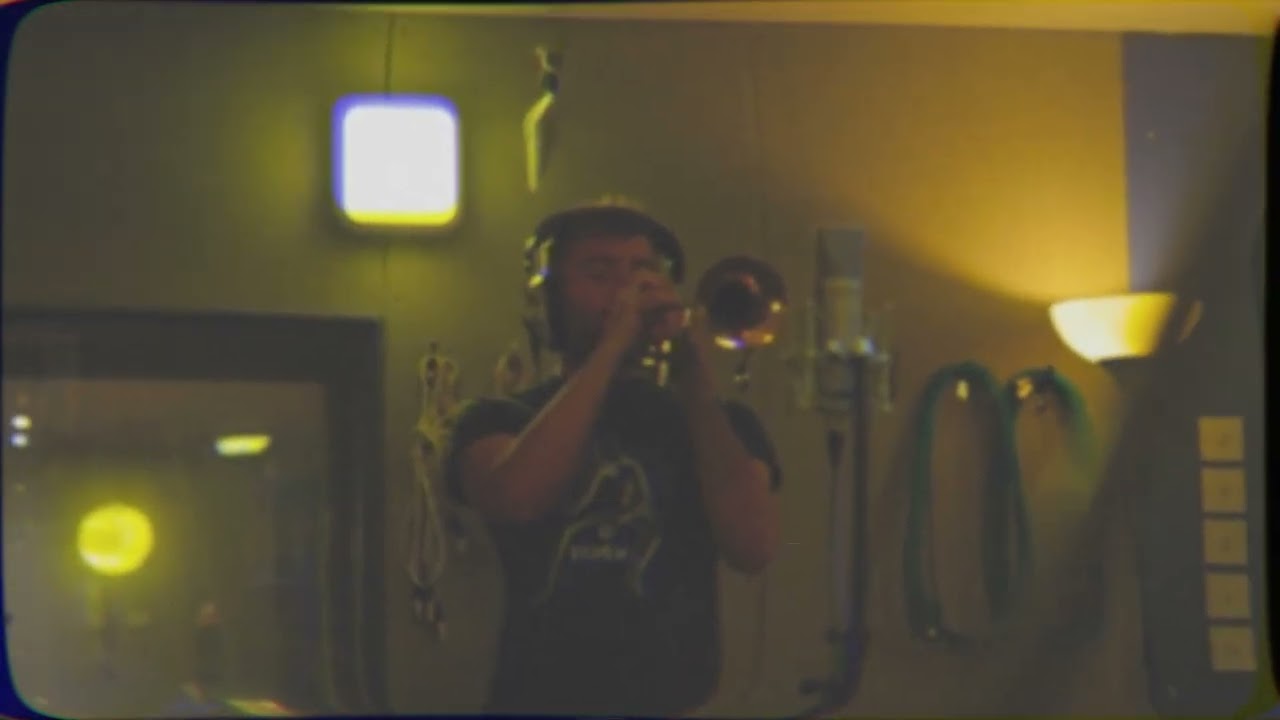
On “Welcome to the Citadel”, the title track of their third album, the London jazz band PYJÆN bring in extra brass. The band formed in 2016 among musicians who met at Trinity Laban, the music conservatoire in Greenwich. Their debut PYJÆN and 2021’s Feast put jazz solos over funk and afrobeat grooves, with detours into hip-hop, disco and punk, always with two horns up front: Dylan Jones on trumpet and Ben Vize on saxophone. For this tune, a composition by bassist Benjamin Crane that runs a prog-rock streak through those grooves, the two are joined by three players from the horn section of Bare Jams, the pop-funk band Vize also plays with.
The album, also called Welcome to the Citadel, is a concept record about an imaginary character who shares the band’s name. PYJÆN began as a barista’s misreading of Jones’s name on a coffee cup; the musicians kept it as their band name and later turned it into this fictional figure, whose origins and world the record describes. Synthesisers played by Jones, Vize and Crane give the band’s jazz fusion an electronic edge across 17 tracks that move between instrumentals and songs with guest singers. The colour keeps shifting: accordion on “C’est la Vie”, a primary-school choir on “Shades of July”, a dub siren on “Eye Spy”.
The writing has moved on since the debut. Back then, the band explain in a short film about the album, they wrote in the London jazz way: a theme, “and then it’s just solo for as long as we can”. This time the five set out to “see who can out-silly each other”, each bringing in the most extreme tune they could; drummer Charlie Hutchinson, who wrote four of them, reaches for unusual harmonies the others liken to Thelonious Monk’s. A meow and deliberately daft horn lines turn up among the arrangements, yet “it’s silly, but it’s not a joke”: the band work every detail out, then “take the legs off it and make it really whimsical”. Much of the record, by their own account, is “quite game music-y”, written with video games and cartoons in mind. They also hear in it an emotional depth they “maybe haven’t had before”.
After travelling to Peter Gabriel’s Real World Studios in Wiltshire for their second album, Feast, the band stayed on their own patch of south-east London this time, booking three days at Perry Vale Studios in Forest Hill because they wanted to record “locally”, as “part of the community”. Engineer Jessica Corcoran, “really quick, really patient” in their words, helped them get all 17 tunes down as live takes with the whole band playing together; the orchestration and extra parts went on afterwards. The band produced the album themselves, with Laurence Wilkins mixing and mastering.
Listen to “Welcome to the Citadel” HERE and buy the album following THIS LINK