

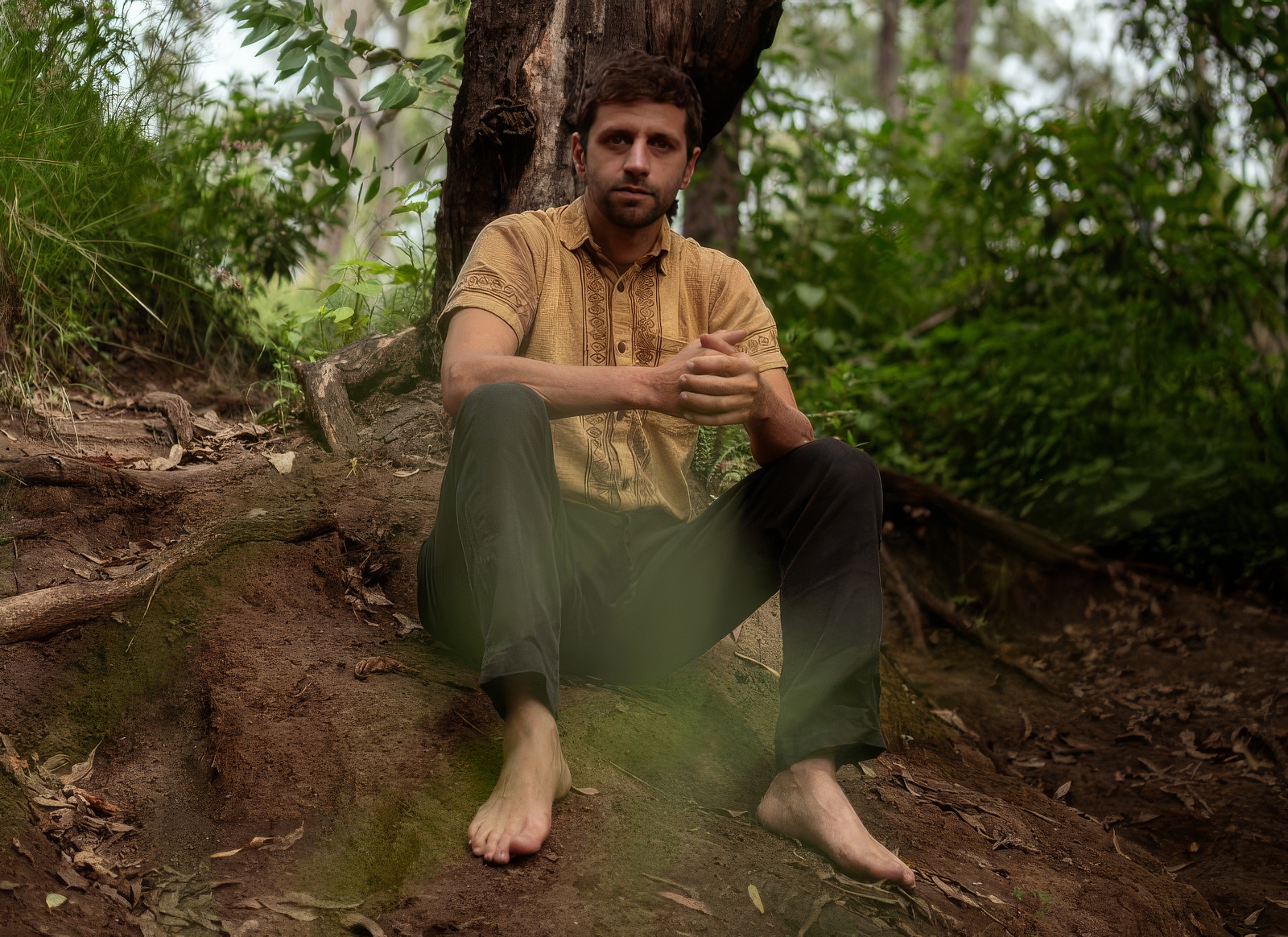
The garden at Hootananny in Brixton was basking in summer on the day Lagartijeando came to play. That night in early July, the Argentine producer born Mati Zundel was sharing the stage with the Chilean multi-instrumentalist and producer Rodrigo Gallardo. Their summer tours had crossed in the UK, and the two had decided to join forces for a pair of nights in London and Barcelona: one bill, two sets, and a route through folktronica, downtempo, cumbia and Andean sounds, built for dancing together.
A few hours before the show, we sat down with Zundel on a bench in that garden, in the sun, to talk in Spanish and Spanglish about his new album, 7 Caminos, out in March on Wonderwheel Recordings. The conversation ran from a healing centre in the Peruvian jungle to his new life in Mexico. He talked about why making music feels to him like a game, and how some songs arrive in a single take while others mutate for months. He also talked about the limits of artistic freedom, his kinship with Rodrigo Gallardo, and the more ancestral sound he is reaching for next.
7 Caminos, seven roads, takes its name from a Mexican way of seeing the world, stretched by three extra directions and one practical problem. “Cuatro Caminos, four directions, is a name the Mexicans use a lot: north, south, east and west, the possibilities a human being has to go in life. But there was a very famous album by Café Tacvba called Cuatro Caminos, so I couldn’t use it. North, south, east, west, up, down and inside. So there are seven. Seven possibilities for a human being.”
The record is soaked in Mexico, where he moved two years ago and where he wrote and produced it, in Cholula. But it began much further south. “To tell the truth, the album didn’t start there. It started in the Peruvian jungle. I stayed for several months at a centre, doing shamanic work, for personal reasons.” The centre was Takiwasi, in Tarapoto, and music was part of the cure. “In Peruvian shamanism, music is used to heal. I worked as a music teacher at the centre where I was staying. It has a residential part for people with addictions, and they use music there. Those kids had been there nine or ten months, and they knew all the icaros, the healing songs, and what each one was for.” The songs of the curanderos worked their way into him. “In a way, all that music of the shamans and the healers was an inspiration and an influence for me. I also recorded an album with them, just of icaros. Little by little the ideas for the songs on this record came out, and in Mexico I concentrated on finishing it.”
If the starting point was a place of healing, the music itself comes from a lighter part of him. “For me, making music is a moment of play. Of feeling that something lifts me. Elevation, for me, is feeling a spirit of movement, of grace, of having fun with something. Someone else picks up a football and feels connected, and the time flies. That happens to me with music, when I pick up a sound or start playing with a rhythm on the computer. I feel the time slipping away, and I’m connected, right there in that moment.” He knows other musicians work the opposite way. “Some people need music to unload a weight they carry. I’ve done a lot of therapy and a lot of shamanic work to balance my energies and feel good, and when I start composing, I compose from feeling good, happy, connected and inspired. I hear a sound and I want to make a rhythm with it. I put the rhythm down, I pick up the charango, and it’s all very playful. I don’t know where it’s going. Other people say, I fought with my girlfriend, I’m going to write a song about it. That doesn’t happen to me. For me it’s more like: I heard this rhythm, I want to make it, how fun.”
Some songs arrive in one go. “La Cumbia De La Selva”, the album’s first single, was one of them. “It was a loop I found in a sample library, some jazz pianos. I put it in a sampler and started playing just the first chord, chan, chan, just that rhythm. Then I put cumbia under it, because it felt right, and it came together quickly. I left it like that.” Others take a long road. “Santa Maria”, which now carries the voices of Khalil Mounji and Nabila Dali and Mounji’s guimbri, began somewhere else entirely. “When I started it, it was very dub. Then I kept changing it, mutating it towards more oriental sounds and more Afro-Peruvian rhythms. The first version didn’t convince me. I liked it, but not that much. Something was missing, and I didn’t know what. When I try several times and it doesn’t work, I go a bit crazy and say, right, I’m going to take it to another level, one that has nothing to do with it, and see what happens.”
“Cholula”, named after the town where he finished the album, landed close to its first take. “I invited a musician from Mexico who plays pre-Hispanic instruments, ocarinas, flutes, and we recorded a session with him, recording melodies on all those instruments. It stayed almost exactly as it came out.” That musician is Markiño, who shares the track with the singer Mariri.
Freedom, he says, is relative, even for someone who works by instinct. “In the end, you’re not so free. Not a prisoner, but conditioned, by certain tastes, by what you can do, by what you live. I love rap, but I could never make a rap song, because it’s not mine. My voice has nothing to do with it. And I’m Latin American, and I like Latin American music. I’m not a prisoner of it, but I’m conditioned by it, because that’s my root, the place I come from. It’s my music.” A long career narrows things in another way. “When I worked as a waiter in a bar, I came home wanting to make music, because I hadn’t made any all day. But when you work with music, afterwards you don’t feel like making more. You want to see a friend, or go and play football. After many years, you’re dedicated to social media, videos, the show, rehearsing, travelling, and there isn’t much time left to compose and experiment. And making new things takes a lot of experimenting.”
7 Caminos still follows the line of the earlier Lagartijeando records, but it leans somewhere new. “I feel it’s a more melodic album. It’s made more for listening at home in the afternoon than for the club, because the work is centred on the melodies.” Much of that comes from his co-producer, the Argentine musician Manu Quintans, who plays violin, guitar, quena and mandolin across the album. “He’s very melodic, and he helped me a lot to polish and improve the melodies, and he layered them with his instruments. Club music is more monotonous, more bass and drums, more rhythmic. This album has rhythm, because Latin music is very rhythmic, but it’s made of melody.”
His listening, he admits, is all over the place, from the huaynos of the Andes to Bad Bunny, and only some of it makes it into the music. “I listen very randomly. You can hear it: there’s cumbia, reggaeton, Afro-Latin American music, pre-Hispanic music. I also listen to Bad Bunny, and there’s nothing of Bad Bunny on the record. His last album is really good, I like listening to it. But at the same time, I really like the huaynos of South America. That’s a genre I listen to and take ideas from. Bad Bunny I see from a distance, as something outside me. With huayno, there’s something that identifies me with the sound, the way of singing, the lyrics.”
Those Andean roots are what bind him to Rodrigo Gallardo, the other half of the Hootananny bill. The two also share a booking agency, which made the London and Barcelona nights easy to put together. “I feel like a brother to Rodrigo, musically too. Rodrigo is a version of Andean music that’s more tied to house, and I’m a different version. We represent two variants of the genre, but we complement each other: the aesthetics of the sound, the rhythm, the BPM, the speed. He has more influence from techno and tech house, and I have more African influences and more cumbia. We share the charango and some flutes, but the palette of sounds is very different, and the creative process is completely different too.”
Beyond the tour, he is already heading further back in time. “In September a track of mine comes out on a label compilation, and in November there’s an EP that’s more ethnic. Right now I’m going deeper into ethnomusicology, more ancestral music, using more ancestral voices, fewer pop references, going back a bit more to the tribal, and experimenting with faster rhythms. That’s where I want to go: a more ethnographic development, much more ancestral than before.” Asked to sum up his music for someone who has never heard it, he barely pauses. “Ancestral electronic music. Modern ancestral. South American electronica.”
7 Caminos is out now on Wonderwheel Recordings
For the earlier records, head to Lagartijeando’s Bandcamp