

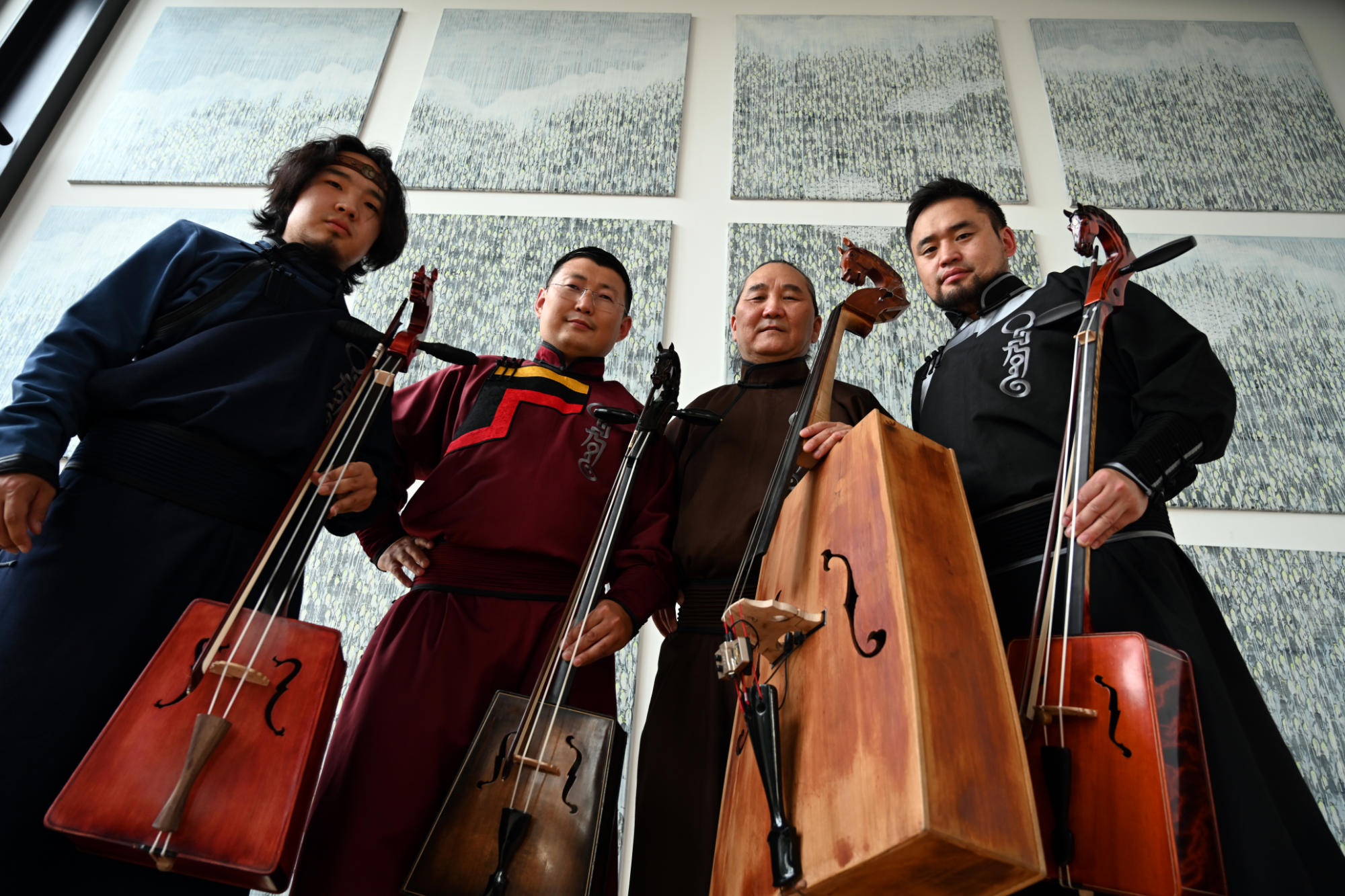
Yesun-Erdene Bat was fifteen and in seventh grade at an ordinary school in Yeröö, a village in Selenge province in northern Mongolia, when his class was offered the chance to learn the morin khuur, the horse-head fiddle. The state had just singled the instrument out, and the teacher was looking for volunteers. Only one hand went up.
“There was a presidential order calling on all Mongolians to respect the morin khuur and to learn it. My school was just a normal school, not a music school, but it started horse-head fiddle courses. The teacher asked who wanted to enrol, and I was the only one who raised my hand.” He puts it down to his mother, who loved the instrument whenever it played on television. “She would say: how beautiful, what a harmonious melody, I would love my son to learn this. Maybe it was a way to make my mother’s dream come true.”
After high school he studied musicology at the National University of Mongolia and learned throat singing from Baatarin Odsüren, the khöömii master who pioneered teaching the art in the classroom and who is himself a teller of epics and a reciter of praise songs. Today Yesun-Erdene plays morin khuur, khöömii and mouth harp in Tengerton, a Mongolian quartet based in Germany that formed in 2023. In March, the band brought their music to Babel Music XP, the annual world music fair in Marseille. Over several days in the city, before and after their showcase, we sat down with the four musicians and their guest on stage, the long song singer Erdenetsetseg Khenmedekh, for an in-depth conversation about Mongolian music, its traditions and its future. Nomindari Shagdarsuren of Routes Nomades, the French organisation that represents them, introduced us to the band, interpreted throughout and acted as our guide to Mongolian music along the way.
The band was started by Uuganbaatar Tsend-Ochir, who plays the bass ikh khuur and came to Tengerton from Egschiglen, one of Mongolia’s best-known ensembles. “I have been in Germany as a musician since 1998, and I played with Egschiglen for almost twenty-five years. It was a beautiful musical journey all around the world, with lots of concerts and lots of success. Then in 2023 I established this new band.” What drew him was the people he could gather around him. “For me it is a new experience, and I am so happy to collaborate with musicians who have this rich background in different types of world music.”
All four members come through the same three channels: “the institutional musical education, the traditional background from very early childhood, and the musical exchanges in Europe.” The line-up follows a similar logic. “It is really a string quartet based on the morin khuur, together with the big contrabass morin khuur that we call ikh khuur.” Around those four fiddles sit khöömii throat singing, the bishguur oboe, the tovshuur lute, the tsuur flute and the mouth harp.
Uuganbaatar’s own road to the bass fiddle was the slowest of the four. “Until I was eighteen I had no contact with music at all. My parents weren’t musicians, but they loved music: both of them played guitar and sang.” He grew up in Ömnögovi in the southern Gobi and finished school in 1990, as Mongolia’s regime changed. “Students who didn’t get into university could work as interns at the local theatre, so that’s what I did, and I also did two years in the army. In 1992 I enrolled at the University of Culture and Arts in Ulaanbaatar and majored in the ikh khuur.” Six years later he joined Egschiglen and moved to Europe, and he stayed with the group until 2022.
Dalaijargal Daansuren, who plays morin khuur and tsuur flute, started at the opposite end, and he tells his story in English. “I didn’t even know I was connected to music, because I started when I was three. My whole family are musicians, so music has been around me since I was a baby. I grew up in a little village in the Gobi, where my parents worked at the village theatre, so I was always listening to traditional music.” Since then he has been “learning to play like a virtuoso”, and by his own account he is “still trying”. Part of that learning now happens beside musicians who have spent decades on European stages: “It is a pleasure to work with experienced musicians. You learn a lot.”
In Tengerton, the tovshuur lute and bishguur oboe are in the hands of Nasanjargal Ganbold, who also plays morin khuur in the band. He was born into a family of musicians from the Torguud, an ethnic group from the mountains of south-western Mongolia. His mother is a singer and his father a musician, and the family’s tradition reaches back to his grandmother. “Mongolian culture is a singing culture. Everybody sings. My grandmother, my mother’s mother, is still alive. She is 94, and she is one of the reference bearers of traditional singing and dance, of long song, and of tatlaga, the traditional way of playing pieces on the tovshuur and the morin khuur.”
With a singer for a mother and a musician for a father, he grew up surrounded by that repertoire, and his grandmother’s long song carries the shape of the place it comes from. “Torguud long song is different, because it is a western way of singing. It has more ornamentation, going up and down, following the contours of the mountains. We come from the high mountains, and our singing follows them.” Studying at the College of Music and Dance in Ulaanbaatar was his own decision, and so is the work he does now with his grandmother’s songs: “I want to inherit and continue her tradition, so I am writing down transcriptions of her repertoire.”
Uuganbaatar and Dalaijargal grew up in the Gobi, Yesun-Erdene in Selenge in the north and Nasanjargal in the Torguud mountains of the south-west, and each of those places has its own way of speaking and of singing. “In Mongolia we have one language, Mongolian, with basically four dialects. Of course we understand each other. But we also have more than twenty different ethnic groups, so playing in the west, the east, the north or the south of the country is very different. The traditional repertoire is very rich and diverse, by ethnic group and by geography.”
In Marseille they opened with the oldest layer of that repertoire. “Altain Magtaal”, a praise song to the Altai mountains, belongs to the world of the tuuli, Mongolia’s sung heroic epics, and it is sung before the epic begins. “An epic can last for days. Before singing the epic, we perform the praise to Altai to call the spirits. It is a singing art, but it also has a spiritual dimension, a kind of spiritual therapy, a way of addressing all the natural spirits, the masters of the invisible world.”
Those spirits belong to the economy of the steppe, where “we depend very much on nature, on the animals, on the changing seasons and circumstances, so we have this deep logic of giving worship and living in harmony with nature.” The band trace that worship back to “an animist vision, from long before any religion was established”, and they suppose the tradition “can go back three thousand years, to the Bronze Age in Mongolia, and maybe even earlier.” Nomindari Shagdarsuren finds the same picture in the archaeology. “When you look at the new excavations, the artefacts we find and monuments such as the anthropomorphic stelae, the deer stones, which date back to the Bronze Age, the images give a hint of the nomads’ vision of the world and the universe. It is vertical, in three stages, with the human world and the invisible world. So we can see these common points in the music, and also in different elements of Mongolian traditional culture.”
The praise also reaches beyond the mountains in its title. “It is not only dedicated to the Altai. We also have the Khangai mountains, the Khentii mountains, the other mountain chains. Mongolia is very diverse geographically, so it is a way to give praise to nature in general.” The version Tengerton play is a fairly recent one, chosen with care. “There are different versions of this ancestral piece, because it changed with time. The version we picked dates back to around the 1970s or 1980s, and it is sung in the Khalkha dialect.”
An older version survives with one of the two epic singers officially recognised by the Mongolian state, who comes from more than eighteen generations of epic singers. On his recording the praise lasts twenty-five minutes. “The words are very different. In his version you feel the spiritual side more. The modern version is more descriptive.” That older text is already pulling at the quartet: “For our second album, we would like to reinterpret the older version, because it holds the legends and the myths of the mountains.”
The audience in Marseille heard the steppe in it. “They told us that through our music they really felt the steppe, the universal dimension of the steppe.” That suits a band whose titles keep returning to nature. “Zakhias” takes its name from “counsel and advice to someone very close to you, your daughter or your son”, and the song asks listeners to love, protect and respect the natural world. Nasanjargal’s “Tsatsal Biyelgee” draws on a ritual found across the whole country, “giving worship with a libation of tea”, and on the biyelgee, a dance “especially popular in the western part of Mongolia”.
In Europe those explanations become part of the concert, and Nasanjargal has seen what they do to a room. “When I play the traditional repertoire in Europe and we explain the meaning of each piece, Western audiences tell me it really felt like a journey, that it brought them to Mongolia. It is very pleasant to hear that even very old, ancestral music can still reach people’s hearts today, whatever their origin.”
At home, the same pieces arrive with expectations already attached, and Uuganbaatar has spent almost three decades between the two audiences. “In Mongolia we mostly play traditional pieces, and they are so popular that the audience expects the same thing: the same way of singing, of interpreting, of performing. It is interesting, of course, but at the same time it frames the tradition.” Abroad, nobody knows how the pieces are supposed to go, and that frees the arrangements. “Western audiences don’t know the pieces exactly, so we can play them with new arrangements, a new way of singing and presenting the music. It is not breaking the traditional pieces. It is a way to enrich how we perform and transmit them.”
The guest on stage in Marseille knows that tension more sharply than anyone. Erdenetsetseg Khenmedekh was born in 1972 in Dundgovi, the Gobi province known as the cradle of Mongolian song, and has sung urtiin duu, the long song, for more than thirty years. With her voice and a limbe flute played with circular breathing, the showcase held every element Mongolia has inscribed with UNESCO, “the morin khuur, khöömii, urtiin duu and the circular breathing flute”, in Nomindari Shagdarsuren’s words.
For Erdenetsetseg, the European stage has become a source of strength. “In 2024 Routes Nomades organised a tour dedicated to long song for the first time, as part of the cultural season around the exhibition on Genghis Khan in Nantes. I played at the opera house in Nantes, at the Théâtre de la Ville in Paris and at the Musée des Confluences in Lyon. The concerts were received with such intensity, such openness and such attention. I didn’t expect it.” The contrast with home is stark. “In Mongolia we are losing long song singers and audiences, because other types of music are taking over. Most programmers say people will be bored by it. The rhythm of life is changing and accelerating, and people are losing the habit of listening to something deeply.”
The French concerts “motivated me a lot”, she says, and that is the response Routes Nomades works for. The French non-governmental organisation has promoted Mongolian arts and culture in the West since 2006, starting with khöömii. In 2018 it became the only French NGO working on Mongolia to be accredited by UNESCO for the safeguarding of intangible cultural heritage. It has released six records with Buda Musique and Pan Records, among them a double-disc anthology of Mongolian khöömii in 2017, and it has presented more than forty traditional and world music artists in sixteen countries. Nomindari Shagdarsuren is its project coordinator between France and Mongolia and its artistic adviser. “We promote these traditions outside Mongolia so that maybe there will be a reflection back into Mongolia, and people there understand that this is our tradition and that we have to take care of it.”
Tengerton’s debut album, Ilch, is due later this year on Buda Musique with Routes Nomades, and it began as a way of showing who the new band is. “As a new band, we had to bring something real to show people, so we gathered ideas from four sides. The idea was to show the identity of the quartet, and to challenge ourselves as musicians, because we have very big and very different musical backgrounds.” That meant letting in “elements of jazz and flamenco, making world music on the base of Mongolian traditional music, and showing Mongolian classical music as well.” The record sets ancestral pieces such as “Altain Magtaal” next to three compositions by Yesun-Erdene, one by Dalaijargal and one by Nasanjargal. “In terms of repertoire it is very eclectic, but the identity of Tengerton is expressed through that eclecticism, and at the same time it stays Mongolian.”
The album is finished and on the launch pad, and Dalaijargal is already looking beyond it. “For us it’s just the beginning of our route, and it’s quite a strong beginning. We want to continue, but in a way where the music says something and transmits a message to people. There is an idea we want to defend through our music.” Nasanjargal is clear about what that idea is. “We aspire to play all around the world and bring Mongolian traditional culture through our music, because the Mongolian way of life depends so much on nature. We want to show this symbiotic relationship between human and nature to the whole world, because we are all humans, and nature is our mother.”
The band’s name points the same way, up towards the sky. “Tenger is the Mongolian word for sky, and for heaven as well. Traditionally we have an animist view of the world, Tengrism, the worship of the sky. Ton is the tone of a colour or of a sound, a note, in French too. And there is a Mongolian word that sounds similar, toono, the crown of the yurt. The idea is to represent the toono with the sky behind it.”
When asked how they would introduce Tengerton to someone who has never heard Mongolian music, the quartet start from “the sound of nature, the different voices of the sky”, and then turn it back on the listener. “Do you know the sky? Have you ever heard the different sounds of the sky, or noticed the different tones of its colour? If a person can answer that question, it means they understand Tengerton.”
Ilch is due later this year on Buda Musique. More on Tengerton’s music and live dates is at Routes Nomades
where you’ll also find Erdenetsetseg Khenmedekh
Cover Photo ©: OtGO