

The cigarette was still burning between Mohamed Barsaoui’s lips when he got up from the table. There was gear waiting inside to be set up for the soundcheck, so he held the cigarette out to Mariem Hamrouni. She said no. He pressed the ember into his own hand until it went out, and walked in as if nothing had happened.
“Fire is his element,” Mariem said later, and she meant it the Sufi way. In Sufi thought the human being is made of earth, water, air and fire, and fire is the element of burning love, the one that consumes the self. It runs deep in the tradition the two of them draw on as Jathb. Their songs come from the Sufi ceremonies of Tunisia. In some brotherhoods there, adepts in trance handle flame as a sign of a saint’s protection, and the rapture that seizes them has a name, jadhb. That night, on the Africa NOW! stage at Tallinn Music Week, they would bring those ceremonies to Estonia: old Tunisian chants remade with synthesisers, sound design and the breath of a didgeridoo.
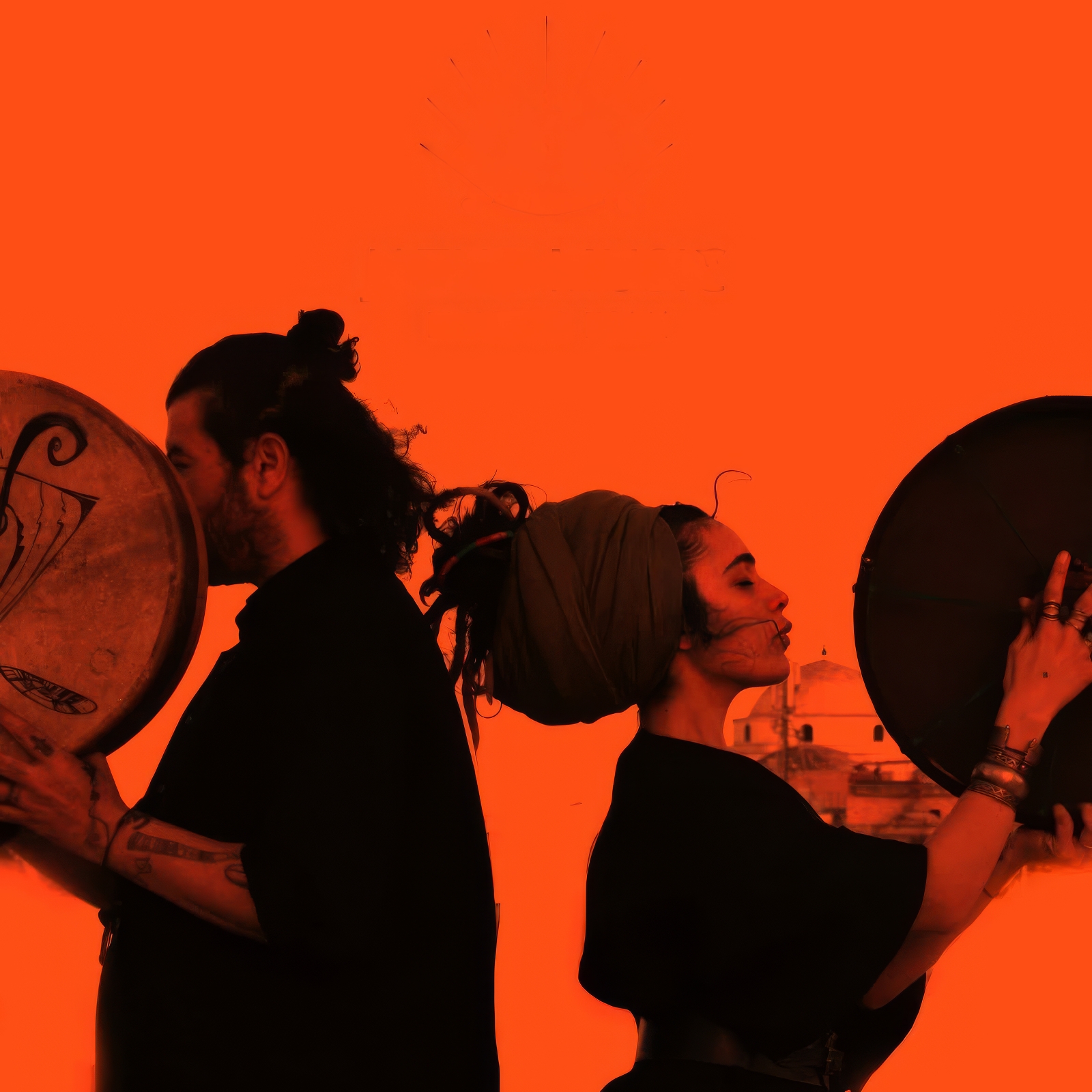
The two come from Ben Arous, just outside Tunis, and have played together as Jathb since 2021. Mohamed builds the electronic side and plays the didgeridoo, and Mariem is the voice, singing the Sufi texts in derja, Tunisian Arabic. While he was inside patching together the tangle of cables that brings his machines to life, Mariem stayed at the table with us for the interview. She talked about how a jam between two near strangers became Jathb, what it means to carry Tunisia’s Sufi saints into electronic music, and how the old masters of the tradition ended up on their side.
Her first words were for Tallinn and for the people who had brought Jathb there. “The weather is so cold, but honestly our hearts are so warm with this opportunity and this invitation. We are really excited to perform for the community here.” What they would play that night, she describes as a trip. “I cannot describe it, because each one will live it in his own way. It could be inward, it could be outward, we never know. We can say it is a spiritual trip that invites us to reflect on our daily lives, our habits, our connection with what surrounds us: people, nature, our thoughts, our behaviours, our earth, our ancestors.”
That is why the instruments come from everywhere. “It is a message of the oneness of our humanity, a reminder that we are all coming from one source, and maybe we forget. We come from the same source and we will go back to the same source. It’s not about language. It’s about the universal language, which is sound, music.”
The spark came on 2 September 2021, and it came by surprise. “It was made with love, literally. We met, me and Mohamed, and we didn’t know that both of us made music. We met outside music. The surprise was when we jammed together, the second or third day after we met.” Both had loved music for years without finding the right partner to take it further. “The day we jammed together, we knew this was the perfect timing and the perfect place to play our favourite game, which is playing music.”
Festivals were nowhere in the plan. “We were just having fun, literally, at home, jamming with friends. Then even our friends started asking for this music.” The word spread from one room to the next. “People started saying this duo is doing a special sound, you need to programme them. We were just going with the flow, and that’s when they started to programme us at big festivals and on big stages.” In 2023 they presented Willia at the Journées Musicales de Carthage in Tunis, and in July 2025 they played the open-air theatre at the Festival International de Hammamet.
As more people came to hear them, Jathb went deeper into the Sufi texts they were already researching. “With time it became a research, a remembrance. With each track that came out, it became a responsibility. It’s not just music for us. Who is this saint we are singing about? It’s not just singing Sufi songs, it is a full philosophy. Who are these ancestors? What did they do?” The answers came from the tradition itself. “We learned a lot about our ancestors and about this Sufi culture: the songs, the way they wrote them, the way they come together to sing them, what they are asking for in the dhikr. And we felt a lot of tolerance, peace, a peaceful energy that always calls people to come together, to remember the oneness.”
Mariem’s voice gave Mohamed’s music something it had been missing. “Mohamed always says that before we met, his sound was very ambient, cinematic, dark and raw. And he always says that when I came into his life, something was added to his sound, something complementary and soft, to make the balance.” For Mariem, the process has no method at all. “I don’t remember any rule when I make music with Mohamed. No musical rules, no rules at all. I just express myself, without thinking or choosing what I will sing. I feel Mohamed’s sounds, his synthesisers and ambient sounds, and I jam with them, I go with them. Then suddenly we discover we have a new track.”
What came out of those sessions fitted no existing shelf, so they made their own. “I will tell you a little secret. With this music, I think we created a new musical genre. It’s not just electronic Sufi music. We can’t put it in any genre that already exists, so for now we call it Sufi Myth Punk. It’s the marriage of the ancestral sound with all the futuristic sounds that Mohamed incarnates. And the punk is for the revolution vibe, because no one dared to change Sufi music.”
Playing with a fire that old, they expected to be burned by the people who keep it. The opposite happened. “We are grateful that when the old Sufi masters heard this music, they were proud. That was so surprising for us. They were proud because they felt the old taste of the Sufi presence. So they started to support us with other texts, very old texts. They sent them to us, and they invited us to their ceremonies to hear new sounds and new texts to work on.”
Mariem sees the duo standing between those masters and her own generation. “One of our messages is to be a bridge. In previous years the new generation didn’t connect with Sufi music. Very few young people are connected to Sufi culture, and they don’t learn it.” Her own connection goes back to a childhood on the coast. “I spent my childhood in a little town called Mahdia. Every celebration we had, we did with a Sufi ceremony, so I learned it by heart from childhood. With time we felt it could be a bridge between the ancient Sufi culture and a new generation that needs to know its culture and connect with it, especially because it carries a very strong message of peace and tolerance.”
At home, that bridge runs into a narrow circuit. “We have a lot of good musicians in Tunisia, and good diversity. There are a lot of talented artists, amazing artists, and some of them are still not recognised enough.” The big stages are the Journées Musicales de Carthage and the Hammamet and Dougga international festivals, and Jathb have already played two of them. “If you play on one of these, it means you are recognised there. But once you’ve done these stages, you need to go out and share your music abroad. You won’t have many more opportunities, or you have to create a new project to play the same stage.” Alternative music, she adds, “always has the underground vibe, everywhere.”
Getting abroad has meant finding allies. Their trip to Tallinn was backed by Elyssa, a programme of the Institut français de Tunisie that supports artists living in Tunisia. “It’s a support we received from the Elyssa residency, where we finished the second EP of Willia. They loved our path, the way we are growing step by step, so they keep following us and supporting us when we receive invitations. It’s very good support, honestly.” The first EP came out in 2024, and the second was still waiting for release, which made Tallinn a first hearing. “Tonight we will play all the unreleased music.” What comes next is visual. “People have started asking about our visual world, the way we will present our music visually, so we are preparing that now.”
Each show, she says, depends on the room as much as on the two of them. “Bringing that trip on stage is always an energy exchange for us, so the audience is part of the experience too. It’s a spiritual music, and it’s based on very energetic vibrations. We try our best to bring the trip on stage as it is. It’s about whether Mohamed and I connect on stage, that click.”
Out in the cold, with the soundcheck still coming through the walls, she had one last invitation for the people about to fill the room. “Each show will be different, because it depends on the crowd and the energy of the place. So I always invite our friends to join this trip, because we always need to remember what the machine is trying to delete every day, bombarding us from all sides. They’re always welcome to join our trip of remembrance.”
The invitation stands beyond Tallinn: Jathb’s trip of remembrance carries on at SoundCloud and Bandcamp