

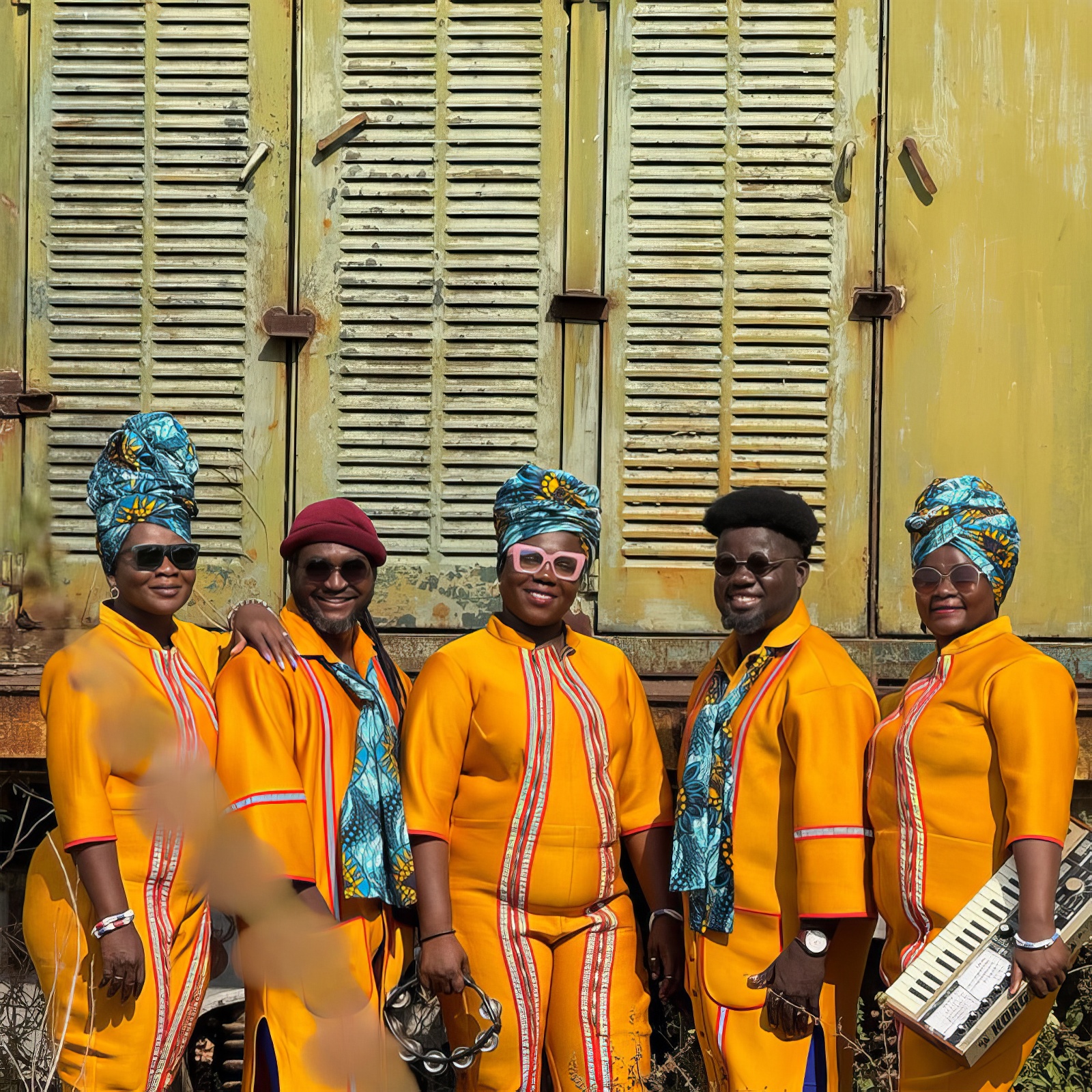
In a house in Lomé, a woman kept a set of ceremonial pots she used for preparing potions for the older women of the Vodun temples. Vodun is the West African religion the Ewe and Fon have practised across Togo and Benin for centuries, the one that crossed the Atlantic on slave ships and became Haitian Vodou and Louisiana Voodoo. Its spirits are bound up with natural forces and they are reached through drumming and singing, so those women sang constantly. Her grandson grew up believing all that singing had gone into the clay and stayed there. Years later he took the pots and built a drum kit out of them.
His name is Toto Tchilatchi, and half of what Nana Benz du Togo carry onto a stage is those pots. The other half is a bass David Kasanku built out of PVC drainpipe. He used to play bass, then spent four years assembling the gazé tuyau. Once it went underneath Toto’s kit, the pots and drums came to life, and together they made a groove full of sub-bass and complex polyrhythms. That groove became the bedrock for three singers, Lady Apoc, Parus Kekeli and Izealedu, with a small vintage Korg keyboard alongside their voices. The band’s word for what all of it adds up to is trance. They describe Vodun itself as being about rhythm, trance, nature and connection, and Lady Apoc says theirs comes from “repetitive energy.“
None of the five knew each other until 2019, when Peter Solo, the leader of Vaudou Game, came to Lomé to run a workshop and brought local musicians and artists together for it. Out of that workshop came the band, and Solo has produced them ever since. They took their name from the Nana Benz, the wax-print traders of Lomé’s central market who drove Mercedes-Benz cars and were confided in by the powerful. The band say they admire the courage and force those women showed in patriarchal societies.
They sing in English, French and Mina, over the Vodun scales of the snake, Dan, and of Mami Wata, about women and the earth, and they say protecting one is inseparable from protecting the other. Their feminism, the band say, comes from the strength and resilience of African women, and their ecology from Vodun itself, and they say protecting women and protecting the earth cannot be pulled apart. Like many people of their generation, they grew up with mixed feelings about Vodun and were taught to be ashamed of parts of it, and at some point they moved away from it. Going back gave them their voice back. They stopped trying to fit into a musical category and started creating from who they are. Even so, they never set out to put Vodun in the spotlight, and years of work in the shadows came before they dared to get on a stage. Their first concert in Europe was Transmusicales de Rennes in 2022, and AGO followed the year after, recorded at the OTODI studio in Lomé with Solo producing.
They went back to OTODI in December 2024 to record SÉ NAM, again with Solo, and it came out in June 2025. Its eleven tracks have a more contemporary production and more room for groove and rhythm. The title means “understand me” in Mina, one of the three languages they sing in. In October they bring it to WOMEX in Las Palmas…
For this episode of Musical Road to WOMEX they answered our questions about how Vodun meets the dancefloor, what their handmade instruments do and what they hope to find on the island: they want to hear the timple, meet local musicians and find out what traces of African and Atlantic exchange can still be heard in Canarian music, and they arrive, as they put it, with their ears open. The playlist at the end lets you hear what they are bringing.
You’ve been described as pioneers of “digital voodoo”. For someone hearing you for the first time, how would you introduce the meeting of Vodun tradition and the dancefloor?
For us, Digital Vodou is not about taking something old and trying to make it modern. It is about showing that Vodun is already alive and has always had the power to evolve.
Vodun is about rhythm, trance, nature and connection. And the dancefloor can be a place for that too. People come together, move together, let go. We bring traditional rhythms, songs, percussion and the handmade instruments we create into electronic music, bass and contemporary sounds.
For us, it is a meeting between something very old and something that is still being born. That is what makes it feel both ancestral and futuristic.
The band takes its name from the Nana Benz, the market women who turned the wax-print trade into power and independence. What did diving back into your Vodun heritage, after leaving it behind, open up for you musically?
It gave us our voice back. Like many people from our generation, we grew up with mixed feelings about Vodun. There were things we were taught to be ashamed of, so at some point we moved away from it.
Coming back to it changed the way we saw ourselves. We realised that Vodun is not only a spiritual tradition. It is also a way of understanding our relationship with the earth, with women, with our ancestors and with each other. And musically, it opened a whole world for us: rhythms, melodies, stories, symbols. Things that were already inside us.
We stopped trying to fit into a musical category. We started creating from who we really are.
WOMEX lands this year in Las Palmas de Gran Canaria, an Atlantic island whose own traditions ride on the timple, a five-string guitar that carries both African and Latin American trade routes. What are you most curious to discover there?
We are curious about the connections between the different traditions. Islands are special places. Cultures arrive there, meet, change and survive. We want to hear the timple, meet local musicians and discover what traces of African and Atlantic exchanges can still be heard in Canarian music.
And honestly, we are excited about the unexpected. Maybe one of our handmade instruments will meet a sound from the island in a way we never imagined. That is what we love about music.
Your instruments are handmade and upcycled, the gazé tuyaux among them, and your themes are feminist and ecological. In a WOMEX programme full of traditions, what makes your sound and your message unmistakably yours?
For us, everything is connected. The recycled instruments are not just something you see on stage. They are part of our sound and part of the way we think. We take things that people throw away and give them another life.
In a way, we do the same with our stories and traditions. We take things that have been misunderstood or pushed aside and bring them back into the present.
Our feminism comes from the strength and resilience of African women. And our connection to ecology comes from Vodun itself. We often say, “Whoever does not respect women does not respect nature.” For us, that says a lot about who Nana Benz Du Togo is.
WOMEX is built on unexpected meetings. Which artists, labels or collaborators are you hoping to cross paths with in Las Palmas?
We don’t really have a list of names. We want to meet people who are deeply connected to where they come from but are not afraid to experiment. Artists who can move between tradition, ritual, electronic music, performance and new ideas.
And that is one of the things we love about WOMEX. You can have a conversation with someone backstage and suddenly discover that there is something you can create together. We are coming with our ears open.
You’ve toured Europe and built a reputation as a live force. Does a room of delegates and music professionals change how you bring the trance and the groove of your set?
Not really. Of course, we know that WOMEX is important and that there will be a lot of professionals in the room. But once we are on stage, we have to be ourselves.
Whether there are one hundred people, a thousand people or music professionals watching us, we want the same thing: for people to feel the music in their bodies.
We want them to forget for a moment who they are supposed to be and simply become part of the rhythm. That is when the magic happens.
“Voodoo is Nature,” you’ve said. Gran Canaria is a volcanic island shaped by the ocean around it. Does a landscape like that speak to the ecology at the heart of your songs?
Absolutely. When you see a volcanic landscape, you are reminded that the earth is alive. It is powerful, it changes, it moves.
For us, nature is not something outside of us. In Vodun, it is a living presence. The ocean, the wind, the stone, the fire inside the earth, these are not just things around us. They are forces.
So being on an island shaped by the ocean and volcanoes feels very familiar to our way of thinking. It reminds us that we are part of something much bigger than ourselves.
Your work carries a clear message about women’s strength and respect for the planet. Is there something you feel especially compelled to say through this showcase?
Yes. We want to remind people that protecting women and protecting the earth are not separate things.
We believe our traditions can still teach us something about that balance. We are not trying to go back to the past. We are trying to understand what we can take from it to imagine a different future. For us, women are creators, transmitters, protectors and forces of transformation. That is something we want to celebrate through our music.
After SÉ NAM, what’s next? New recordings, new collaborations, directions you’re keen to push the project toward?
SÉ NAM was an important chapter for us, but we already feel the next one coming.
We are working on new music and pushing the dialogue between ritual percussion, the instruments we make ourselves and electronic production even further.
We also want to work with artists from other parts of Africa, the Caribbean and Latin America. There are so many shared histories, rhythms and spiritual connections across the Atlantic that we would love to explore.
We want to keep moving forward without losing our roots.
If you could write a personal invitation to the people of Las Palmas to come and discover your showcase, what would it say?
Come with your body before your expectations. Come to dance, listen, feel and maybe remember something older than all of us.
We are bringing rhythms from Togo, women’s voices, handmade instruments and the energy of Digital Vodou.
Don’t just come and watch us. Come and experience it with us. If you join us, we will create the ceremony together.
On 23 October at the Plaza Stage in Las Palmas de Gran Canaria,
Nana Benz du Togo will ask the WOMEX crowd
to forget for a moment who they are supposed to be and become part of the rhythm
PLAYLIST: NANA BENZ DU TOGO X RHYTHM PASSPORT
You can find all the previous episodes of Musical Road to Womex HERE