

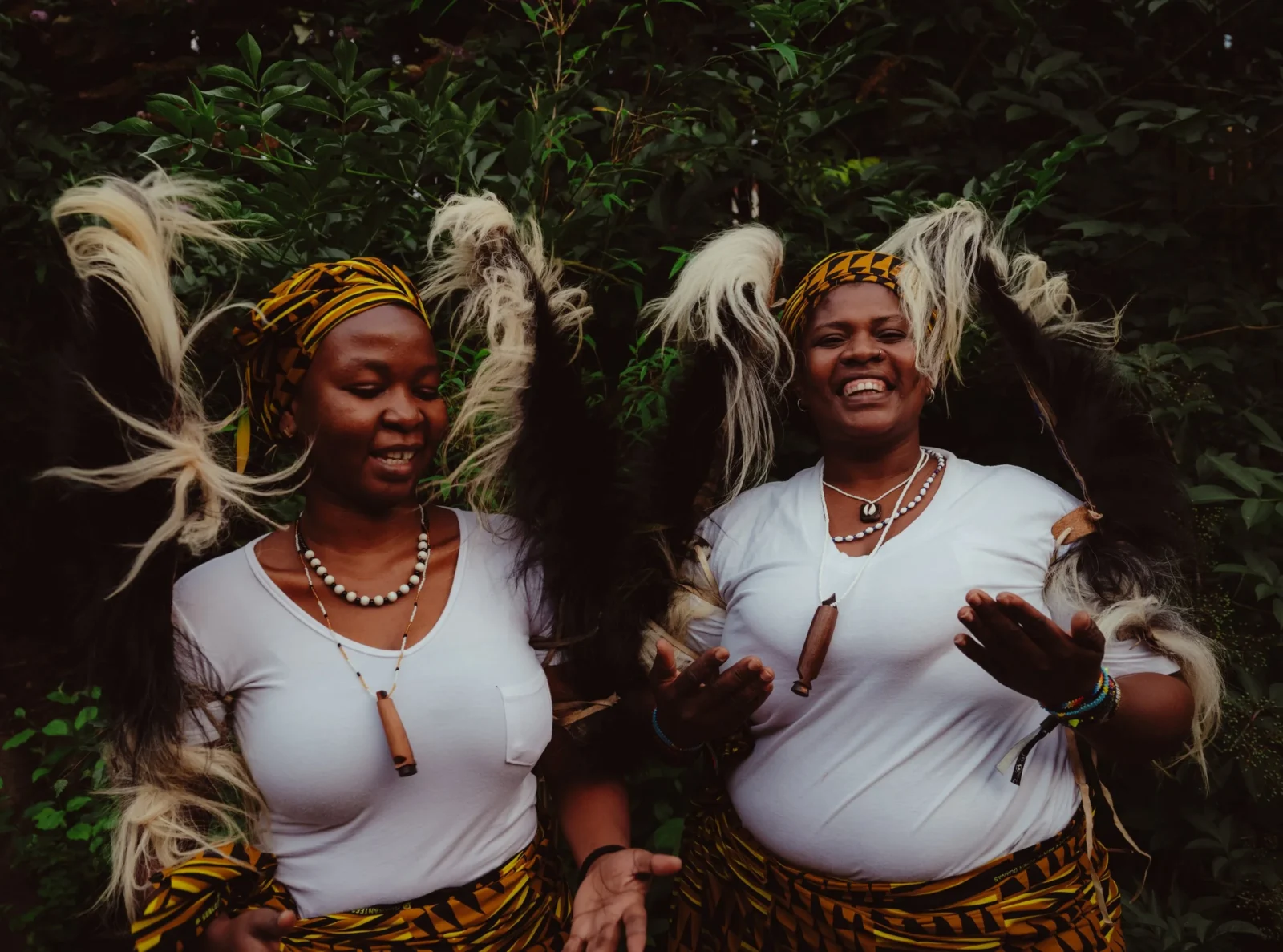
For generations a woman in the Zawose family was allowed one instrument, the muheme, a small drum within the ngoma family played only by women, and one job, harmony under a man’s lead. The ilimba was closed to her. Pendo Zawose joined the troupe of her father, Hukwe Zawose, at fourteen on those terms, one of his seventeen children by seven wives. She plays the ilimba now and sings lead, and this summer she has done it across seven countries with her niece Leah beside her.
The Zawose Queens played two sets in late July at Viljandi Folk Music Festival, Estonia’s largest annual music festival, and between them sat down in a basement room under the Traditional Music Centre. Pendo and Leah play this run as a quartet, Ben Brown on drums and James Kitchman on guitar. Brown has been with them since the live band started.
The run comes to around thirty-five shows, and Leah is playing it pregnant. In Viljandi that meant a craving for ice cream between sets, strong enough that the festival team brought some down to the basement for her. The tour still adds up for both of them: “We feel good, because we get experience and we share the music.”
The festival’s theme for the year was To Each Their Own Instrument, and the Queens brought three: the chizeze fiddle, the ilimba thumb piano and the ngoma drums of the Wagogo people of central Tanzania. All three came down to them from Hukwe, who carried that music well beyond Tanzania. He released three albums on Real World between 1996 and 2002, played WOMAD festivals and, in 2003, supported Peter Gabriel on the North American leg of his Growing Up tour. It was his last trip abroad, and he died in Bagamoyo that December. What the music is for, in the Queens’ words: “the meaning is to bring the theme in your heart and to give someone.”
Writing their own songs came later. In 2019 a British Council-funded project in Dar es Salaam set out to connect Tanzanian and British artists, run by arts manager Aziza Ongala, daughter of the late Remmy Ongala. Its UK producers, Oli Barton-Wood and Tom Excell, ran songwriting and production workshops, and after a set at Sauti za Busara in Zanzibar, Pendo and Leah started writing together. Barton-Wood and Excell produced what came out of it, recording on a hotel rooftop in Zanzibar and on the beach in Bagamoyo, the port town north of Dar es Salaam where the Zawose family settled in the 1970s. The Wamwiduka Band added banjo and percussion, and Leah’s father, a chizeze player known as Baba Leah, joined them on the record.
That record became Maisha, eleven songs released on Real World on 7 June 2024, and it took them to Glastonbury, WOMAD, Lowlands, Le Guess Who, Trans Musicales and WOMEX. Two years on, they still stand by it: “We’re happy with Maisha. It’s a lot of songs about living our life.” The one Pendo most enjoys giving to a crowd is “Sauti Ya Mama”, for the plainest of reasons: “Because I’m a mama.” It was also one of three Maisha songs the band recorded live in the Wood Room at Real World Studios in July 2024, released as Moja Kwa Moja on 31 October 2025.
Those crowds hear the songs in two languages, sometimes inside the same piece: “We mix it. We sing in Swahili and we sing in Chigogo,” the second being the language of the Wagogo, also written Kigogo. The questions come after the show: “When we finish, some people love it and they ask which language we’re singing in.” During the show, the audience is already with them: “When we’re performing, they see you and they just go with you. They want to sing along, but they don’t know how you sing it.”
Getting that across on a different stage every night takes four people, and Brown sees the practical side from behind the kit, where the instruments meet each new venue’s PA: “It creates hurdles for sound people, because they’re often just like, what do we do with this?” He sees the quartet itself in plain terms: “I think it’s maybe proof of what can happen when people from very different places find a way of doing things together.” Kitchman is the newest arrival on guitar, and for the Queens that changes little: “It’s not different. When he comes, he just follows us, and we make it good.”
The next record is already close: “It’s mostly recorded and finished.” The label looks set to stay the same, “it will probably be with Real World again,” and they call it “a cool continuation.” Two of its songs are already in the set. “Wazazi” closed the previous night as the encore: “Wazazi means thank you to our parents, because they taught us so many things. That song is for all parents, Baba and Mama.” “Asante Sana” is Pendo’s own dedication: “Asante Sana is a special song for my dad, who taught me the music.”
Follow The Zawose Queens on their website and Bandcamp
UK dates: Sheffield 13 Nov, Newcastle 14 Nov, London, 100 Club 15 November