

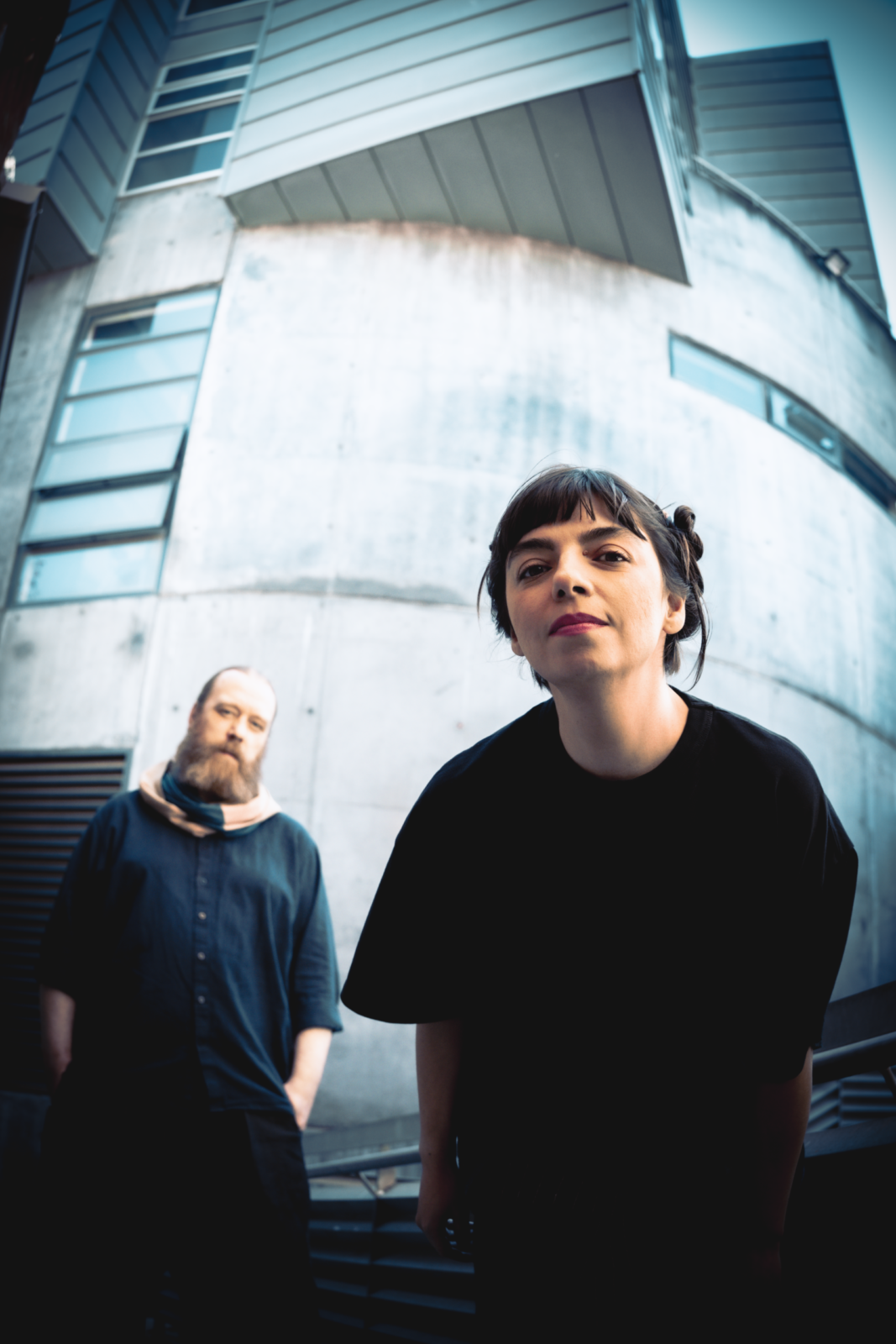
Gelareh Pour and Brian O’Dwyer build each show live, on the spot, from a kamancheh, a voice, and a drum kit. Nine years into the project, that’s made them genuinely hard to predict, even for themselves. Pour grew up in Iran, where the path to a singing career ran through very narrow lanes for a woman; she carried that instrument and that history with her to Australia, where she met O’Dwyer, a drummer with a strong ear for improvisation and a real curiosity about where Persian tradition could go next.
Together they’ve picked up an Art Music Award for Excellence in Experimental Practice in 2024, and travelled to the Banff Centre for Arts and Creativity in Canada to record their third album in a single live pass, each take committed to tape as it happened.
Its title, May The Devil’s Ear Be Deaf, comes from an old Persian phrase spoken after voicing something beautiful, a quiet ritual to protect fragile, precious things from envy.
Vulnerability like that runs through everything ZÖJ do. Nothing is rehearsed, nothing is fixed after the fact, and once a performance is out in the room it belongs to whoever is listening. That’s how we want to start this year’s Musical Road to WOMEX: with two musicians who make something delicate in front of an audience and then hand it over, so that what happens in Las Palmas will exist only for the people in that room.
ZÖJ means “pair”, and your music is a conversation — kamancheh, voice and drums, largely improvised. For a first-time listener, how would you describe what happens between you on stage?
Every ZÖJ performance begins with listening. Before there is sound, there is attention, to each other, to the room, to the audience, to the things that cannot be planned. We don’t approach the stage with a fixed script; we bring our shared musical language and trust. Then we allow the music to reveal itself in the moment.
We don’t think of the kamancheh, voice and drums as accompanying one another, more so they’re in conversation. Sometimes they whisper, sometimes they challenge, sometimes they leave space for silence to speak. Our approach to and use of improvisation allows us to be completely present, and that presence becomes something we share with everyone in the room. The audience isn’t only watching the performance; they’re part of shaping its energy. No two concerts are ever the same because no gathering of people is ever the same.
Gelareh, you grew up as a girl in Iran where a professional life in music wasn’t an option, and you’ve since made it your whole world across two countries. What in that journey most shapes ZÖJ’s sound?
Growing up in Iran, I was surrounded by music. I attended concerts, listened deeply, and was inspired by extraordinary musicians. But as a girl, I also understood from an early age that there were limits on what a musical future could look like for me. Singing publicly as a woman wasn’t a path that was open to me, and that awareness shaped the way I related to music as something precious that had to be protected and pursued with determination.
Migrating to Australia gave me the freedom to explore music without those constraints, while carrying with me everything I had learned in Iran. Rather than leaving one world behind for another, ZÖJ lives in the conversation between them. My Iranian heritage, my research into women’s voices in diaspora, and Brian’s openness as an improviser come together in a space where memory meets discovery.
I think that’s what most defines our sound: it’s not about choosing between cultures or traditions, but allowing them to meet with honesty, curiosity and deep listening.
The Canary Islands are their own crossing of worlds: a Berber Indigenous root, Spanish layers on top, and deep ties to Latin America through centuries of migration. As a duo whose music is about belonging to more than one place, what can that kind of mixed identity mean at this particular moment in history?
Mixed identities aren’t exceptions; they’re one of the defining experiences of our time.
Most of us carry multiple histories, languages and homes within us. Those intersections aren’t something fragmented, they’re places of creativity and possibility. Music has always travelled more freely than borders allow, and it reminds us that cultures have always been shaped through exchange.
The Canary Islands feel like a place where many currents meet. That makes it an especially meaningful setting for WOMEX, because the festival itself celebrates dialogue rather than division. At a time when the world often asks us to choose one identity over another, we’re interested in making music that embraces complexity and connection.
Your music is improvisation-based: no two ZÖJ concerts alike, with the audience as a third point of the triangle. In a WOMEX programme full of traditions, what makes that approach distinctly yours, and what do you hope people take from it?
We’re deeply rooted in tradition, but we don’t treat tradition as something fixed. The Persian musical language I draw from has always had improvisation at its heart, and we bring that into conversation with contemporary expression, original compositions, and the unique dynamic conversation we’ve developed as a duo.
What makes ZÖJ distinctive is that improvisation isn’t a section of the performance, it is the performance. We don’t begin with the intention of reproducing a recording or presenting a definitive version of a piece. We trust the relationship between us, the atmosphere of the room, and the presence of the audience to shape where the music goes. We are creating in real-time, not reciting a learned repertoire.
We hope people leave feeling that music can be a living conversation rather than a finished product. If our performance encourages someone to listen more openly, to sound, to silence, to each other, or to their own inner world, then we’ve achieved something meaningful.
WOMEX always sparks unexpected meetings. Are there particular artists or showcases you’re looking forward to in Las Palmas?
One of the things we love most about festivals is discovering artists we didn’t know we needed to hear. Some of the most memorable musical encounters happen completely by chance.
We’re especially looking forward to seeing Nana Benz Du Togo again. We first saw them at WOMADelaide in Australia, and we were so captivated that, while we were standing there watching their set, we bought their record online before the concert had even finished.
More broadly, we’re excited by artists who are deeply grounded in their own traditions while remaining open to dialogue and exchange. WOMEX has a remarkable way of bringing those people together, and we’re looking forward as much to the conversations between showcases as the performances themselves.
6Your work asks for deep, patient listening and treats the audience as a collaborator. How does a room of delegates — and an unfamiliar space — shape a ZÖJ set?
An unfamiliar space sharpens our listening.
We don’t try to make every venue feel the same. We’d rather allow the room to become part of the instrument. The acoustics, the atmosphere, the attention of the audience, all of these influence the music.
A room full of delegates can be wonderfully energising because everyone arrives carrying different musical histories. Our hope is that, for a little while, those different backgrounds dissolve into a shared experience of listening. That’s where real connection begins.
You’ve spoken about nature feeding directly into your music, the moon, the horizon, the wind in the leaves. What’s your relationship to place and landscape in what you write, and is there anything about a volcanic Atlantic island like Gran Canaria you’re hoping to take in while you’re there?
Nature reminds us how to listen. The rhythms of wind, tides, birds, light and silence have always been big influences. We don’t try to imitate nature, but we do try to remember that we’re part of it.
We’re looking forward to walking Gran Canaria’s coastline, watching the Atlantic horizon, and spending time with the landscape.
Gelareh, your research and your art both centre Iranian women’s voices in diaspora. Is there a message you feel especially compelled to carry through this showcase, at this moment?
My work has always been about making space for voices that have too often been unheard.
Iranian women have shown extraordinary courage, resilience and creativity, both inside Iran and across the diaspora. Rather than speaking for them, I hope our music creates space where their strength, complexity and humanity can be felt.
At a time when many people are displaced by conflict, oppression or circumstance, I hope this showcase reminds us that every migration carries stories, knowledge and beauty, not only pain. Listening deeply to those stories is an act of solidarity.
Beyond WOMEX, now that May The Devil’s Ear Be Deaf is out, what’s next for the duo? New writing, touring, collaborations, a direction you haven’t tried yet?
We’re excited to let May The Devil’s Ear Be Deaf continue finding its audience through touring and live performance, because that’s where the music keeps evolving.
Alongside that, we are always recording new material that continues to explore improvisation, storytelling and the meeting of musical traditions. We’re always open to collaborations with artists from different cultural and artistic backgrounds, particularly where there’s genuine curiosity in communication.
If you could write a personal invitation to the people of Las Palmas to come and discover your showcase, what would it say?
Dear friends,
We would love to meet you through music.
If you come to our concert, you won’t hear a performance that has been repeated many times before. You’ll hear something that exists only in that room, on that evening, created together with everyone present.
Bring your curiosity. Bring your imagination. Bring your silence as well as your applause.
Let’s discover what becomes possible when we truly listen to one another.
See you in Las Palmas.
What ZÖJ play on 24 October won't exist before that hour and won't exist again after it.
Their showcase runs 13:00 to 14:00 at the Daycase Stage (Sala Gabriel Rodó)
part of the Official Showcase Selection at WOMEX 2026 in Las Palmas de Gran Canaria.
PLAYLIST: ZÖJ X RHYTHM PASSPORT
You can find all the previous episodes of Musical Road to Womex HERE