

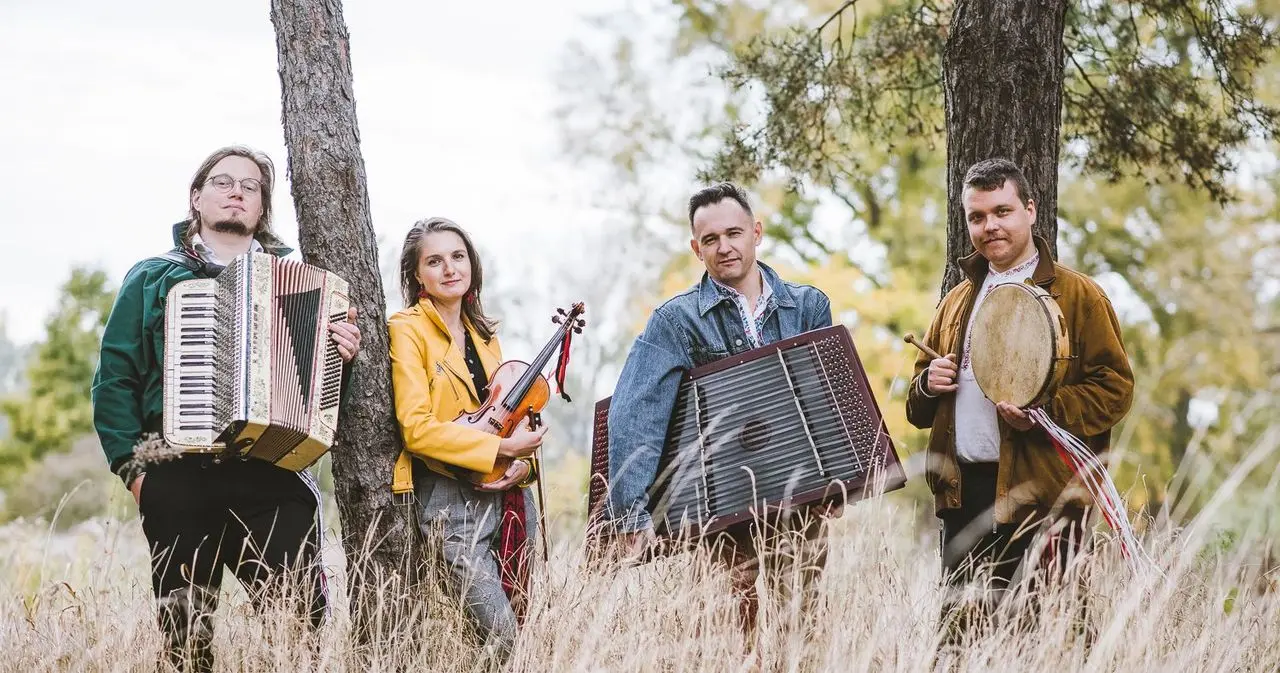
The polkas of Podlasie come with a warning from the people who play them: “dance to these the way you would to modern dance music and you would die”. Close to midnight on a Friday at Von Krahl, on the Viljandi Folk Music Festival stage of Tallinn Music Week, a sold-out room took the risk. Hajda Banda had the slot directly after local heroes SADU, who swept Album, Band and Debut Album of the Year at this year’s Estonian Music Awards, and the Polish-Belarusian quartet were playing the country for the first time. Smoke, stage lights and a full sound crew are a luxury village dance bands seldom get. They filled them with a violin, a three-row harmonia, a cymbały and a frame drum, and the full house SADU left behind stayed where it was and danced.
What the room heard was polkas, obereks and waltzes from both sides of the Białowieża Forest: the dance music of Podlasie in eastern Poland, of western Belarus and of the Polesye wetlands where Poland, Belarus and Ukraine meet. The next morning, hours before the flight home, Daria Butskaya, the violinist who founded the group, harmonia player Kuba Zimończyk and Paweł Iwan, on cymbały, sat down to talk while frame drummer Mateusz Dobrowolski was at the festival conference doing what they call “the marketing stuff”.
Iwan, the man who warned of the perils of dancing a polka, began with the people who had braved it. “The audience was very energetic. They were listening very carefully and they were dancing as well.” Then he got to the stage they had played on. “A very professional stage and sound engineers, and all the smoke and lights. That’s something we don’t find very often at traditional music, ethno-folk concerts.”
What they hear has been chosen with care, and Iwan sets out the principle. “We always try to present the most characteristic features of that tradition, of that music. First of all, we play on the traditional instruments from that region.” He goes through them: the violin in the lead, the three-row harmonia, “a very old type, not played too often anymore”, then the frame drum and the cymbały, the hammered dulcimer, both seldom heard elsewhere and both, in his words, “very typical to that region”. The songs come from the same villages, and at some concerts so do the steps. “We organise workshops of the dance, how to dance to this. We try to really present everything this tradition has to offer.”
All of it began in autumn 2021 as Butskaya’s project, and it began with a grant. “In Poland you had a good opportunity to create your own project and to receive money for it. It was called Gaude Polonia, and I was looking for pieces, music from between the borders of Belarus and Poland. And then the idea was to create a band that would perform these pieces.” Gaude Polonia is a scholarship for young artists from Central and Eastern Europe. Zimończyk, Iwan and Dobrowolski were the players who joined her. “I didn’t expect there would be, you know, so much material.” That material has filled two albums so far, Hajda!, released on Karrot Kommando in February 2023, and Niepraudzivaya, on the same label in March 2025.
The decision to look between the two countries came from Butskaya’s own life. “I’m from Belarus, but Poland is like a second home to me. That’s why I wanted to find the elements the two cultures share. The regions along the borders are so interesting because the cultures mixed there. I find that amazing.” The mixing carries on to the south, in Polesye. “Some of the songs we perform are sung in both Belarus and Ukraine, because Polesye is one region. It’s the same on both sides.”
Collecting songs is harder on the Belarusian side, where Butskaya and the band work at a distance. “It’s hard to find this kind of music. We can’t travel to Belarus, so we only have archives and the songs our friends there share with us.” On the Polish side they can still go and meet players in person, and Iwan points to the Belarusian minority near the border as an early source. “We have friends in the Belarusian minority who live near the border on the Polish side. They were our first source of inspiration and material, or at least part of it.”
That closed border belongs to a politics the three would sooner leave alone. “It’s better to take the next question,” one of them says. “It’s tough.” Zimończyk does describe how the war has reached Polish stages. “Because of the war, some cities in Poland don’t want to have anything to do with anything which sounds at least a bit like Russian. Even if it’s not Russian, they don’t want to have anything to do with the East. So they don’t invite Ukrainians, Belarusians, Russians especially, and everything which they think is too much Russian.” People in Podlasie meet the same reflex, he adds, because their dialect “sounds a little bit like an Eastern language, not like Russian, but for the common Poles it sounds like Russian”. The sentence after that trails off, and the subject closes. “We don’t want to talk about it too much.”
Back on the music itself, the band’s members come from different regions, so the work starts apart, with listening, and comes together afterwards. “We start by listening to a lot of music. Then we meet and try to make our own version of it. We don’t copy the music; that was the main task at the beginning.” Their own version still has to sit inside the tradition, which Butskaya calls “something alive”. What the band hold on to is the way a tune was played, and Zimończyk links how much that varies in Podlasie to sheet music. “Instrumental music in Podlasie was heavily influenced by the sheet music coming from the cities, the books of notes.” Some of those printed tunes were 19th-century compositions, and others dated from the 1940s to the 1970s. “Sometimes the musicians in the village couldn’t read the music, so somebody would play it once on the piano and they would try to remember as much as they could. It always changed a lot. So in Podlasie you can find the same composed polka played totally differently by five musicians, who mix it all together. Their interpretation of this music is the most interesting thing. We try to preserve that original way of playing.”
Preserving that original way of playing depends on people who still remember it, and Zimończyk found them first in another region. “When I was starting, I played traditional music from Mazovia, from the Radom region, where more people than in Podlasie remember this music. At first I got a lot of critique, but I played hard and long, so they came round all at once, and later they said it was really good now. It was a really positive critique, and it gave me a lot of information about the music.” In Podlasie fewer of them are left to ask, because the instrumental music there died out sooner. “Radio and television arrived in Podlasie pretty early. In the 50s they were already forming bands with percussion and saxophones, and with guitars more in the 60s and 70s.” Those bands played biesiada, the wedding repertoire of songs every guest knows. “This music dominated the wedding scene in Podlasie, and then very quickly the keyboards came and it was disco polo. Podlasie is now the capital of disco polo in Poland.”
The same turn away from village music happened across the country, and Zimończyk saw it in his own family. “Western culture in Poland wasn’t only active from the 90s. It was earlier. My parents did everything to get it, recordings from the black market and so on.” Under communism, the folk music the government promoted was the work of the Zespoły Pieśni i Tańca, the song and dance ensembles, of which Mazowsze and Śląsk are the names most Poles still know. “It was a mix in the Russian style, a mix of ballet and traditional dances. So it was totally an invention, not true. Everything in it, from the dances to the music, was invented, and it lost the most important aspects of traditional music.” Hungary’s equivalents, by his account, stayed “closer to the sources than in Poland”.
In Poland the source versions live on around Dom Tańca, the dance house Zimończyk compares to the Hungarian táncház, and a few smaller ones in other cities. It is a small scene, and he puts a number on it. “I think the young people in Poland who dance and are interested in traditional music number no more than 5,000 in the whole country. Really, we can see it in the dances.” A hundred people at a concert, by his reckoning, is a great success, and he sees where that has to change. “I think it’s mostly about education and promoting it. If people don’t even know it exists and only think about Mazowsze and the like, why should they come?”
For Iwan the cause is exposure: a generation raised on Western culture has seen little of its own. “Polish people are forgetting their own traditional music and the tradition itself.” Even the curious then meet a practical barrier. “Dancing to this music isn’t simple. It’s very fast, so you need to know the steps, more or less, and how to behave, how to really dance, at least the basics. If you try to dance to it the way you would to modern music, you would die. You can’t dance that fast without some technique. People don’t know that, and if you don’t know, you just stand there not knowing what to do. That’s sad. But I hope it’s changing, and we are fighting for it.”
Anyone who wants to hear more of that fight has a short list to start from. Warsaw Village Band come first, with the caveat that they sit far from the source, closer to world music. Kapela Brodów come second, the band Iwan says they were “raised by”. “We call it traditional rock and roll, you could say. It’s very good technically, with a lot of energy, and you can feel the dancing spirit in it. But it’s still played very traditionally.” From the younger generation, who are “above 40 now”, Zimończyk adds Janusz Prusinowski Kompania, Tęgie Chłopy and WoWaKin, and he is sharp about the many groups who claim the tradition from a distance. “In Poland we have lots of bands who say they play traditional music, and they don’t. They say they take inspiration from traditional Polish music, but they don’t know anything about it. With Polish traditional music, if you haven’t played it at least once in the source version, it’s really hard to understand.” Plenty of new bands, he says, still “sound like they were made in the nineties”.
Hajda Banda’s own take on the tradition is on Niepraudzivaya, an album built around a wedding. The title means “false” and comes from the opening song, “Niepraudzivaya Kalina”. The record closes on another wedding song, “Kalino Malino”, and in between, in Iwan’s words, “you’ll find all the dances as well, dances from the region that people still dance today, interpreted by us but close to the traditional original.” Butskaya describes the opening song. “It’s a wedding song, and it’s difficult to explain. A woman says she won’t get married because she doesn’t love the man, and then something changes and she decides to marry him. We don’t know, maybe it’s about a difficult relationship between her family and his. Sometimes it’s not only the woman who decides what she should do.”
Family trouble returns in “Czumak”, sung a cappella and named after the chumaks, the salt traders. The men are less sure of this one. “I forget what it’s about, because I’m not the one singing it,” Zimończyk admits, before Butskaya takes over. “He’s rich, he just came back with a lot of money, and his mother told him he shouldn’t drink so much or he’ll sell his horse. And he said, oh, it’s okay, it’s okay.” The mother then tells him to leave his girlfriend. “So again, it’s about how a mother goes about educating her son, an adult son at that. It’s a funny story, I think.” Drink and difficult family relations recur across the album’s texts. “It’s old music, but it’s really interesting to find new meaning in these lyrics and see how similar they are to our own lives.” In April a third album was in the works.
The next record is already under way. In April a third album was in the works, with studio time planned for September, and Butskaya called the work so far “a long process”. Before then, their summer calendar is built around two festivals. Ethno Port in Poznań held its 19th edition this year with artists from Finland, Spain, South Africa, Georgia, Iran and Senegal. Globaltica in Gdynia surrounds its concerts with workshops, film screenings and talks. The band call them “the two most important ones”. Beyond those, the calendar shrank to “local projects, or something like the celebration of the potato”. Abroad again, there are two dates in the UK, still “early news” in April and since taken shape: Hall Two at Kings Place in London on 8 October, a mixed seated and standing evening in the Songlines Encounters series where the audience is encouraged to dance, and the next night the National Centre for Early Music, at St Margaret’s Church in York.
Wherever they play, Iwan’s reference point is the village musicians the tunes came from. “They were very happy when they got together and played music. They played what they heard on the radio and treated it as their own music. What mattered was just to play, to meet and have fun, have drinks, meet nice girls. That’s what was always important in that music.” For Butskaya, the listeners who count most are the oldest ones in Podlasie. “Sometimes we get feedback from old people in Podlasie who say they remember the song from their youngest years. For us that’s one of the happiest moments, because it’s the point of our work, actually.”
Hajda Banda play Kings Place, London, on 8/10 and the National Centre for Early Music, York, on 9/10
Niepraudzivaya, their latest album, is out on Karrot Kommando.