

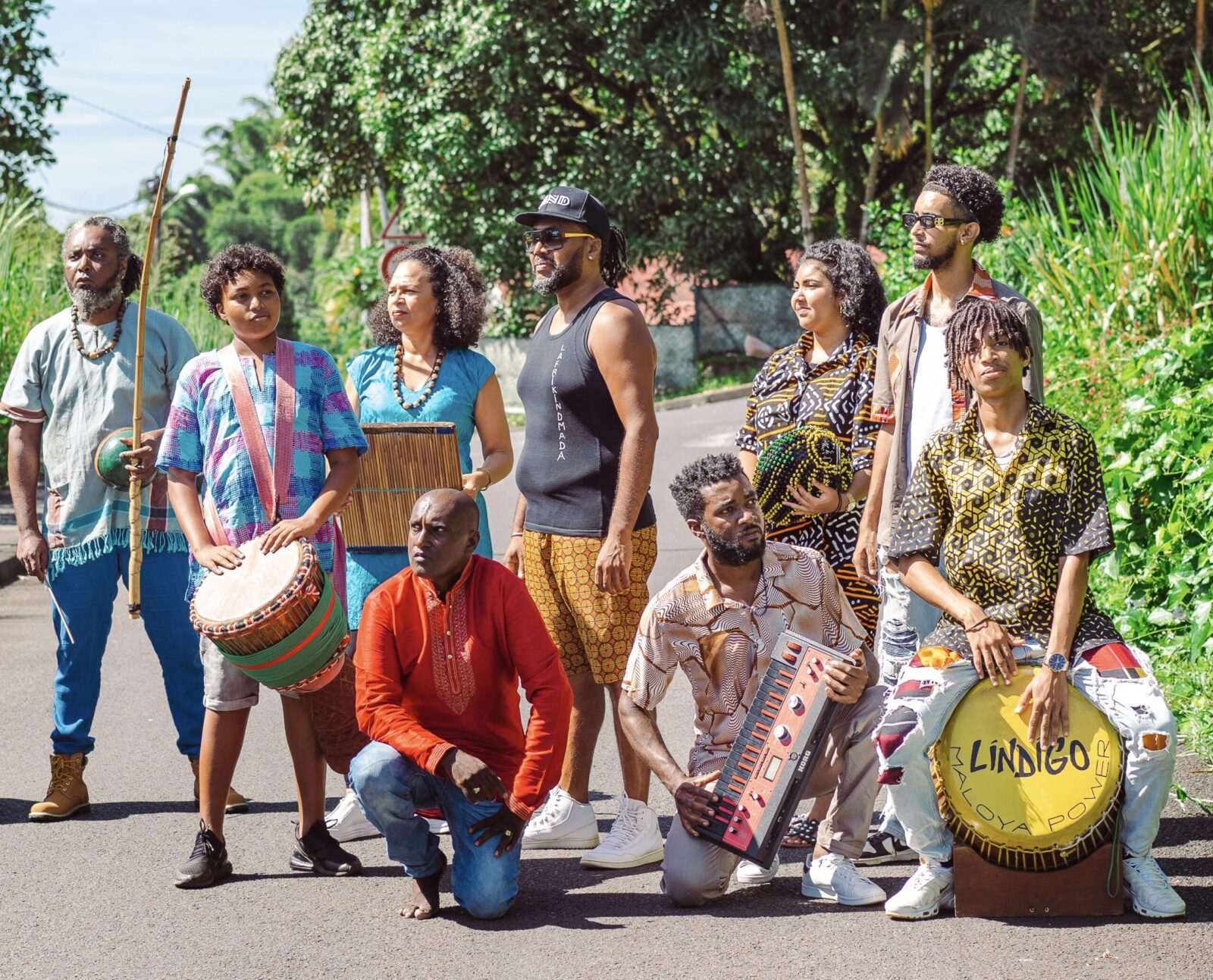
Olivier Araste does not travel light. Moving an eight-piece maloya ensemble from Réunion to the French mainland is its own logistical project, but that is the smaller freight. The larger one is what he has picked up along the way, country by country, and brought back into the music. “When I went to Cuba, I brought the conga into my maloya. When I went to Africa, I brought the djembe and the balafon into my maloya. When I went to Paris, I met Fixi, and I brought the synths, the keys into the maloya.” The base, he is careful to say, does not move. “In my kitchen, it is the cuisine of the world, but the base stays there.”
We are backstage at Babel Music XP in Marseille, a few hours before Lindigo take the stage. His son sits beside him. He translates from French into English and back with the ease of someone who has done it many times before. Araste answers in short, considered bursts. Soundchecks bleed through the walls of the corridor outside, but here it is quiet enough. When something amuses him, such as a question he finds too simple or an idea he wants to bat back, he laughs first and answers second.
Maloya is the music of Réunion, rooted in the songs and rituals of enslaved Africans and Malagasy people brought to the island to work the sugar cane. Its core instruments are the kayamb, a flat rattle filled with seeds, the roulér, a barrel drum played by hand, and the piker, a struck bamboo tube, together with the voice and call and response choruses. For much of the twentieth century the music was politically suppressed, pushed out of public life and into the yards of plantation workers. It was only through campaigning from the 1970s onwards, led by singers and associations on the island, that maloya began to move back into the open. Some groups were banned into the 1980s. In 2009, UNESCO inscribed maloya on its Representative List of the Intangible Cultural Heritage of Humanity.
Araste grew up inside it. He comes from Paniandy, a quarter of Bras-Panon on the east coast of Réunion, and the family line reaches back to Madagascar. His great-grandfather travelled from Fort-Dauphin, in the south of Madagascar, to work for landowners on the island. His grandfather was born on the boat crossing. By the time Araste arrived, the house was already saturated with the music. His grandfather was a chef tambouyé, the lead musician in Malbar ritual ceremonies, and his father carried that role forward.
He started playing at eight, first with his brother’s group and later alongside the elders. He founded Lindigo in 1999 with his brother Aldo Araste, who still plays in the band today on piker and balafon. Their first album, Misaotra Mama, appeared in 2004 with songs in Malagasy and Réunion Creole. In the twenty-six years since, Lindigo have become the most popular maloya group on the island while steadily widening the geography of their sound.
When the question of style comes up he answers it with a question of his own. “Which maloya? What is the difference between maloya and maloya? Maloya has a drum roller, a kayam and a voice. I have a drum roller, a kayam and a voice with two instruments.” Then: “It is a new style of maloya.” That newness comes from accumulation. Every encounter that mattered left an instrument or a rhythm behind, and those are what now surround the singing, though they never replace it. Cuba. West Africa. Paris. The singing itself remains maloya singing.
Asked whether he feels like a torchbearer and ambassador for maloya and for Réunion, he does not deflect, and he does not make it about himself either. “Thanks to the new generation, we cannot reject the youth. We live with the youth, we live with the elders, and we find the right environment. Lindigo is the right environment between the youth and the elders.” He names the other carriers of the tradition with respect, Danyèl Waro, Christine Salem, and a younger wave coming up behind. “There are other groups in Réunion who are coming. The new generation is coming. They are trying to export themselves. I encourage the young people to export themselves too. I bring producers, managers. I try to help maloya.”
On the island, young listeners are now the strongest audience the music has, by his account. “Young people play maloya more than others.” Seventeen, eighteen, and nineteen year olds are inside the form. Many of them also listen to rap, he says, but maloya is stronger.
The cost of staying with the music he states flatly. “Maloya is about commitment. If you do not commit, you cannot stay in there and make a career like us. I am committed, but I commit my family too. If we fall, we fall together. Stand up, together. Down, together. All together.”
That commitment has built something on Réunion that Araste describes simply. “We have a strong audience in Réunion. We are a lot on the radio, on the media, on social media. When we play live, it is full stadiums. The public recognises Lindigo in the heart. We have a public of love. Love, love, love.”
The band number eight. Araste calls them a family, and the word is not decorative: his son is translating today, and Aldo, his brother, has been in the line-up since it began. “It is easier in a family context. It is not like, hello, how are you? We are here together. That is the force.”
On stage everything opens out. “In the studio, there is the spirit of the studio too. It is magical also. But live, it is freedom. Because live, there is no five minutes, four minutes. Thirty minutes on one song. Live, it is the public, the connection, us, Lindigo, the ancestor, the spirit, Babel. It is the connection.” The set moves with the room. “Live, it is planned to be seven songs. Sometimes it is four. Four, and it is finished. The public is the maestro. The public is the boss.”
Their most recent album, Oyé Maloya, came out via HELICO in May 2024. Twelve tracks, with Los Muñequitos de Matanzas on the opener and Fixi on a later cut. Fixi goes back further: he produced Maloya Power in 2011 and appeared on Kosa Néna in 2019.
Before the next album there is a double vinyl coming with the French producer Guts, who made their previous vinyl. One of its tracks is a song Lindigo wrote twenty years ago, never before pressed. The album itself is being road-tested in rehearsal and on tour. “We are preparing the album. Maybe for the end of the year, maybe for next year. When it is hot, we will serve it hot. It is not a cold dish. It is a hot dish.”
“Lindigo is a tisane,” he says, and he means it literally: indigo is a medicinal plant on Réunion that eases aches, stimulates appetite, and cures a hangover, and the concert works the same way. “When you dance at a Lindigo concert, when you come out of a Lindigo concert, it cleans you. After, there are no more problems. You forget. You have to dance. It is maloya. You have to dance, you have to sing, you have to live. You cannot just stand there and watch. You have to dance, you have to live it. After that, it does you good.”
You can find Lindigo on Spotify, Apple Music, and Bandcamp,
and follow them at @lindigo.officiel on Instagram and Facebook for live dates and the album,
whenever it is hot enough to serve.