

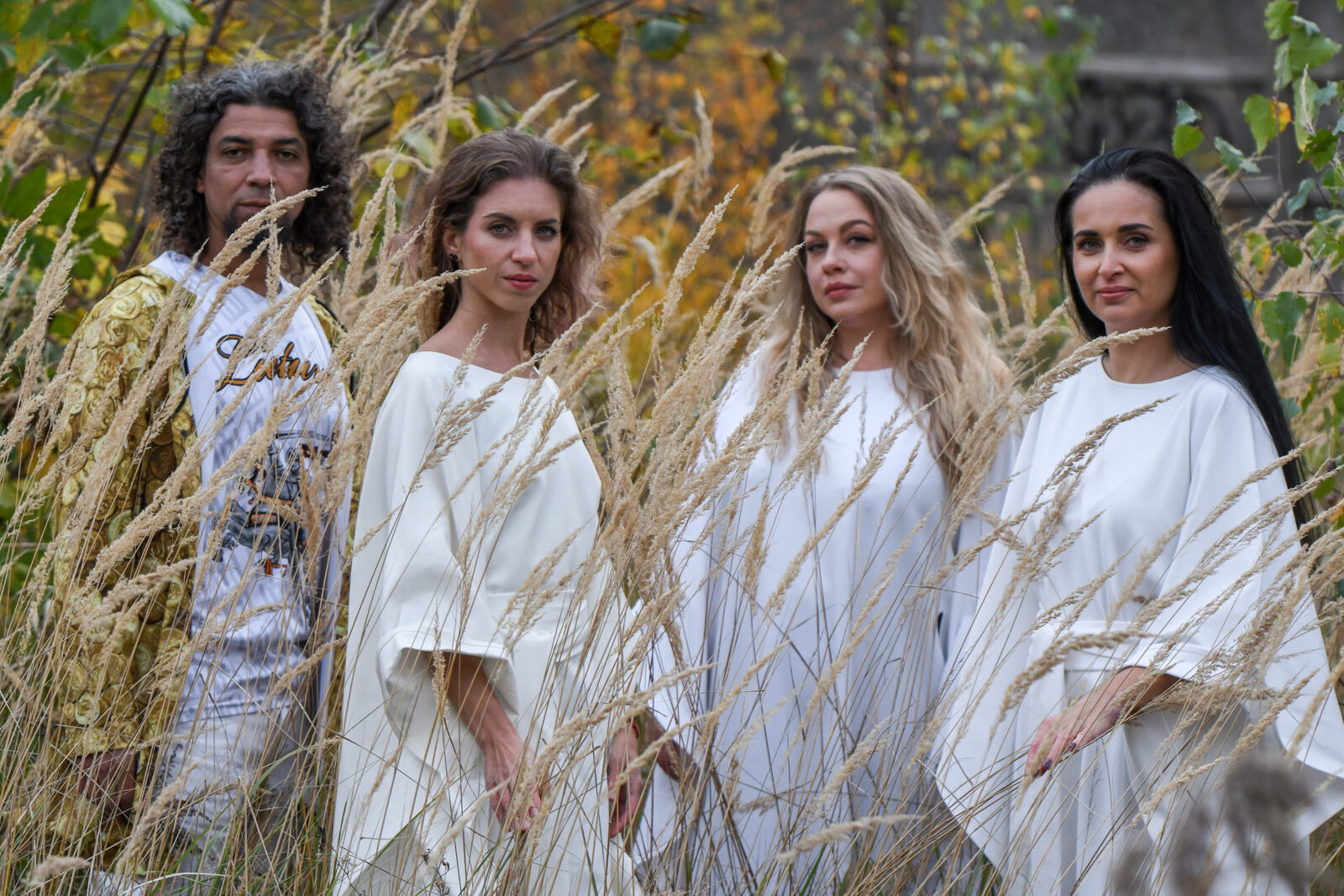
With WOMEX opening in just two days in Tampere, our Musical Road to WOMEX 2025 closes in both time and distance, reaching the Baltics and Lithuania. Here we meet Sutartronica, a project taking sutartinės — Lithuania’s polyphonic chants once sung by women in fields and rituals — and reworking them through live electronics. Voices loop, overlap, and collide with synths and beats, keeping the original phrasing and rhythm intact while pushing them into new sonic space.
Led by producer Victor Diawara and singer-researcher Laurita Peleniūtė, joined by Viltė Ambrazaitytė and Eglė Jačauskienė, the group rebuilds sutartinės as polyphonic structures that can stretch across genre and generation. Each performance keeps the original pronunciation, rhythmic overlap, and call-and-response form intact, while Diawara’s production folds them into a sound that can sit between folklore archive and warehouse set.
Following appearances at Tallinn Music Week and Le Printemps de Bourges, Sutartronica now arrive at WOMEX, closing the Northern Connections Stage on Saturday 25 October. In our Q&A, they talk about how their music grows from Laurita’s field-collected sutartinės, the parallels they find between Baltic and Nordic vocal traditions, and why they see sutartinės as a living language of rhythm. They also compiled a playlist for this episode, tracing the sounds currently resonating through their world.
How would you introduce Sutartronica to someone hearing it for the first time? How do you connect the ancient sutartinės singing tradition with forward-looking electronic production in your music?
The essence of Sutartronica is rooted in sutartinės — ancient Lithuanian polyphonic songs that are part of UNESCO’s Intangible Cultural Heritage. We blend them with electronic music to make this tradition feel alive and relevant today. The idea is to present this incredible part of Lithuania’s culture to younger listeners who might not normally connect with folk or traditional music, and to share it with people outside Lithuania who most likely have never heard it before.
Laurita sings the sutartinės in their authentic form — with the same pronunciation, rhythm, and structure as they were originally sung. I build the electronic arrangements around that core, following the natural tempo, mood, and energy of each song. The electronics are there to complement, not replace, the voice. It’s really about finding that balance between something very old and something completely new.
Sutartronica brings together musicians from different creative paths. How do you work together as a group — writing, rehearsing, or performing — to shape the sound collectively?
Laurita and I have known each other for quite a while. We first worked together back in 2013 in a project called Malituanie with the Malian musician Baba Sissoko. That experience was a big turning point, it mixed Lithuanian sutartinės and Malian traditional music, and it was all based on improvisation. No rehearsals, no plans — everything happened naturally in the studio. That approach stayed with me.
For Sutartronica, Laurita usually chooses which sutartinės we’ll work on — she has deep knowledge of the tradition. I record her vocals and then create the electronic layers around them. The tempo and feeling of the original piece guide the whole process.
For the new album, we’ve expanded the vocal side, Laurita is joined by Eglė Jačauskienė and Viltė Ambrazaitytė, which brings the real multi-voice texture of sutartinės to life. For live shows, every member adds their own energy and interpretation, so the performances always feel fresh and a bit different each time.
WOMEX lands this year in Tampere, a city known for turning factories into culture and having more saunas than anyone could ever visit in a week. What are you most curious to discover about the city, and how do you imagine your music connecting with audiences there?
It feels very fitting to present Sutartronica in the North. Lithuania and Finland share a lot — nature, forests, lakes, sauna culture, and strong folk song traditions. Both sutartinės and Finnish runolaulu have this polyphonic, cyclical quality that’s deeply connected to ritual and nature. I think that shared sensibility will make it easy for people to connect with what we do.
I’ve never been to Finland before, so I’m really excited to finally experience Tampere, the architecture, the atmosphere, and of course the people and music scene. I’ve heard a lot about WOMEX over the years, so being there both as a performer and part of that global community is something special.
With so many traditions and genres represented at WOMEX, what makes your music distinctive within this global context, and what do you hope people hearing you there take away from it?
Sutartinės are truly unique. There’s nothing else quite like them. They’re hypnotic, meditative, and powerful. Hearing them is one thing, but singing them in a circle is a whole other experience – it’s communal and almost trance-like.
We hope people at WOMEX will not only hear something new but feel that connection between ancient voices and contemporary sound, between Lithuania’s past and a shared global present. Sutartronica fits both on festival stages and in intimate spaces, so whatever the setting, we’ll make it immersive.
WOMEX sparks new encounters and collaborations every year. Are there artists, showcases or styles at WOMEX 2025 you’re particularly curious to see or connect with?
There are quite a few actually. I’ve been following AySay from Denmark for some time. I also want to see Yegor Zabelov from Belarus, and artists from Africa like Kankou Kouyaté et Les Étoiles de Garaná and Noura Mint Seymali from Mauritania. And of course, I’m excited to catch some of our Baltic colleagues OOPUS, Kass-Talsi-Minn, and The Baltic Sisters. The lineup is strong this year, and I love discovering how other artists reinterpret their own traditions.
Tampere is known for the closeness between stage and audience. How does that intimacy shape your performance, especially when balancing vocal polyphony, electronics, improvisation and ritual energy?
Balancing live electronics with polyphonic voices can be tricky, but it also creates space for dynamics and tension. We’ve played in all kinds of settings, clubs, festivals, and very small spaces, so we’re comfortable adapting.
At WOMEX we’ll be closing the Northern Connection Stage on Saturday night, so we’ll bring a more energetic set. We want to leave people on a high — something deep and spiritual but also physical and danceable.
Tampere sits between two lakes, cut through by rapids and surrounded by dense forests. Do surroundings like these influence how you experience a place, and do they leave a trace in how you connect with your music?
Absolutely. Nature plays a big role in what we do — not just visually but energetically. The repetition and cycles in sutartinės are directly connected to the rhythms of nature, seasons, work, rituals. I hope we’ll have time to explore Tampere’s surroundings a bit and maybe even film some sutartinės performances outdoors. It would feel natural to do that in a landscape that resonates so closely with our own.
WOMEX often features artists whose work carries cultural and social depth. For you, how does presenting sutartinės-rooted music internationally connect with conversations around heritage, identity and cultural sustainability?
The whole idea of Sutartronica is to keep this heritage alive — not in a museum, but in the present moment. Everyone in the group has been involved with Lithuanian folk traditions since childhood, and it feels meaningful to carry that forward in a way that connects with new audiences.
This year we’ve already played Tallinn Music Week, Le Printemps de Bourges, and soon we’ll perform at PIN Conference and Mundial Montréal. Each time we see that people are genuinely curious about sutartinės. It shows that even very local traditions can speak to global audiences when you find the right language for them, in our case, electronic sound.
Looking ahead beyond WOMEX, what’s next for Sutartronica? Any upcoming recordings, collaborations, or projects you can share?
We’re finishing our second album, which should be out in the second half of 2026. There’s also a residency planned in France early next year where we’ll collaborate with a local world music band and that track might become part of the album.
Our booking agent Juliana Volož (JV-Promotion) is working on festival and club dates for 2026, and we’ll also re-release our first album under the name Sutartronica to make everything consistent. The new record will go deeper into vocal textures and more live instrumentation — still electronic, but warmer and more organic.
If you were to write a short personal invitation to WOMEX attendees and people in Tampere to come to your set, what would it say?
Come experience the ancient and the new: sutartinės, Lithuania’s UNESCO-listed polyphonic songs, reimagined through live electronics. Join us on Saturday night at 00:45 on the Northern Connection Stage and feel how Baltic voices meet modern sound.
PLAYLIST: SUTARTRONICA X RHYTHM PASSPORT
You can find all the previous episodes of Musical Road to Womex HERE