

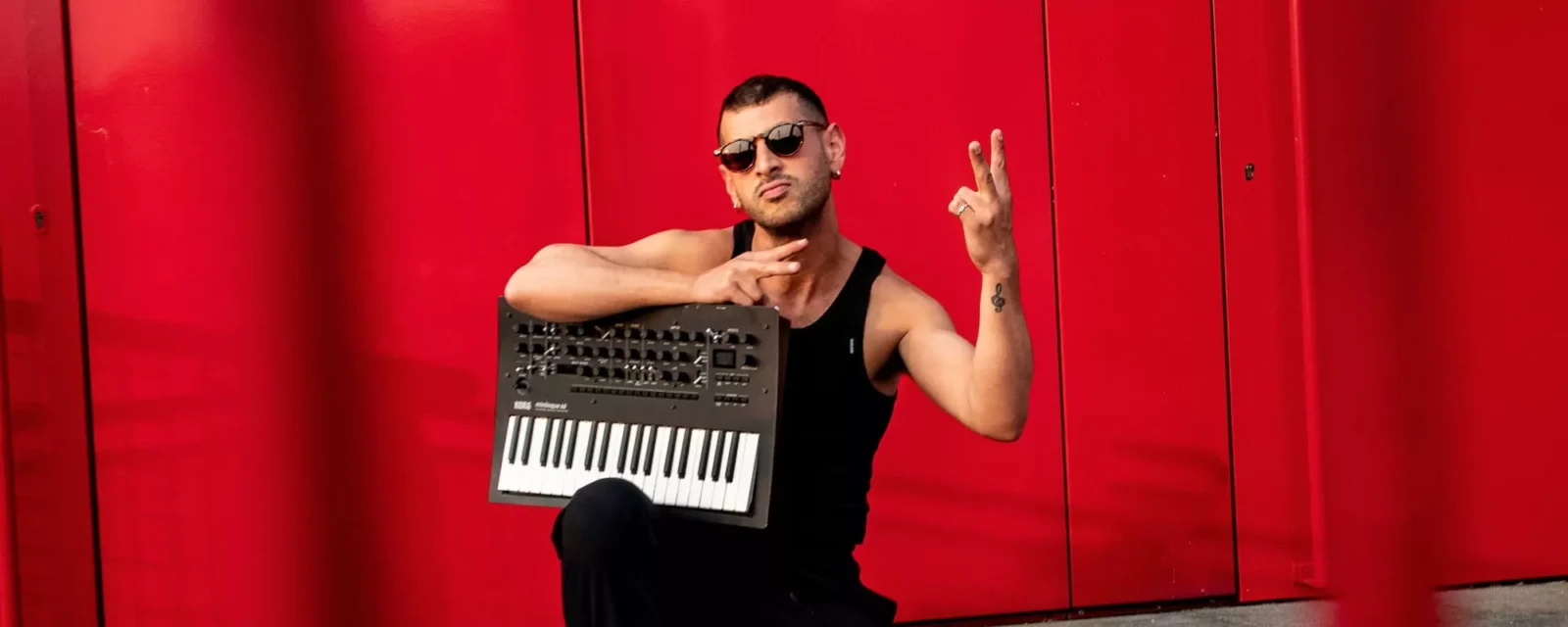
Six years into Zenobia, Isam Elias needed another way to keep working. The practical reality of touring an electronic duo out of Palestine had collapsed under the weight of Israel’s war on Gaza and the wider system of occupation. Airports closed regularly, flights ran to impossible prices, and the constant threat of attack meant leaving family behind in the region became an unsustainable risk for his musical partner, Nasser Halahlih. The conditions made international movement as a duo nearly impossible. Alongside those geographical barriers, the older format had stopped holding everything Elias wanted his music to carry: classical piano, singing, Levantine scales, and heavy club production. A solo project became the necessary route forward.
Elias played his first solo show in Marseille at Babel Music XP in late March, and the following morning, the Palestinian pianist and songwriter, who left his home city of Nazareth to live and work in France three and a half years ago, laid out to us why the change had become necessary and how it was unfolding. “Zenobia was an amazing project for me, but it’s hard to continue and it’s hard to perform and to travel just because of the reason of the war that’s happening all the time,” he said. Those conditions left the older work standing but narrowed what it could do, and they pushed Elias towards a format he had wanted for some time. “I also needed to do a solo show. I needed to be independent on some level and I wanted to continue my music and to put more of the classical music and the piano and some singing in my solo show.”
The musical foundations established during his time with Zenobia remain central to his current work. Elias still speaks with admiration about the route that project opened and about the force of Palestinian and Levantine dance forms inside electronic music. The duo’s self-titled debut EP arrived in 2019, followed by the album Halak Halak in 2020 and the EP Warriors Never Die in 2023, all released through Acid Arab Records, the imprint Crammed Discs set up with the Parisian collective Acid Arab. Working from a studio in Shefa-‘Amr, a small town between Haifa and Nazareth that has become one of the hubs of the contemporary Palestinian electronic scene, the duo tapped into a distinct regional energy that Elias continues to champion and cherish. “I love the dabke and our folkloric music, which you could even call our wedding music. And to put it in the Afro rhythms, to make it in a new production, like 47 Soul did.”
The piano drives the new live set. Elias trained in European classical music; in Zenobia, he played keyboards while Nasser Halahlih handled a production style that runs back to the late 1990s. Working solo puts his classical training at the front without losing the club weight built over six years on the road. Rather than keeping his background and his electronic production separate, he plays traditional Arab scales and Western modulations directly over heavy electronic beats. He charts a direct path between his past and his current setup: “It’s a journey that goes between the classical piano and the sounds of electrical synthesisers, and it goes between the classical modulations of western music and the oriental scales that we have back home, with Afro beats and electronic western production.”
Those traditional scales and quarter-tones stay at the centre of his sound, no matter how heavy the electronic production gets around them. When he played in Marseille, he brought those specific intervals to a room of mostly European listeners who might have found the sound completely unfamiliar: “The music I do is happy, it’s dancey. Even if for Europeans the scales and quarter-tones we use might sound exotic, they still relate very well.” For Elias, the main goal of any live show is simple: “Before my show, there will be a certain vibe in the hall or festival, and after it, people leave with more smiles and more energy. That is really what I look for.”
That focus on joy is where his music gets political. Elias rejects the expectation that Palestinian art needs to work as lament. Occupation is a constant presence, and it sits inside his music either way, but he chooses to channel that reality into energy rather than grief. “Our reality isn’t just reflected by how hard we live or being under attack all the time, I’m not going to just sing sad songs the whole time.” For Elias, celebrating ordinary pleasure and movement is its own form of defiance: “As Palestinians, we like to live. We like to dance. We like to eat. Our food is amazing, our music is amazing. We don’t want to be remembered as sad people. We want to be seen as normal people who can have fun.”
That desire to be seen as normal people who just want to have fun and dance comes through in the artists he names as essential listening for anyone wanting to understand the true variety and energy of contemporary Palestinian music. “You should listen to The Synaptik, he’s a rapper and he’s doing an amazing job. You should listen to Bashar Murad, who played yesterday, who’s doing something completely different. You should listen to Ahmed Eid, who’s performing tonight.” The Synaptik, the Palestinian-Jordanian rapper Laith Al-Husseini, is based in Ramallah and one of the leading voices in Arabic hip-hop. Bashar Murad, born in East Jerusalem, makes electro-pop that goes directly at Palestinian identity and social norms. Ahmed Eid, co-founder of Bukahara, moves between Ramallah and Berlin and runs the Palestine Music Space in Ramallah, a free music school and recording studio.
Through his own solo project, Elias is carving out for himself that exact same multi-layered identity represented by artists like The Synaptik, Bashar Murad and Ahmed Eid. In June 2025, he released TUBES, a five-track EP he describes as a summary of his first year working alone. But he is clear that it was only a stepping stone. “It’s not enough, it doesn’t represent me enough.”
The real weight, however, is behind his upcoming album, Mafraq. The title means “junction,” and he sees the record as a crossroads on every level: between musical styles, piano and synthesisers, western chord progressions and oriental scales, and the different chapters of his own life. He framed it as a set of firsts. “It’s the first album I will do and I will release as a solo act. And it’s the first album that will have singing, collaborations, piano, and my influences from my folklore and from the places I’ve been. So it’s really the project, like the biggest thing. It’s like a summary of what I have been until now.” That junction is personal, too. Having moved to France nearly four years ago, the album marks the definitive start of this next phase. “It’s also a junction for my personal life. And also my career life.”
Mafraq is nearly finished. The first single from the record is “Tamam”, a collaboration with Palestinian hip-hop pioneer and founder of DAM, Tamer Nafar, alongside Mary May, a French singer of Congolese origin. “It’s an energetic song with synthesisers and dabke moves. Tamam means okay, and it says that we are okay no matter what’s happening and we want to stay okay.“
Staying okay is a daily struggle. Palestine, and those left behind, fill his days from the first hour. “I come from there and all my life now it’s, I wake up in the morning, I’m on the news, I have some phone calls from people, I’m on the news at night also. I wake up, I check what happened last night. So without even thinking of that, it’s gonna be inside.”
The album arrives this summer, and shows are already booked: a run through France, Les Vieilles Charrues in Carhaix among them in July, then FMM Sines in Portugal and Rhybadi in Schaffhausen, Switzerland. On stage, all of it comes heavier. “People will want to dance.” The dancing belongs to the same life as the news from home. “Now and for the whole last 80 years, we are living under occupation and all, but we still live and we still want to live.”
Follow Isam Elias on his official website & Instagram
and stream his music on Spotify & SoundCloud