

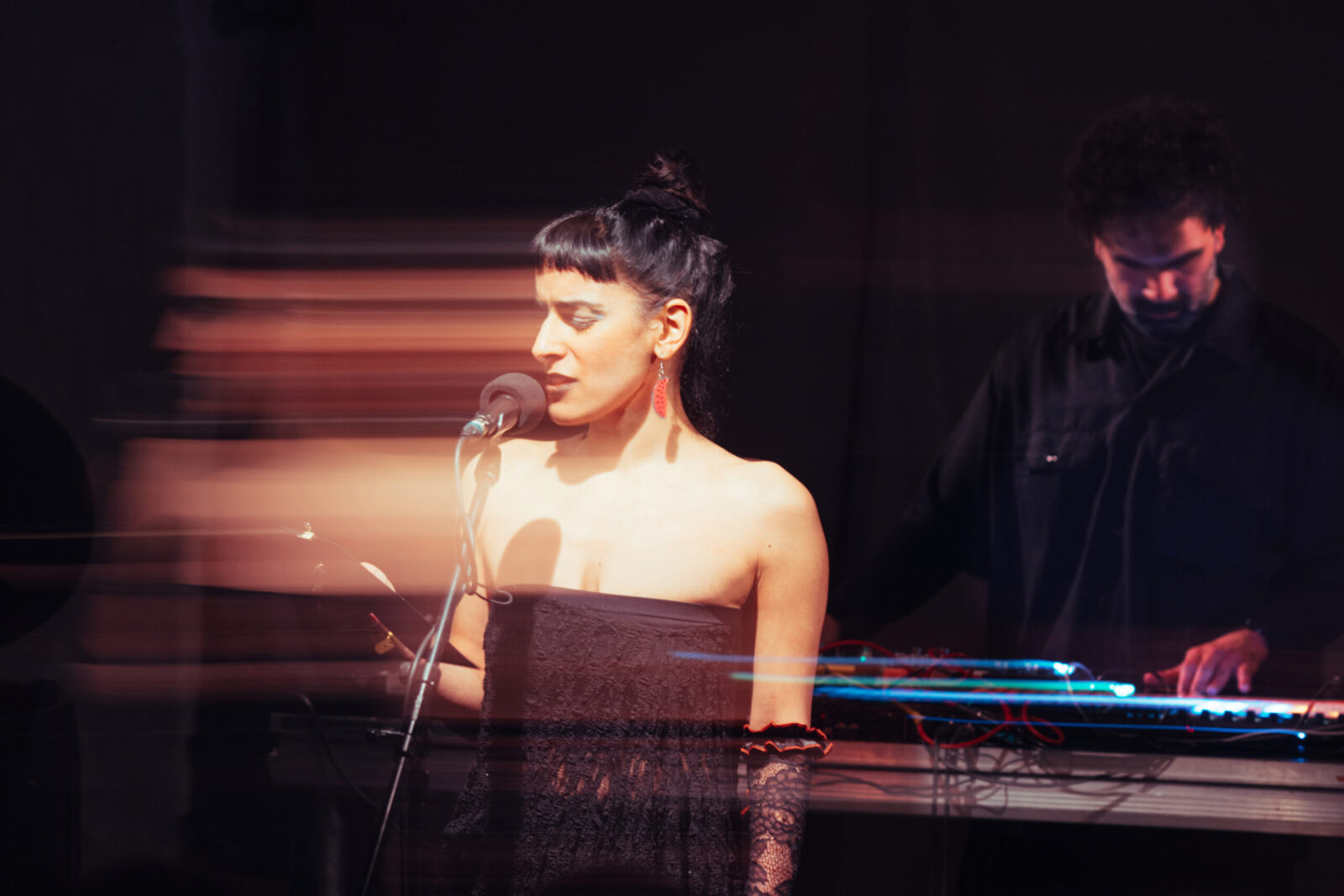
A Bakhshi or an Ashiq, in the old Iranian tradition, walks from village to village with a saz across his back, and when he stops to eat or sleep, he stops to tell a story. The stories travel further than he does. By the time he leaves a village they are already on their way to the next one, in the mouths of the people who heard him. Pouya Ehsaei and Tara Fatehi reached back to this tradition, more than to any club night or experimental music format, for the first cue for the project they have built in London over the past four years. That tradition remains a vital touchstone for them, as Pouya puts it: “Poetry has a very strong presence in Iranians’ life, in our culture, actually.” From the Lips to the Moon, the music-and-poetry night the two have curated and performed in since May 2022, channels that same spirit. In their residency, the “village” is the room itself, and every performance, with its rotating lineup stretching from a Senegalese griot to a Berlin improviser to a poet from Burkina Faso, carries the tradition forward.
The name comes from a passage by the Iranian short story writer Mohammad-Reza Safdari, in a book that pairs his fiction with research on around forty fables from the south of Iran. Pouya explains that in its introduction, Safdari describes the act of storytelling by a mother to a child as if “the story goes from the mother’s lips to the moon, and then from the moon comes to the ears of the child.”
Speaking by phone a few days before the launch of their debut album on Akazib Records, the two were generous with time, talking for over an hour and across far more ground than a single feature can carry. What follows is a partial map.
From the Lips to the Moon’s first form was not a stage but a radio broadcast. Pouya recalls the origins: “It started as a radio show, which was on Radio Alhara, and it was a collaboration between musicians and poets back then. That was, I think mid-2021, in the middle of the Covid pandemic. That’s how it started. Then we decided to turn it into a live show. Actually, Marlow who runs the events at Reference Point, heard the radio show and said, ‘what if we do this live at our venue?’” Reference Point is the Charing Cross bookshop-by-day, venue-by-night that hosted the first live edition in May 2022 and several after it. Tara and Pouya were already long collaborators by then. They had moved in the same circles in Iran since the early 2010s, and in early 2014 performed their duet of performative text and electronic music for the first time on a live art bill curated by Franko B at The Flying Dutchman in south east London. Tara describes that initial performance. “That was the first time we did this thing of like, we’ve done other performances with each other, but this was the first time there was just the two of us doing this performative text and music.” The piece travelled to festivals in Iran and to the UK’s Spill Festival over the next few years. Pouya, in parallel, was developing Parasang, his series of live electronic and acoustic encounters with musicians from across genres. By the time the radio show appeared, the muscle memory for what From the Lips to the Moon would become was already there.
What was new was the format, and it struck a chord. Reference Point sold out repeatedly. The night eventually moved up the road to Cafe Oto, where it has lived since. The pair have played the V&A and the Purcell Room at the Southbank Centre, and taken the show to Brighton, Margate, Dorset, Berlin and Mexico. Tara considers the shifting environments. “It’s always interesting to have the cosy vibes of Reference Point, or the larger scale of Cafe Oto, where you still get an intimacy that gives space to both the creative and social aspects of the work. But doing things at the Southbank, or in bigger, theatre-style places, has its own perks and beauties.” The shape of the ideas behind the project has stayed the same; almost everything else has expanded. To date, the duo have hosted over 130 guest artists across disciplines, and the night has run twenty-eight times live, plus dedicated radio editions.
What kept it going and gave the project room to evolve is that no two editions are the same. Pouya is clear about the philosophy: “The plan is to continue going and growing; that has always been a core concept of From the Lips to the Moon. The name stays the same and Tara and I are always there, but we keep things surprising for the audience. Whether it is the performance elements, the layout, the visuals, or just the combination of musicians and instruments, we make sure there is always something new for our audience to come back to.” For regular attendees, the experience carries a distinct communal weight. Tara shares a common sentiment from the audience. “Someone told me that when they go to From the Lips to the Moon, it feels like being at a wedding where you know some of the people, but there are always new faces, too.”
The events themselves are improvised. The artists often meet for the first time on the day, do a half-hour soundcheck, and walk out in front of the audience with no rehearsal. Pouya highlights the necessity of trust. “It is about trusting ourselves, the people we invite to play with us on the night, and the audience. I think that’s one of the most important things when you have these kinds of performances. Because these events are one-off, improvised events, we don’t rehearse. It’s about believing in that process of searching and finding together, and getting the audience involved as we go along. That creates the natural tension and release that carries the whole piece from beginning to end. Even when you’re not sure where you’re going, you just trust that you will get there.” When asked if any show has ever misfired, the answer is immediate: “I don’t think we have ever had a bad show yet.”
That run is partly down to curation. The lineups are not assembled the week of the show. Tara describes the methodical approach. “The curation process is long because we are constantly researching and expanding our network.” Recommendations come from artists they have already worked with, and suggestions are tested against gigs Tara and Pouya attend. Some artists sit on a wish list for a year before the scheduling aligns. Some events are themed, with the cast built around that specific concept. Tara offers an example. “If we are thinking about, I don’t know, cacophony and playfulness, we consider who the most cacophonous and playful people are that we can bring in. Sometimes, the themes are more political.” Pouya expands on the brief. “We curate not just the music and poetry, but the theatricality of the performance. It is important to us to have different characters on stage performing together.”
The curation also tests for a quality the pair has come to value above almost any other. Tara captures the essence of it:“There’s this element of generosity in listening. The artists’ generosity and experience of live listening and live responding, rather than just flying in their own universe. That is the magical moment, which we try to always emphasise in our pep talks.” Tara, watching from the inside of the format she co-leads, gives Pouya the credit for this. “Pouya is the person who’s always playing, but he’s also very good at holding that musical space where these different voices can come in and have a life. They can be there when they feel like they want to be there, or hold back when they want to hold back. And somehow, it’s worked.” From his sprawling, cable-tangled altar of synths and samplers, he manages to cast a spell over the musical entropy, keeping the entire performance whole.
This insistence on listening is also what keeps the night from collapsing into a multicultural exhibition. The lineups have included over a dozen languages on stage; the artists span Iran, Palestine, Trinidad, Burkina Faso, Senegal, Zimbabwe, Nigeria, Germany, South Africa and more. But the project’s ethos is not to flatten any of that into a single texture. Pouya emphasises the importance of individuality. “It’s very important for us to let each sound and each voice be themselves, however they like to be themselves. We’re not changing anyone’s art to be able to put it into a modern structure of electronic music. Everyone exists together and everyone is themselves, and I think there is beauty in that multi-voice world.” He cites feedback they received after a show from Burkinabé actor, director, and playwright Étienne Minoungou as the best summary of the night: “This is like a fantastical world that you create, that anything can happen in it.”
The current geopolitical climate has crept into the line-ups, the texts and the dates themselves. Pouya reflects on the heavy backdrop: “Each live event became a marker. One, for instance, was in solidarity with Woman Life Freedom in Iran; another was on Nakba Day; another for the Iranian New Year. It was a very turbulent four years in the world, and unfortunately, it does not look like it is going to get better. Our last event was literally on the day the war started.” This proximity to such volatile history is why the album exists. Because the performances were tied to specific, fleeting moments, both Pouya and Tara felt an urgent need to capture them before they vanished. “This was a feeling I had after Parasang,” Pouya says. “We did a lot of live shows where the experiences were very ephemeral: each performance just disappeared in the aftermath of it, which was also the beauty of it. But now I feel like it would have been nice if we had recordings of some of those moments, just for ourselves, if not for others.”
Capturing live energy on record is a challenge Pouya knows well from his own releases and his work with Ariwo, the project fusing electronic soundscapes with Afro-Cuban rhythms, featuring Pouya alongside Cuban percussionists Hammadi Valdes and Oreste Noda, and trumpeters Sam Warner and Yelfris Valdes. Their focus on improvisation makes the group a perfect case study for bottling spontaneous studio energy. “The core energy that feeds the music comes from the spontaneity of performing in front of an audience, so capturing that on an album is always a challenge. It’s been a learning process of finding that balance between the live performance and the studio environment”. The studio sessions were lengthy, with takes typically running seven or eight minutes before being edited down to three or five. Of the twenty-five tracks recorded, twelve made the final cut.
Among those twelve selected tracks is “Choppers,” the album’s first single, which emerged from a December 2024 edition of the show. The track is built around a rhythmic, mechanical chopping sound, like helicopter blades cutting through the air, with the word ‘money’ repeating throughout. The text, written by Tara, weaves domestic tension with external realities. “The track starts with a family dispute: mama saying one thing, papa saying another, arguing that Tories are fuckers, that Labours are Tories. It’s that kind of family.” Regarding the specific imagery, she recalls, “It’s stuff I pick up here and there. There’s a line where a kid asks, ‘Mommy, what does C-A-L-A-I-S mean?’ That’s something a little girl actually said when we were on the ferry crossing the Channel. Arriving at Calais, she saw the sign, but having no idea what it was, she just started spelling it out, asking, ‘What is this?’”
Bringing these everyday moments alongside images of military helicopters and tanks creates a disorienting atmosphere. “I guess this is the chaos in which I live,” Tara adds. The track then connects these experiences to a sharp critique of consumerism and capitalism. Pouya is blunt: “It’s a race of just who can consume more, and whoever is consuming more is causing more damage.” The fast, dense arrangement, centred on a balafon part, reflects that tension. “Musically, it was about that chaos, the bombardment of information at this time and being a little bit confused of what is happening,” he picks up. “Koroleko Moussa on balafon is killing it on this one. We were all amazed at the studio when he came up with the melody.”
Other tracks draw from different corners of Tara’s notebooks, notably “Bulldozer,” written in July 2023, well before the latest escalation in Gaza. It was a piece born of necessity; often, Tara is writing down to the wire, responding to what’s happening in that moment in time. “Bulldozer resonates across the years,” she notes. “You see a bulldozer wiping out a village, and then you see all these pink-washed and green-washed worlds that we live in; the bulldozer just cuts through all of that.” The track’s impact was immediate. “We actually did that one for the first time at Reference Point,” she adds. “People were raving about it, and it clicked the moment we were playing it live, so it became clear it was destined to be a single. Bringing these fragments of writing into the studio to build a cohesive life for the music was an interesting journey, particularly seeing how those live-tested moments held up under the scrutiny of recording.”
“Dickie” is a track Tara considers especially significant. “Dickie is a special one, it is very much about the moment of thinking through these failures of social systems. It is a list of things that have failed to work. The education system didn’t work, the healthcare system didn’t work, and the political system was so fucked up we had to start over.” She describes how this culminates in the character of Dickie. “At the end, there is someone named Dickie who comes home with a machine gun and starts enjoying themselves. It is a journey of explaining why our society is collapsing and leading into violence, and what makes the ‘Dickies’ of our times.”
To emphasise the sense of total collapse, the song is layered with haunting imagery. As she describes it: “There are a lot of repetitions and images of dead birds falling from the sky and it feels like the end of the world, with bird shit pouring down.” Ultimately, the track grapples with the difficult reality of violence and societal failure. She sits with it for a moment: “I’m trying to understand the person who comes home with a machine gun, and where we have failed collectively that leads to this glorification of violence”.
This story of collapse is just one of many voices the record gathers around a shared experience. For Tara, the connective thread is as much about location as it is about music: All of these voices are residing in London. So what binds everything together is our proximity to each other and what is happening, and what are our experiences in London from the beginning to the end. Everyone bring the way that they look at their experiences in London and also their heritage and how they are going back and forth is still connected to that, to their heritage. Pouya traces it through individual tracks: Belinda Zhawi, who records as MA.MOYO, a Zimbabwean-born literary and sound artist; Nomakhwezi Becker, German-South African, whose “Plant Me” closes Side A; Tasneim Zyada, Palestinian, whose “How We Love” ends the record; and Maureen Onwunali, Dublin-born Nigerian poet and two-time national slam champion. Belinda Zhawi’s track came from a photograph of her mother and her continuing connection to Zimbabwe. Becker and Zyada, he notes, are both writing about home, and the vinyl places them either side of the break for that reason. Onwunali’s “Empire” lands fourth: “an Irish-Nigerian who lives in London stands eye to eye with the British Empire and speaks directly to it.”
Another constant is the relationship with the audience. Tara would open each night by asking who was there for the first, second, or third time. They also provided notebooks at every event for attendees to contribute to throughout the night. As Tara puts it: Two notebooks full of people’s writings and doodles and a lot of comments and feelings from people. Many people have also written poetry in that, like, suddenly inspires its own world of writing and drawing. The pair are happy to hear that some attendees have started their own music-and-poetry projects. They also frequently hear the same line on the way out: “This was the best one.” It is a sentiment repeated after every show, to the point that it has become a private joke between the organisers and the regulars.
The pride the duo feels also stems from the community that has grown around the project. Having both arrived in the UK from Iran, they view their ability to foster this creative network as a defining milestone. Pouya highlights the relentless effort required to sustain that vision: “As migrant artists, it’s extra work to keep the ball rolling and keep connecting and gaining trust.” For the pair, this community has become inseparable from the city they now call home: “If we can call London our home, it’s partly because of this community that we have at the Lips.”
Looking ahead, their immediate focus is their album launch at Cafe Oto on 15 May, arriving three days before the project’s fourth anniversary with a room full of featured artists from the record and past live editions.
Beyond London, they head to Turin in June to play the sixth edition of Metronimie Festival. To sustain this kind of growth, they want to take the format to new cities by teaming up with local promoters who can handle some of the heavy lifting. They have already recorded enough studio material for a second album, and they are talking about launching a From the Lips to the Moon festival in the next few years, complete with workshops. They are even dreaming up an experimental opera built from the pieces written for their nights. Tara adds: “That is the sort of ultimate dream version. We have dreams, I suppose.”
Dreams take time. What exists now, pressed and sequenced and ready, is the album: one way of holding still something that has never wanted to stay still. “Words that glitch, sounds that misbehave.” Tara fills it out: a night built on performativity, on what they prefer to call spontaneity rather than improvisation, on a multi-sensory experience that is visual as much as musical. A record of, in Pouya’s words, “tender moments, melancholic moments, at the same time very rageful and violent moments too.” On the album those moments belong to sixteen artists. In the room they belong to whoever is there. “It is about just having all of these voices, characters, sounds, words in one space, which is surrounded by a musical structure that encompasses everything, but it stays very open.”
From the Lips to the Moon is out on Akazib Records - Stream & purchase your copy on Bandcamp
The album launch takes place at Cafe Oto, London, on 15 May - Tickets available HERE
Cover Photo: © Josh Snaps