

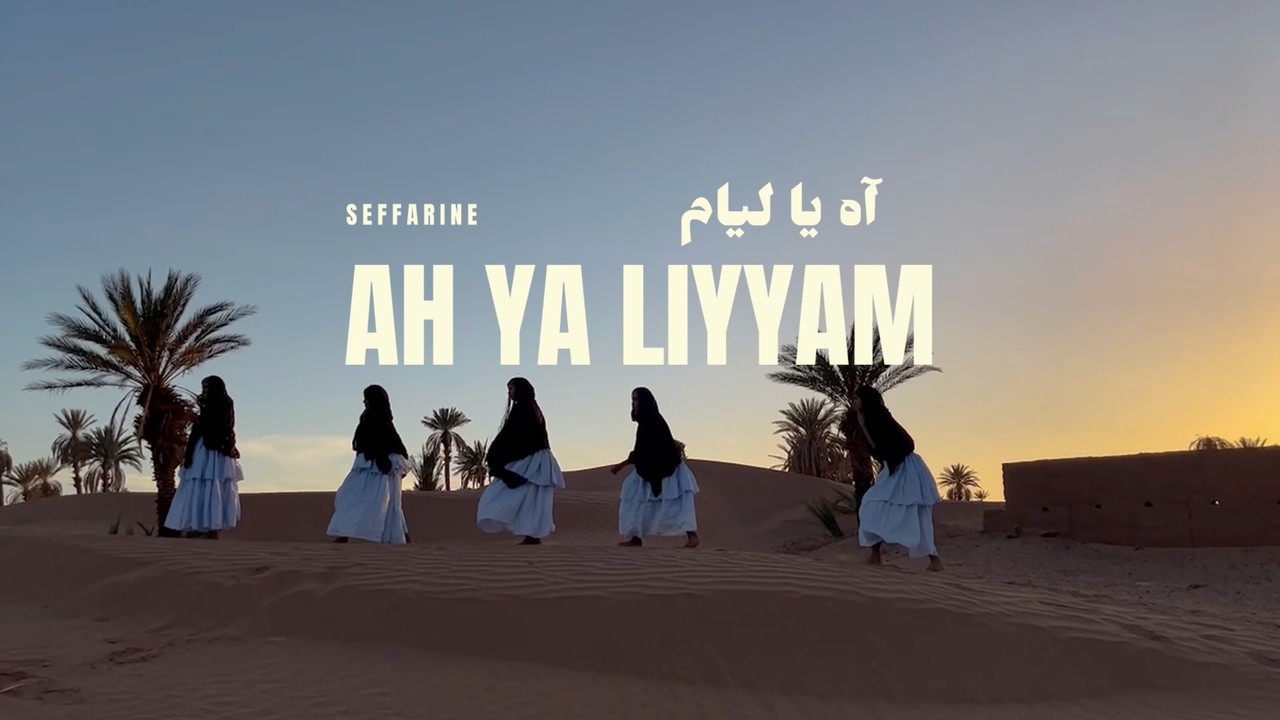
“Ah Ya Liyyam” sets the djeli ngoni, the lute of Mali’s griots, against the iron qraqeb of the Gnawa, the Moroccan ritual musicians descended from West Africans brought north across the Sahara. The pairing retraces the old caravan road between Timbuktu and M’Hamid El Ghizlane, the oasis in southern Morocco where the route from Marrakech runs out into sand and where Seffarine first worked on the song.
Lamiae Naki and Nat Hulskamp, the couple who lead the Portland-based band, spent several weeks in M’Hamid on a residency at Joudour Sahara, a music school that teaches the traditions of the Drâa valley to local children. They often played on its roof at night, once the heat had dropped. The town is losing ground to the desert: the Drâa, Morocco’s longest river, has run dry, the palms are dying and sand is burying houses. With many of the town’s working-age adults gone to Marrakech and Casablanca, the songs that used to pass from parents to children now skip a generation. At Joudour Sahara the children learn them straight from the elders who stayed. Some of those children answer Naki in the call-and-response chorus of “Ah Ya Liyyam”, a song about time passing and the days that are gone.
Naki sings in Darija, Morocco’s everyday Arabic, over percussion that brings together the qraqeb, a calabash, darbuka and the bendir frame drum in the quick, communal rhythms of ahwach, the Amazigh song-and-dance of southern Morocco. Ngoni, guitar and bass carry the melody above them, with solos played off the cuff in the session. Much of the song was recorded at Aziz Ozouss’s AZ-OZ-REC studio in Biougra, south of Agadir, with musicians the couple met on the trip. They are joined by the Malian ngoni player Daouda Mangara and the Los Angeles-based Cuban bassist Yosmel Montejo.
Naki was born in Fes and trained there in Andalusi and classical Arabic music, though her family’s roots lie in the south. Hulskamp, a guitarist and oud player from Portland, Oregon, first reached Morocco as a teenage student in the 1990s. He studied the Andalusi repertoire of the north and travelled the country with a DAT recorder, taping the musicians he met. The two met in Fes and named the band after the city’s Seffarine Square, where coppersmiths still hammer out pots and trays in the medina. Their 2015 album De Fez a Jerez traced Morocco’s links to flamenco. Abaraz, released on 16 October and named after an old trading crossroads near M’Hamid on the trans-Saharan routes, heads into the desert, with “Ah Ya Liyyam” as its first single and opening track.
Pablo Macías and Soledad Villalba, filmmakers from Málaga who travelled with the band, shot the video of the single at Joudour Sahara, the Biougra studio and M’Hamid’s 7 Kasbah Museum. Their footage from the trip also runs as projections in the band’s live multimedia show, which shares the album’s name.
Hear “Ah Ya Liyyam” HERE and find the rest of Abaraz through THIS LINK