

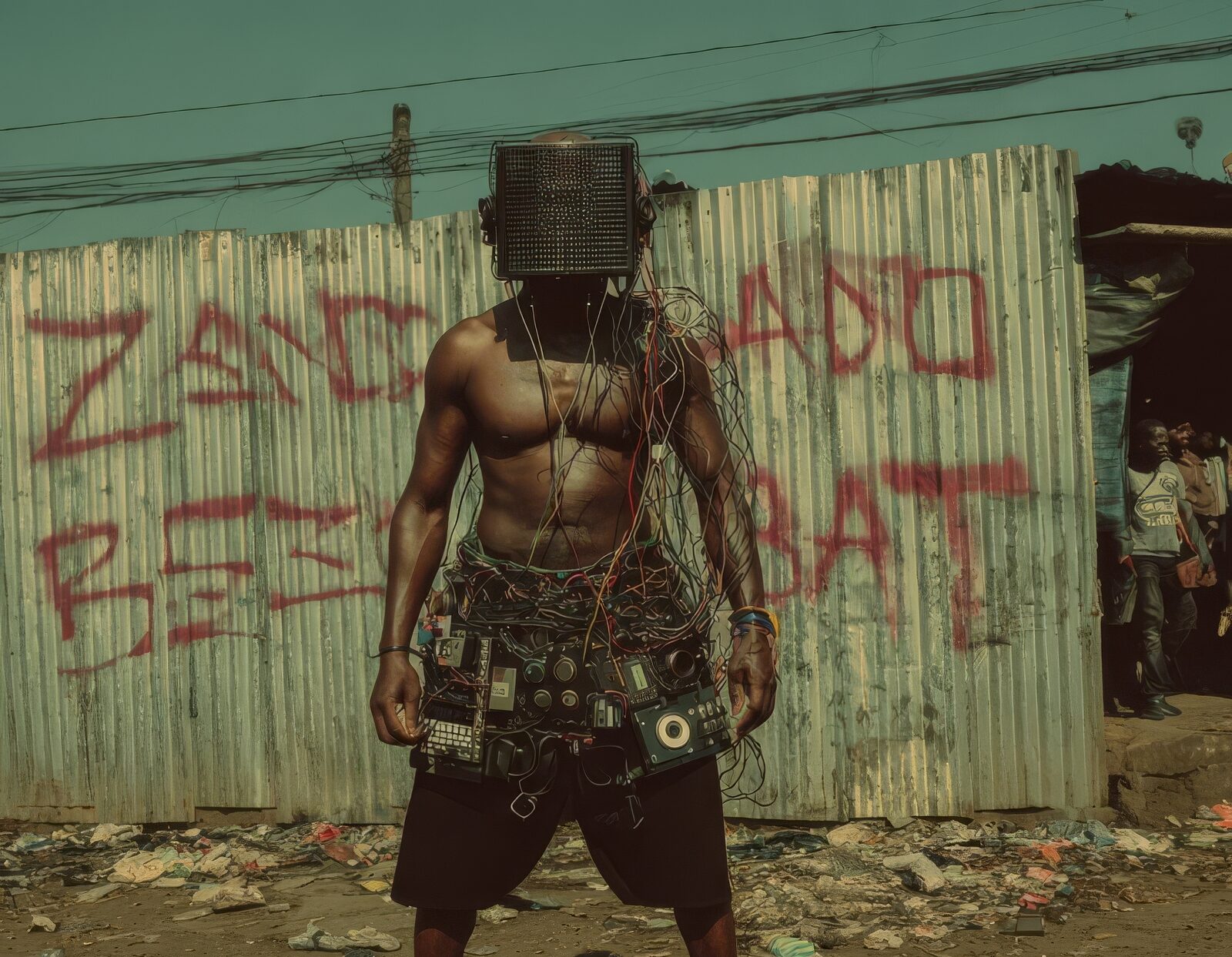
Zando no longer exists. The market at the centre of Kinshasa, a city inside the city, where hundreds of thousands of Kinois poured in daily through a permanent uproar of decibels, bodies and adrenaline, has been demolished and is being rebuilt. The gangs that gave it its mythology, Vampire 4, Arabes Chauds, Gucci Boys, Zaïre 243, Temple Rouge, BB d’Amour, P8, Androïdes, Filles Têtues, have been dismantled by police. What survives of it, in large part, is on a record.
DJ Fantôme, aka Lévi Ekofo, spent a decade as the resident beatmaker of that underworld. He learned his trade at fourteen, repairing second-hand audio gear and playing organ in Kinshasa churches, then started building beats on old PCs for the singers and gang members who came knocking. In 2017 he set up a studio inside the market itself. Between power cuts, for less than twenty dollars a time, he recorded the anthems of each gang at Timbela Yo Studio, which he co-founded. The ambition, as he puts it, was to record the invisible symphony of Kinshasa.
Zando Beat, released on Palenque Records, is the result: twelve tracks cut between 2020 and 2021, through the pandemic and the zero-tolerance police operations that followed. The voices are not professional musicians. Colonelle Yvette, Dorcas, Kebano, Sitos, Gladys and the rest were gang members, street vendors, pickpockets, lookouts, day labourers, chosen for their lives rather than their technique. Many have since been arrested, sent to forced labour, or vanished. Underneath them runs Zagué, the music of urgency born in the market’s arteries: ghetto techno fed by coupé-décalé, kuduro, trance and makeshift drill, shouted refrains repeated like combat mantras.
For our Musical Road to WOMEX, he answered our questions about building that studio, recording through the raids of 2021, why he put non-musicians on these beats, and where Zagué goes now the world it came from has been knocked down. He has also put together an exclusive playlist for us, gathering the tracks and artists that shaped his sound.
Your sound comes out of Zando and mixes coupé-décalé, kuduro and trance into something you call ghetto techno. For a WOMEX audience hearing it for the first time, how would you describe it?
Zagué has many different forms. The original Zagué comes straight from the ghetto. It is the rage and energy of the Atalaku, the MC, played extremely loud through bad speakers, with a cheap microphone, a Clavinova or Casio keyboard instead of real synths, and very basic drum machines. But it works because of the energy and the lyrics deeply rooted into the ghetto realities. I wanted to bring something new into it. I added the minimal, precise and repetitive techno feeling that I love so much.
Can you tell us about your journey as a producer, and the sound you have built over the last ten years?
I started working in music as a sound engineer when I was very young, around 14. I was plugging in instruments at churches on Sundays and during religious events. I first learned how to repair second-hand audio gear and make it work. I learned electricity and electronics like that. In Kinshasa, you always have to find DIY solutions. It becomes part of your DNA.
I also started playing classical organ at church, but I was more interested in urban beats because I grew up around Zando Market. There were gangs, underground clubs, and new street anthems coming out every day.
I began making my own beats on old PCs with synth emulators. I also sampled my own drum sounds. I was good with electronics and knew how to use the software, so singers from the gangs and musicians from the ghetto started calling me to record them and make instrumentals. I bought some basic recording equipment and started working with these people while I was still at university.
At that time, I also recorded many traditional groups, including Pygmy musicians, and tried to give their music an electronic touch. Kinshasa is full of so many different musical styles. But young ghetto musicians were mostly into hip-hop and coupé-décalé. So I learned all the basic rhythms and worked on that kind of dance music for some time.
Then, one day in 2018, someone sent me some vintage acid house tracks from Europe and Detroit. It completely blew my mind. I wanted to bring that minimalist approach into the ghetto sound.
Later, I worked as a sound engineer with a French producer on a band called KOKOKO!. That was also when I discovered Ableton.
You set up a studio right inside the market. What made you record there, in the middle of it, rather than somewhere quieter?
Zando is now completely destroyed. The whole area is being rebuilt, which can also be a good thing. But at that time, it was a city inside the city. It was a centre for every kind of business and traffic. It was complete chaos, almost like the Wild West, with a huge underground culture and many legends.
Zando was a sanctuary for gangs, thieves and saints, street kids and sex workers. They all had their own anthems and punchlines, just like the street sellers. I always wanted to record that invisible symphony of Kinshasa.
I had set up my studio inside the market in 2017. I was recording people for very little money and making instrumentals for local MCs and gang members. I started collecting street chants, urban punchlines and voices from the market. I used them as vocal riffs that I could mix into my music.
The album was recorded between 2020 and 2021, through the pandemic and the police operations that followed. How did that time get into the music?
People from Kinshasa, especially people from Zando, are tough as nails. From childhood, you learn to survive malaria, typhoid, cholera, power cuts, bad water and hunger. There is a proverb here that says: “We are in the fire, but we do not burn.”
The whole Covid situation was not taken very seriously by the people in the street. Many saw it as an excuse for the government to clean up the streets: arrest homeless people, pickpockets and street kids because they were not wearing masks.
The real fear and anger that you can hear in some of the tracks came from the brutal zero-tolerance police operations happening across the city in 2021. People from the street were hunted down. Some were even shot, just like that. It was a terrible time for them. Many people came to hide and sleep inside the studio.
You recorded with gang members and other local voices, not trained singers. How did you find the people you worked with, and why was that important?
The whole idea was to capture the raw energy of Zando Market. None of the artists were professional musicians. But when you are homeless and surviving from one day to the next, you become a performer. You have to perform every day just to survive.
Many of these people were almost living inside the studio during the police raids of 2021. I was there, the microphones were plugged in, and one by one they started bringing their ideas: their best punchlines, street rhymes and favourite gang anthems.
I understood instantly that this was something important to record and archive about that particular time in Kinshasa.
What are some of the themes and experiences rapped about across the project?
I first recorded real ghetto girls like Colonelle Yvette, Dorcas and Kebano. They were members of all-girl gangs from Zando, like P8, Filles Android and Bébé d’Amour. Each one brought her own ghetto rhyme. Some are about rivalry between girls’ gangs, bragging about being the best lovers. Another is a health warning telling women in Kinshasa not to use products made in India to make their booties bigger.
They rapped first, then I composed while listening to them. After that, we recorded it again together.
All the guys on the album came from gangs like Vampyre 4 and Armée Rouge. You have to imagine they were all being hunted by the police at that time. One track tells the story of a guy from the street who met a Mami Wata, a mermaid, and almost went mad. Others sing about the art of being a pickpocket. Another tells his brothers to “put their fingers right down into the toilet” to understand what is happening in the country.
In Kinshasa, phrases naturally become punchlines. People in the street know how to sing or rap about their troubles, even if they are not singers. That is the Atalaku culture, the MC culture.
Ghetto techno, gqom, singeli, Afro-house: African club sounds are having a real moment, and WOMEX’s Club Summit is full of them. Where does Zagué sit in that, and where does it live outside the market?
In Kinshasa, there is no electronic scene as such, no electronic music festivals like in Lagos or Joburg. Everything is scattered across a city of 18 million people, and everything changes very fast.
100% of people listen to rumba on repeat: Fally Ipupa, Koffi Olomide, very soft and romantic music.
Zagué has always been an underground sound linked to the gangs, ever since the phenomenon started in 2010. Instant ghetto anthems, passed around on USB sticks, through music shops in the markets and clubs in rough neighbourhoods. Sometimes a track creates a dance that everybody copies, then it disappears. You cannot really pin it down to one place.
Now that the gangs have been dismantled by the police, Zagué is mutating into something else, and I feel part of it.
The album has come out during a time of political unrest in the Democratic Republic of Congo. Is there anything about what is happening that you feel is important to talk about right now?
A new era, we hope. A new era, they say. We will see.
We have lived through decades of violence, war and chaos. We Congolese know very well that most political decisions made in our name are really taken by foreign powers.
But, to be honest, some things have been getting better these days. Maybe it is a wind of change. We hope so.
What’s next?
Womex…
Zando has been flattened, but the sound it produced is still travelling
and it lands in Las Palmas on Saturday 24 October
when DJ Fantôme takes over the Club Summit at the Sala San Borondón from 02:30
PLAYLIST: DJ FANTÔME X RHYTHM PASSPORT
You can find all the previous episodes of Musical Road to Womex HERE