

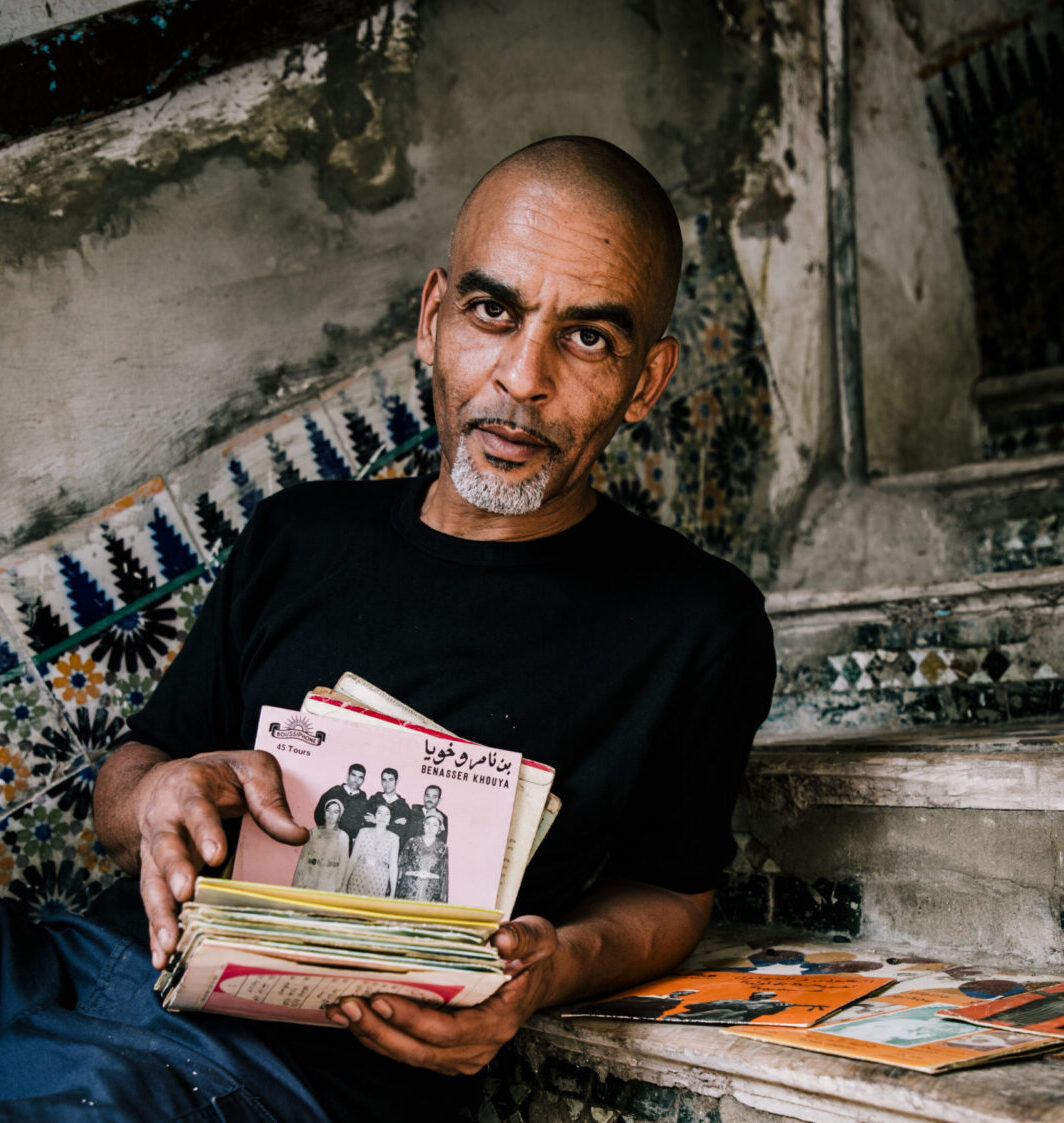
It all began with a box nobody wanted. In 2004, digging for jazz and funk at Casablanca’s Derb Ghallef flea market, Aziz Konkrite found a neglected crate of nearly two hundred Moroccan 45s. Their owner saw little value in them. Twenty years later, they have become the foundation of Siba Sawt-System, the project the Franco-Moroccan DJ, digger and producer describes as an instrument he built in order to speak: one that archives on the road, composes in the studio and performs on stage.
What he heard once he started playing them was his own childhood. Family parties, his parents, aunts, people no longer alive, faces he can no longer place but who were clearly there at the time. He has called the records sonic locks, each one opening a window he hadn’t known was shut. He spent years afterwards travelling Morocco by motorcycle, tracking down local studios and surviving musicians, less interested, he says, in the people who kept the records than in the people still keeping the musical practices behind them alive: young musicians he met in Sidi Allal el-Bahraoui after breaking down there, who now appear in the visuals for “Love & Hayt” during his live show, and others he found the same spirit in around Imilchil and in Haha communities.
He draws on Chaâbi, Aïta, Reggada, Amarg, Gnawa, Ahwach and Izlan, the rural styles that found city audiences in Morocco’s bars and studios through the 1960s and 70s, and builds with them the way hip-hop taught him to: sampling, breaks, traditional instruments, analogue keyboards, field recordings. Siba Sawt-System #1 came out in November 2023, fifteen years of digging distilled into seven tracks. Siba Sawt-System #2 followed in June 2026, a record he has described as being about continuity, about keeping the dead present to give meaning to what’s still here.
This October he brings it to the Canary Islands, playing the Club Summit at WOMEX 2026 in Las Palmas, his first time at a world music conference on anything like this scale.
For this year’s Musical Road to WOMEX, Aziz answered our questions on the Derb Ghallef box that started it all, on what Siba Sawt-System asks of the people who hear it, and on the country that exists nowhere outside his work, and put together a playlist exclusively for Rhythm Passport.
You gave your music its own name, Moroccan Broken Electronics, because nothing else fit. For someone who’s never heard Siba Sawt-System, how would you describe what happens when you play?
When I play, people can enter Siba Sawt-System through many different doors. Some are drawn to the music first, others to the images. But even within those two worlds, the paths divide again.
With the music, some people will recognise an electronic aesthetic they’re familiar with, while others will be more drawn to the traditional Moroccan sounds. With the visuals, some will connect with the graphics and design, while others will follow the storytelling and the visual narrative. So it’s almost like a whole tree of possible entry points.
I’m not an artist who tries to physically take over the stage. What interests me is building that experience and letting people enter it through their own senses. Then, gradually, the sound feeds the images, the images feed the sound, the different branches come back together, and eventually it becomes one single experience.
It started in 2004 at Derb Ghallef, with a neglected box of nearly two hundred Moroccan 45s you found while looking for jazz and funk. What did you hear in those records that turned a flea market find into twenty years of work?
In those records, I heard the soundtrack to the Moroccan part of my life. I found my childhood again, family parties, the smiles and laughter of my parents, my aunts, members of my family who are no longer here today. Some sounds even brought back faces of people I can’t quite remember anymore, but who were clearly part of our lives at the time.
Those sounds worked almost like sonic locks. Once opened, they gave me access to windows into the past. Without them, many of those people or moments would probably have remained forgotten. And strangely enough, I never heard this music as something from the past. It felt more like finding something that had always been there, but that I had simply forgotten to live.
The different lives I’d lived, and the different places I’d lived in, had taken me quite far away from my family and my community. Those records were like a harpoon pulling me back towards my roots. As if I’d been driving for years with a four-cylinder engine with only two cylinders working, and this music suddenly fired up the other two: my Moroccan identity, my culture, my roots.
You spent years searching across Morocco for these records, and you’ve said it was never about collecting them but about meeting the people who chose to keep them alive. Who has stayed with you most from those encounters?
I’d make one distinction first: I’m not so much interested in the people who kept the records alive, but in the people who continue to keep alive the musical practices those records are traces of.
I often think about the young musicians I met in Sidi Allal el-Bahraoui, after breaking down there. A problem brought me to that place and ended up creating something beautiful. They’re the ones you can now see in the visuals for “Love & Hayt” during my live show. What really struck me was their age, and the simplicity with which they live this music: being outside, together, making music with whatever they have around them. I found that same feeling among young people in Imilchil, in Haha communities and elsewhere.
At first, I thought the records had to be saved in order to preserve this heritage. Then I realised something much more reassuring: the records and archives need to be preserved, of course, but the culture they document is still very much alive. Seeing young people naturally continuing to practise these musics is probably the most reassuring thing I’ve found for their future.
You call Siba Sawt-System an instrument you built to speak with, one that archives on the road, composes in the studio and performs on stage. How does something you found in a village end up as a track people dance to?
First of all, not everything I find ends up in a track, and even less in something designed to make people dance. When I travel, I never go on a mission to find sounds for a track. I travel because I’m curious, because I want to meet people and discover things. For me, travelling and creating are two separate moments.
Later comes a kind of retreat. I can spend an evening on my own listening to hundreds of records and archives, still with no particular intention of making music. And sometimes something clicks. One sound reminds me of something I heard somewhere else, which might work with a rhythm or a voice from another record. A sort of musical spider’s web starts forming in my head.
From that point, things often move very quickly: I go back through my archives to find the elements my brain has just connected. So I collect because I want to discover. And much later, without looking for it, some of those discoveries start talking to each other. That’s when the music begins.
WOMEX is a room full of people who book, release and champion music from everywhere. Who or what are you hoping to connect with while you’re there?
I don’t really chase music industry events. When I do go to them, my first instinct is usually to watch gigs and discover things. Curiosity tends to lead me before my address book does.
I’ve already been to different professional gatherings in France, Morocco and around the Euro-Mediterranean scene. With WOMEX, for the first time, I’ll experience that on a genuinely international scale. But the main reason I’m going this year is because I’m playing there. I don’t yet have the international network I need to develop Siba Sawt-System in the way I’d like to, and I probably wouldn’t have made that investment just as a visitor.
I’m not arriving with a list of people I absolutely have to meet either. What I like are the unexpected connections: someone who knows your work naturally introducing you to somebody else because they feel your worlds might understand each other.
So I hope to see people I already know, discover loads of artists and meet passionate people, but also, of course, professionals and future collaborators who genuinely connect with what I do and with whom Siba Sawt-System can go further.
You say people don’t need to know anything about Moroccan music for your set to work on them, that the music hits first and the story comes later. WOMEX audiences are professionals, watching with one eye on the business. Can you still get that room to let go?
Programmers are professionals, of course, sometimes business people, but first of all they’re music lovers and simply human beings. Siba Sawt-System is deeply connected to my personal story, my identity and my roots, but the questions behind it are universal: where do I come from? What made me who I am? How does understanding where we come from help us understand why we became the people we are?
A lot of the music at WOMEX probably carries those same questions in its own way. What interests me is approaching them through my own language.
As I said earlier, I build my live show so that the experience comes before the explanation. So if, for a few minutes, a programmer forgets to wonder where they could book Siba Sawt-System and simply starts experiencing it, then I’ve probably succeeded.
Las Palmas de Gran Canaria sits a short crossing from the Moroccan coast, with its own long history of traffic between the islands and North Africa. What are you most curious to find there?
To be fair, I haven’t really thought about Las Palmas in that way. I’m going there because WOMEX happens to be there this year, and my attention is much more focused on the festival, the people I’ll meet and my showcase than on its geographical location.
Of course, I know there’s a geographical proximity and historical connections between the Canary Islands and North Africa. But I don’t want to invent a personal or artistic connection afterwards simply because I’m Moroccan and WOMEX happens to be in the Canaries.
Human history is made of movement, and if you dig deep enough, places always reveal connections. Maybe I’ll discover some of those while I’m there. But I’m a curious person, so I’d rather let Las Palmas surprise me than decide in advance what I’m supposed to find there.
Many of the musicians whose records you sample were forgotten, and some are gone. What do you want a WOMEX audience to understand about them?
I’m not sure I want the audience to understand anything specific. That’s not really my position. Selfishly, I’m first of all telling my own story and my own relationship with this music.
Then everyone can enter Siba Sawt-System as deeply as they want. Some people will simply take the musical aesthetic, the images, the energy, or whatever the experience creates in them physically or emotionally. And I’m absolutely fine with that.
Others might become curious enough to dig deeper. If my work can create that little spark of curiosity and help these musics travel further, then I’m very happy. And for those who do go further, I hope they get lost, maybe even drown a little, in the incredible richness of Moroccan musical practices, sometimes still described as “folklore” or “old music”, when many of them are very much alive and continue to be played and passed on today.
Siba Sawt-System #2 came out in June, and you’ve described it as a record about continuity, how we keep the dead present to give meaning to what’s still here. Where does that leave you now, and what’s next?
In this search around my own identity, I’ve needed to go back to the origins of certain things: words I heard in my family, decisions made in the past, directions taken by some family members, but also musical movements that met or mixed along the way. Understanding what happened before me gives more meaning to the present I’m living now.
But some of the people who could have answered my questions are no longer here. I come from a culture where the elders don’t necessarily talk much about the past, and I think that’s true of many other cultures too. It made me realise there’s a certain urgency to collecting those stories while the people who carry them are still here.
For me, keeping the dead present doesn’t mean living in the past. It means recognising the stones they laid, sometimes three or four generations before us, on which part of who we are today has been built. And then continuing to give those stones meaning and passing them on ourselves. So today, I’m left with plenty more questions, and above all, the desire to keep searching.
If you could write a personal invitation to the people of Las Palmas to come and discover your showcase, what would it say?
If you fancy discovering an exciting hybrid country, somewhere no travel agent or airline could ever take you, then I’d invite you to come and see Siba Sawt-System.
It’s a territory that only exists in my work. You’ll find sometimes hidden sides of Moroccan and North African cultures, intertwined with the Western cultures that also shaped me. Not two identities living side by side, but something that has eventually developed an identity and geography of its own.
In this country, it’s hot and cold at the same time. There’s the warmth of analogue bass and keyboards, but also violins that can attack your ears, metallic percussion and raw sounds. There’s electronics, archives, images and, above all, a lot of human presence. So I can’t really invite you to come and discover Moroccan music, nor simply to an electronic music gig. It wouldn’t be entirely one or the other.
All I can really offer is a visit to this country that exists nowhere else. The journey lasts one hour. No passport or visa required.
Twenty years spent chasing a box of 45s nobody else wanted puts Aziz Konkrite at the Club Summit at WOMEX
on Friday 23 October, 01:30 to 02:30, at the Borondón Stage in Las Palmas de Gran Canaria
PLAYLIST: AZIZ KONKRITE X RHYTHM PASSPORT
You can find all the previous episodes of Musical Road to Womex HERE