

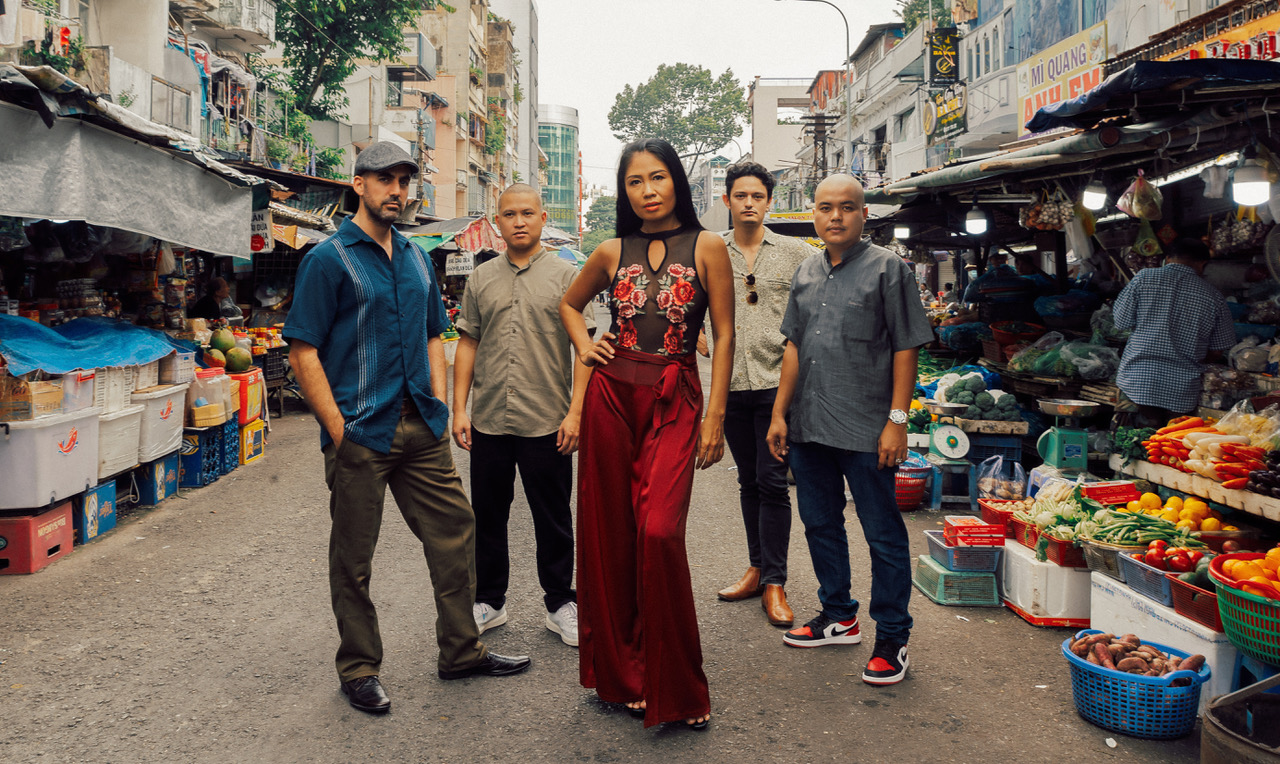
For the third episode of our Musical Road to WOMEX, we travel not only in place but also in time: back to Saigon before 1975, when GI bars ran fuzzed-out rock and twist alongside Cải Lương theatres and bolero radio. That’s the era Saigon Soul Revival dug back up in Ho Chi Minh City in 2016, after a handful of musicians found a compilation called Saigon Rock & Soul: Vietnamese Classic Tracks 1968-1974 by Seattle label Sublime Frequencies, and realised nobody was playing that music live anymore. Nhạc kích động, the Western-influenced rock and soul strand of the period, had been banned outright after the war, while gentler nhạc vàng ballads survived. They started as a covers band and ended up writing most of their own catalogue instead. Ten years on, they carry it to WOMEX in Las Palmas de Gran Canaria this October.
The band is Nguyễn Anh Minh on vocals, Indy Jeremy Vinh Laville on guitar and đàn nguyệt, Nguyễn Hương Bảo Hiếu on drums, Gabriel Kaouros on bass and percussion, and Đăng Nguyễn Khoa on keys, with traditional player Nguyễn Thị Hải Phượng guesting on đàn tranh and đàn bầu across their records.
Their 2019 debut, Họa Âm Xưa, picked up airplay from Iggy Pop’s BBC6 show and France’s Radio FIP. Their second album, Mối Lương Duyên (2024), featured the single “Đám Cưới Nhà Em”, which went on to soundtrack a scene in HBO’s The Sympathizer. That December, the band recorded a live session for KEXP at l’Antipode in Rennes during TransMusicales.
Their third album, Chốn Ta Về, releases 11 September via Saigon Supersound, folding in the T’rung bamboo xylophone and the sáo trúc flute alongside guest spots from multi-instrumentalist Đinh Nhật Minh and saxophonist Trần Mạnh Tuấn. From their WOMEX showcase, the band heads straight into a UK and Europe run: Musicport Festival in Whitby on 24 October, London’s Jazz Cafe the next night, then Bristol and Manchester, before continuing through mainland Europe to a Berlin date on 6 November.
Below, the band talks about what it means to bring back music that was banned once already, and what they hope it means to a generation of young Vietnamese listeners discovering it for the first time. They also curate a playlist of the tracks that shaped their sound, exclusively for Rhythm Passport.
For someone who’s never heard Nhạc Vàng, how would you describe what the band does, and what that sound felt like in the city it came from?
Imagine being a teenager in Saigon, Vietnam in the late 1960s. Your grandparents are at a Cải Lương theater watching a traditional form of folk opera, your parents are singing along to a heartfelt nhạc vàng record in a typical Vietnamese bolero style, your auntie is going to a ballroom to dance the cha-cha-cha and on your way to the night market you pass by an American GI bar where a Vietnamese band is playing fuzzed out rock and twist songs for a young lively audience. All this while there is a war raging in the country with no end in sight. As a band we try to capture the essence of this period and imagine what it may have been like if the music of that time continued to develop without interruption until the present day.
This music was effectively erased after 1975, when Western pop was banned and replaced. What drew the five of you to dig it back up rather than write something new, and how did you first find your way into these songs?
Many classic nhạc vàng songs survived after 1975 and are popular to this day in Vietnam, but the more western influenced dance music, nhạc kích động, which were commonly in the styles of rock, surf, twist and soul were strictly banned and therefore were mostly unknown. When some of the members of SSR came across the compilation “Saigon Rock & Soul: Vietnamese Classic Tracks 1968-1974” we were blown away by the heavy raw sound and were amazed that these old songs were not being performed live to our knowledge, at least not the old versions. This inspired us to look more into such old recordings and start a tribute band to bring that energy back to the stage.
You put rock musicians alongside players of the đàn nguyệt and đàn bầu, and let bolero sit next to psychedelia. What makes your version of this revival different from simply covering the originals?
Though we started as a tribute band playing cover versions of these old 1960s/70s recordings and trying to really achieve that vintage sound, we eventually started making our own interpretations and ended up writing our own music entirely. In fact most of the songs on our albums are original compositions, many of which incorporate traditional Vietnamese instrumentation and fuse different styles in a very contemporary fashion. We always try to be true to our original inspiration and there are some old songs that are too good not to play, however our live shows and releases mainly consist of original material which we are happy to say has been received very positively.
WOMEX is a room full of people who book, release and champion music from everywhere. Who or what are you hoping to connect with while you’re there?
For us it’s an amazing opportunity to be able to perform at WOMEX and since Vietnam is not a country that is very present in the international music industry, we feel very privileged to be a part of such a globally recognised event. We do not have a specific agenda but we hope that we can make some good connections that will allow us to share our music and Vietnamese culture further across the world!
You’ve built the band on raw, live shows: you’ve described the sound as descending out of the southern night sky. How does playing to a room of industry delegates, rather than a festival crowd, change the way you play?
It’s hard to say because this will be our first time performing for a room of industry delegates haha. However, we have played several function gigs for embassies/consulates, hotels etc. and we always manage to connect with our audience and have them dancing by the end of the show.
Your music resurrects a specific place and moment: the Saigon of the 1960s and 70s, dense and humid and electric. What’s it like to carry that sound to somewhere as far from it as a small Atlantic island, and does where you play change how it lands?
Every place we play at has its own culture and vibe so it’s a pleasure for us to see how people react across the world. We are humans after all so we flow with and adapt to the energy at every show. That being said, we believe that wherever we play, it is our duty to create an atmosphere where people feel immersed in the music and energy we bring.
Bringing back suppressed music is an act of memory as much as performance. What do you hope younger Vietnamese listeners, and audiences abroad who don’t know this history, take from it?
We live in a very modern technological age where young people are increasingly valuing superficial entertainment and material wealth more than real culture. We hope to encourage the youth around the world to see the value in live performances and we especially wish to inspire our younger Vietnamese listeners to feel proud of their heritage, to appreciate and seek the roots of their culture. That is truly something worth valuing.
Your new album Chốn Ta Về means “the place we return to.” What’s the homecoming in it, and where does the band go afterwards: more originals, more digging into the golden era, touring?
Chốn Ta Về does not only refer to a literal home or country. The songs on the album tell different stories including ones of love, loss, resilience and acceptance. It’s not so much a matter of identity but a reference to finding our internal peace and our place in this world, no matter what the circumstances.
If you could write a personal invitation to the people of Las Palmas to come and discover your showcase, what would it say?
¡Ahul a toda la gente linda de las Islas Canarias! It’s not everyday you get to hear a Vietnamese band that fuses traditional ethnic sounds with heavy contemporary grooves and psychedilia. We will take you on a journey like no other. ¡Dale! Let’s get loose and show us how you party in Las Palmas!
Thursday 22 October, midnight: the hour Saigon Soul Revival's fuzzed-out rock and soul takes over
the Borondón Stage at WOMEX 2026 in Las Palmas,
 music made for a city that still danced through a war.
PLAYLIST: SAIGON SOUL REVIVAL X RHYTHM PASSPORT
You can find all the previous episodes of Musical Road to Womex HERE