

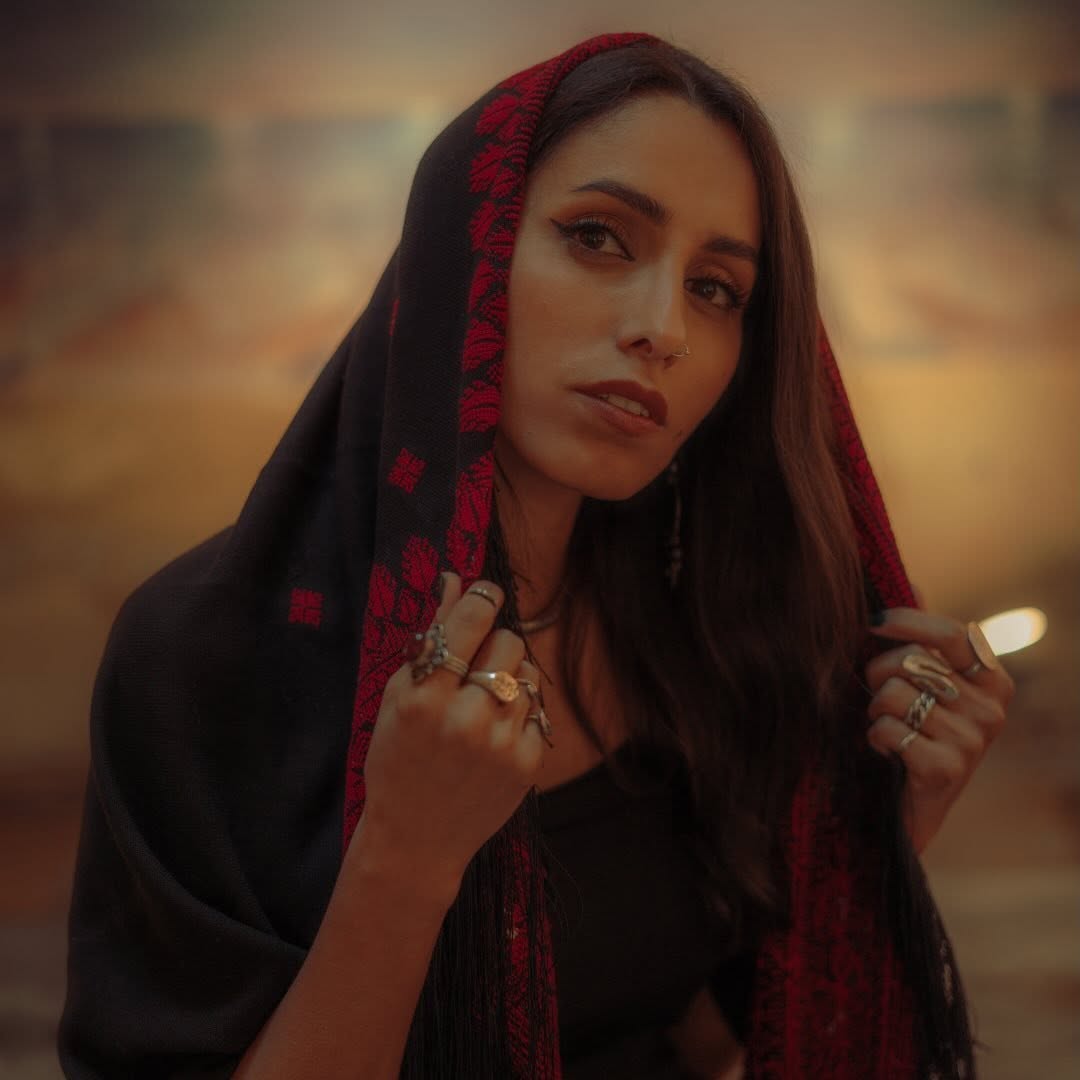
Palestinian vocalist and musicologist Salwa Jaradat has spent years recovering voices that history almost buried. The women she went looking for, deep in the shellac archives of a Lebanese mountain foundation, sang adwar in an era when that form belonged to men, performed theatrical roles written for bodies unlike theirs, and left behind recordings that most of the Arab world had stopped hearing before they had properly started listening.
On a bright afternoon in late March, outside La Friche Belle de Mai in Marseille, a few hours before her evening showcase at La Plateforme as part of Babel Music XP, Jaradat spoke about what those women gave her and what the present is demanding back.
That present was war. Israeli strikes had returned to Beirut and the rest of Lebanon on 2 March, and by mid-April they had killed more than two thousand people and driven more than a million from their homes. In Gaza, where the ceasefire announced the previous October had held in name more than in practice, more than 70,000 people had been killed since October 2023. As a Palestinian whose musical life was built partly in Lebanon, Jaradat felt both wars closely. “Of course we’re very impacted by everything that’s happening, but what I can do is sing, and so this is what I do.”
She learned to sing at the Edward Said National Conservatory of Music in Ramallah, then took that voice to Beirut and the ASIL Ensemble, a group devoted to classical Arabic music. In 2016 she started work as an archivist at the AMAR Foundation, digitising recordings from the Nahda period, and there she found the women who would become the spine of her work.
What she found in the archive were women who had been doing the unthinkable for their era. “There was a moment in my life when I was mainly listening to very old music made by women. Of course we all know Umm Kulthum, but there were even earlier singers, such as Munira al-Mahdiyya and Asma al-Kumthariyya, from the late 19th and early 20th century, whom I discovered through my work as a music archivist at the AMAR Foundation in Lebanon.” Al-Kumthariyya, a Tunisian singer, took up adwar when the form was sung by men. Al-Mahdiyya, the Egyptian singer known as Sultanat al-Tarab, sang adwar for male audiences and, when her mentor fell ill, went on stage disguised as a man to sing the role written for him. Their recordings survive on 78-rpm discs, and Jaradat listened to them closely. “I really went deep into their voices and got to know this original music.”
That archival work produced two concert productions performed at Metro al Madina theatre in Beirut: “Huna Al-Quds”, based on recordings from the radio station of the same name founded in Jerusalem in 1936, and “Awalem Share’ Imadiddin”, another homage to the early Arab female singing tradition. Both shows were the product of research turned into performance, Jaradat moving between historian and vocalist within the same project. Now, after years of that dual practice, she has released her first original album.
Nafas, Arabic for breath, came out on 13 March on Thawra Records and Tiny House Music. “Last week I released my own first personal album, which is called Nafas. It’s far from the world of electronic music. It’s a composition made from poems by Sufi women from the region that I turned into music.” Those poets span seven centuries. Rabia al-Adawiya and Sayyeda Nafisa wrote in the eighth, Fatima, the wife of Hamdoun al-Qassar, in the ninth, Maymouna bint Hassan in the twelfth and Aicha al-Baouniya in the fifteenth, alongside Rayhana, known as the Fool. For Jaradat, bringing their words back is part of the same work she began in the archive: the record is “a form of resistance, the reflection of our culture, and the fruit of archives that must be preserved.”
The songs took shape during a residency at Hammana Artist House in Lebanon, with Cham Salloum on oud, Ali Hout on percussion, Raphaël Haddad on soprano oud and violin, Makram Aboul Hosn on double bass, and buzuq alongside. The arrangements are spare and move patiently, with her voice at the centre: held, extended, precise. Lebanon was meant to hear it first, but the Beirut launch was postponed twice as the situation there made it impossible, and the album was presented instead at the Institut des Cultures d’Islam in Paris in mid-March.
The present reached Marseille as well. The festival had billed the set as Etyen & Salwa Jaradat. “Tonight was supposed to be with Etyen, mixing electronic music with traditional Palestinian songs.” Etyen, a Lebanese producer and electronic musician, had been her partner in that since the Galah Waji EP in April 2022. He remixed the title track of her 2024 EP Inta Mana Walla Mahom, and in March 2025 the two released the Qoumi EP on Thawra Records, built on the coded language of Palestinian folklore. With Lebanon under bombardment, a medical emergency kept him from leaving the country, and the duo the festival had programmed could no longer go ahead as planned. For the second time that spring, the war in Lebanon had rewritten her plans. “Zeid Hamdan is joining me instead. I really respect him, for his values and as a musician, so I’m really happy to do this concert with him.”
Zeid Hamdan, the Beirut-born composer, producer, and co-founder of Soapkills, one of the foundational projects of the Lebanese electronic underground, already shared a project with her. “It began in Marseille last year. We were in a residency and we worked on a four-track project.” An album was to follow. “We’re going to release an album together next September.” For the showcase, the two bodies of work would share the stage. “We’re going to play the songs that were composed with Etyen, and we’re also going to add music that we were making together with Zeid.”
“Like with Etyen, the project mixes Zeid’s electronic background with my own work on traditional Palestinian songs, which has been part of my education and my creation for a while.” The title came from what the two of them share. “What was beautiful is that the project was called Resistance. Beyond the music, Zeid and I share a language and the same experience, one of us in Lebanon and one in Palestine, in the same geographical situation.”
For Jaradat, that shared geography runs through everything she makes. “As musicians we’re not excluded from everything that’s happening in our region, so our music can’t avoid expressing what we feel about the situation.” The work with Etyen is a case in point. “When we composed with Etyen, I can’t tell you it was before the current events, because there has always been a conflict situation for us, especially for Palestinians. Of course our creations will always be influenced by circumstances, but at the end of the day that will never prevent me from singing, because this is what I do, this is what I’ve always done.”
Keeping on singing comes at a cost, and she is plain about it. “It’s actually really hard. The people close to me know how much the situation affects us. Sometimes we go very low, very deep down, and in the end we always try to come back up and continue, because we realise that throughout history, artists from our region have faced the same challenges.” She sees that history repeating in everyone who keeps creating under the bombs. “I read a lot of poems from Gaza, from the heart of the war, and I think about how much creativity, music and poetry are our way. We have chosen this way of expression, and I feel that we are part of history today.” That persistence is what convinced her. “In spite of the situation they’re still able to create, and I realised that this is our way of expressing ourselves, it always has been. Through this creation and these words, we are the ones who own our narrative.”
Owning the narrative is, for her, a task with a clear owner. “We are able to do it, and we have to do it, and this is our role today. We have to focus a lot, we have to choose our terms, and we have to write. We have the right to write.” The reason lies in what the war is aiming at. “The war is not only about destroying buildings and infrastructure. It’s also trying to destroy our ability to be ourselves and to maintain our culture and our identity. So writing and expressing ourselves is a necessity and a duty, and also our way to cope and to continue to be present, and we need to be especially aware of the words and the expressions we use to defend our culture in this moment when they’re trying to erase it.”
Electronic music is one part of that expression, and she is careful to keep it in proportion. “I just want to be precise: I don’t only do electronic music projects. I still do my own projects of purely classical Arab music, which I’m really connected to. Any musician loves to experiment and learn new things, and electronic music is a new challenge for me, because it’s far from the way I learned.” The distance is the point. “It’s really remotely connected to my way of creating and singing. So I’m living a new challenge for myself, and I’m also discovering my voice with it.” She hears the difference most clearly on stage. “When I sing traditional Arabic music live, there’s a feeling we all share. We make music with our feelings, with our emotions, and it’s very organic. With electronic music there’s a very clear rhythm, and the sounds are very obvious. For me it’s a very different experience, and I’m interested to see what comes out of my way of singing with this kind of music.”
Her listening now reaches outward from the archive. “Today maybe I’m more open. I’m listening to more international and traditional music, and especially electronic, and I’m trying to build a bridge between my knowledge of old music and what I can present to people: voices that they like, that are needed on the scene, that are beautiful, and that I also like.” Among those voices are the Syrian vocalist Lynn Adib, Hamdan’s partner in the Bedouin Burger project, and the Palestinian singer Nai Barghouti. “I’m really attracted to new artists on the scene, and I feel that they have a lot of intelligence. Lynn Adib, for example, I think her work is very smart, and Nai Barghouti, a Palestinian singer.”
Later that evening at La Plateforme, with Zeid Hamdan beside her, Jaradat sang traditional Palestinian material over electronics, including the songs she and Hamdan had begun in Marseille under the name Resistance. Before the show, she had thought about an audience that would hear her sing in Arabic. “Not everyone will be able to understand my lyrics tonight, but I would still like them to share the idea that what gathers us, what unifies us, is bigger than what divides us. So tonight I would like us to feel the music together, away from our differences. Let’s focus on the things we share. Right now it’s very difficult to remember how human we are, in the full sense of the word. The only thing I want for tonight is for us to feel the musical moment, and for all of us to remember to seek the humanity inside us. That is the most important thing we should try to preserve nowadays.”
Nafas, Salwa Jaradat’s debut album, is out now on Thawra Records and Tiny House Music
Bandcamp also has her Inta Mana Walla Mahom single and her two EPs with Etyen, Galah Waji and Qoumi.