

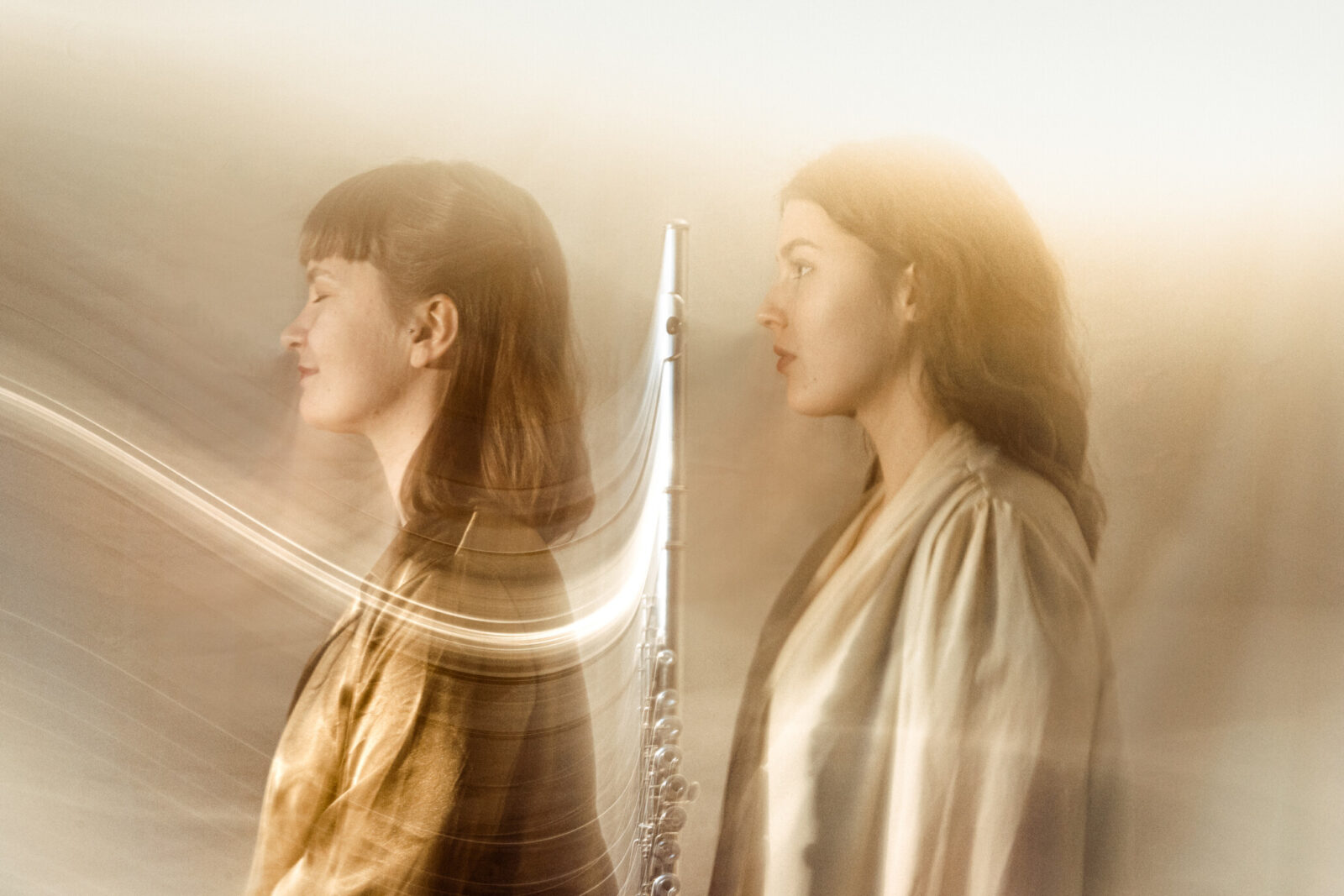
Katariina Tirmaste was teaching at a traditional music camp in Estonia five years ago when one of her students, Kärt Pihlap, ended up on stage beside her. “We just looked at each other. And then we played,” Pihlap says. “The chemistry or the listening was really good between us. And so it was like, oh, wow, experience.” They kept going after that. The two flutes became a project, and the project eventually pulled in a third element when they collaborated with the Estonian producer Maris Pihlap and discovered that electronics belonged in the room too. Kuula Hetke – Pihlap and Tirmaste, two flutes, voices and a live looping rig they built themselves – were born out of that combination. Earlier this year they took the Debut Album of the Year prize at the Estonian Folk Music Awards Etnokulp.
We met at La Friche la Belle de Mai in Marseille, a few minutes after the duo had opened the daytime showcases at Babel Music XP. The set had started quietly, two flutes, close listening, the kind of sound that asks the room to lean in, and by the end a group of delegates near the stage had stopped watching and started dancing. Pihlap and Tirmaste were still carrying some of that energy when they sat down.
That electronic edge is a far cry from the project’s acoustic beginnings. Integrating digital textures was never intended to be permanent; what started as a one-off experiment with Maris Pihlap simply revealed a new way to work. Tirmaste traces it back to that first session: “It all started with this collaboration. And it was just a one-time collaboration. But we found that the electronics actually bring a lot to our music. So we started looking for ways how to do it all ourselves as well. And then we dived into the world of MIDI technology and live looping.” Before any of that, the two of them had already been chasing rooms that did some of the work for them, as Pihlap puts it: “We like playing in churches where it’s really reverb-y.”
Running the rig themselves meant rethinking what performance actually requires of a body. The flute takes both hands, which leaves the feet, and Pihlap is matter-of-fact about what that means in practice: “Now we are basically playing two instruments at the same time. With our feet and then flutes and the keyboard.” Pedals, buttons, loops going on and off, effects layered mid-phrase, breath still moving through the flute the whole time. “You play flute and your hands are full already. So you just got your feet. To press buttons and loop there and put some loops on and off. And do some effects with our pedals. That’s our way.”
They came to all of this inside a country where traditional music has never been a fringe concern. In Estonia you can study folk music from music school through to university, and the training gives players the core of the tradition before they start pulling it apart. For Tirmaste, that foundation is what makes experimentation feel natural: “I think in schools it’s still more straightforward. And so when you study Estonian traditional music, you get the core, and then you can expand the core according to your own taste.” Which means that when Kuula Hetke run archive tunes through a MIDI rig, no one in Tallinn finds it particularly strange. Pihlap makes the point simply: “Maybe the village musicians would have also used electronics if they had them. There are some examples already, and then people can see that it’s possible to do so.”
The material starts in the archive. Kuula Hetke build their repertoire from tunes tied to the specific Estonian regions where their grandparents and great-grandparents were born, working outward from that family geography as the circle of relatives widens. “We started as more particular, but now we have some other places also. We have many relatives. Many places in Estonia,” Tirmaste notes. The tunes come from published collections of archive material and from the large folklore databases that Estonian cultural institutions have digitised over decades. “Most of our tunes we have found from books. Archives. Like books which have archive material published in them, yes. And also there are some webpages and big folklore archives in Estonia as well. So that’s our main source.”
From the page to the hands, the process moves in a fixed order. Two flutes first, jamming on the melody until it opens up. Pihlap, who studied production alongside traditional music, describes how the arrangement builds from there: “We have some inversions or arendused. Anyway, we expand them, and then we do electronics. Since I also studied production, I have the ability to put my thoughts into electronics also, and then we together can work on that too. So it’s melody first, then some electronics, and then we arrange if we have some new ideas around that.” Tirmaste came to the music through a different route: “I have mostly studied traditional music, and Kärt has studied producing and also traditional music.”
That difference in background shapes how carefully they handle what they find in the archive. “I’ve grown up in traditional music, and I feel like I’m at home with that, so it’s not that I’m doing something completely unknown. Since we are Estonians and our grandfathers might have played those tunes, it’s more close to us, and we try the best to not remix it too much, to capture the essence of it still, but with electronics,” Tirmaste explains. Pihlap puts the same thought another way: “We try to keep the core of the tradition and just build on it.”
The same electronics that hold everything together also make change expensive. “Since electronics, it’s quite a lot of work. If you want to rearrange something, then it’s not, like, okay, let’s play it differently. We have to redo everything electronically. There are so many connections that need to be rebuilt,” Pihlap notes. What they have worked out is a structure that holds the core but leaves the edges open: “Electronics set some boundaries, but at the same time we try to leave some boundaries open as well. For example, we have lots of loops which are pre-recorded, but we can start and stop them when we want to.” The studio and live versions of the same tune pull apart from each other over time, and neither of them tries to close that gap: “The tunes, for sure, are not exactly the same every live, and also from studio to live versions.”
Both musicians currently live in Tallinn, and both are paying attention to what is happening around them in the city. When Pihlap talks about younger Estonian artists she wants people to hear, she moves away from folk entirely. Alonette first, working in what Pihlap calls “dreamy pop, and then the drummer Kristian Tenzo, whose recent solo album she recommends: “It’s really rhythmic. In some circles we call that kind of music stoner music. So you can really go to places with it.”
Outside Estonia, the concerts take on a different weight. For Tirmaste, that means something specific: “There’s lots of teaching when you bring it outside of Estonia: you become a representative of the culture. You’re bringing a touch of Estonia abroad, teaching some facts about it.” The labajalg, a traditional Estonian dance, is one example, and the only way to explain it is to make people do it. “By now, every audience we’ve played to has danced it. There’s a corporeal understanding of Estonian folk dance that way.“
That “ambassador role” has taken them as far as Rajasthan. A meeting with organiser Divya Bhatia at Tallinn Music Week led to a booking at Jodhpur RIFF, the Rajasthan International Folk Festival, and performing there raised questions about language that Estonia never had. “We understood, for example, the importance of translating our lyrics there. In Estonia you just sing the song and that’s it. But if you sing in your national language abroad, you have to think a little bit more.” The setting didn’t make it any easier: a sunrise set on top of a hill, soundcheck at 3AM “It was crazy, but it was beautiful.“
Marseille asked different things of them altogether. The club room at La Friche pushed the bass forward in a way a hilltop in Rajasthan never would, and Pihlap felt it immediately: “Here we had club room. So the bass was really coming out. The venues really, really change your music. And also you change your presence, of course, because you have to adjust yourself. When we are rehearsing or composing for a specific event, we for sure take the venue in consideration as well. We could still play in churches… Or also lately we have played quite a lot of clubs. So that’s what has also shaped our sound in a way. We are flexible.”
The Babel Music XP showcase was built almost entirely from new material, the foundations of the album they are currently finishing. “We are working on our new album, which is basically the basis of our show today as well,” Tirmaste confirms. No date is set, as Pihlap makes clear: “This year… Let’s say this year. End of this year, kind of. We are working. But we don’t have a proper date.” What the record does differently: more layers, more vocals, more experimentation with the flute itself. Their debut, Kuula Hetke REMIXED Live @ TMW 2023, was a live recording from Tallinn Music Week, released in 2024 and distributed by Playground Music Oy.. The new album will be their first made in a studio.
But whether they are tracking in a studio, playing a club in Marseille, or facing a home crowd at Viljandi Folk Festival this summer – returning to the scene where the project began – the baseline of the project stays exactly the same. “We’re from Estonia. We play two flutes. We play traditional music. We love to listen to the moment and be flexible to things which are around us,” Pihlap says. Tirmaste finishes the list: “Yes, flutes, voices and electronics. And Estonia.”
Visit Kuula Hetcke's Official Website for news and tour dates, and follow them on Instagram and Facebook
Their music is available to stream on Spotify and YouTube
Photo ©: Kerttu Kruusla