

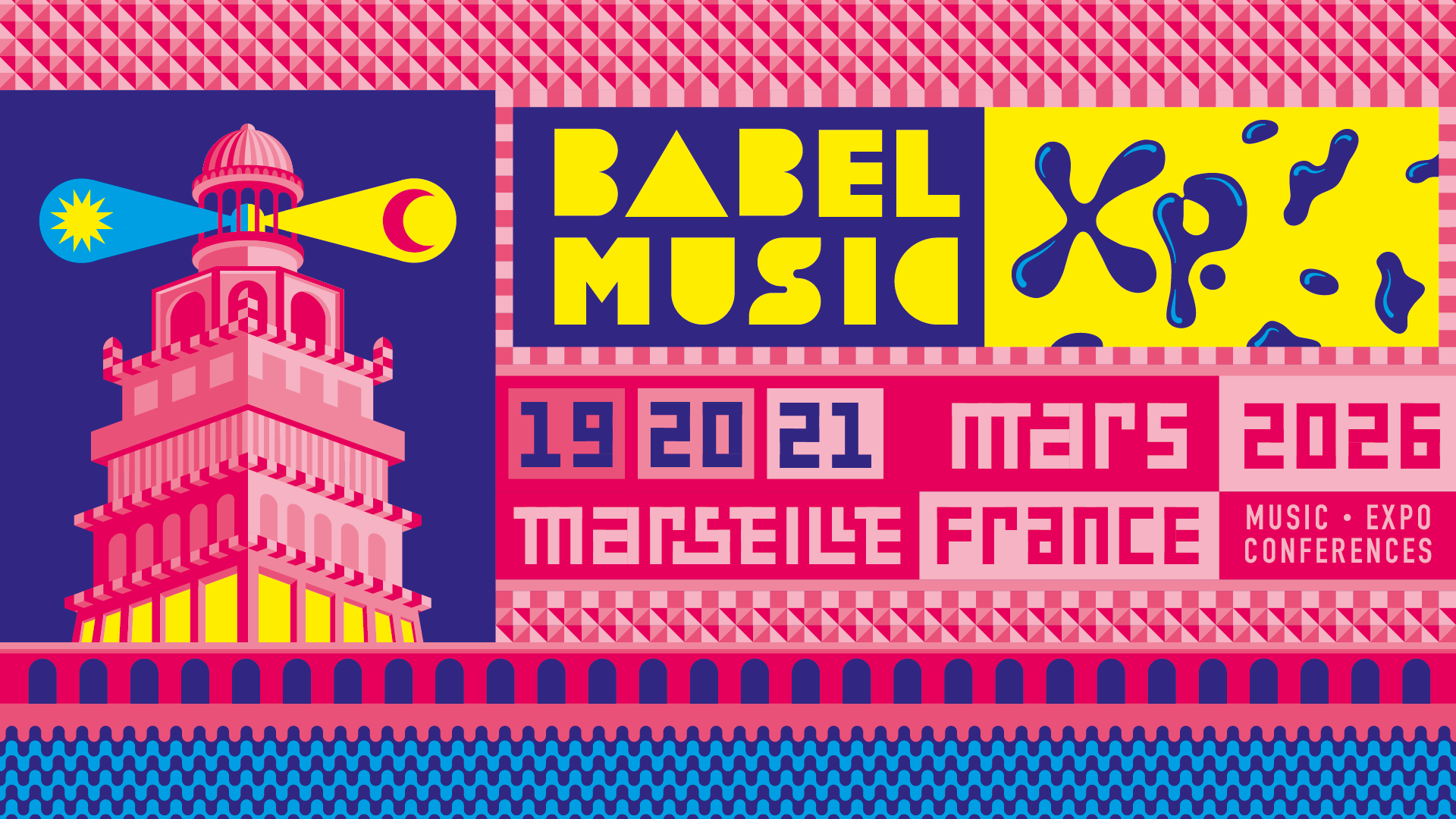
Thirty-one bands. Twenty-five countries. Three nights where Mongolian throat-singing, Congolese electro-punk and Occitan polyphonic percussion share the same city programme. Every March, Marseille becomes a compass point for global music, and Babel Music XP is the reason why.
From Thursday 19th to Saturday 21st March 2026, Babel Music XP returns with its twin identity as festival and professional forum, anchored at La Friche la Belle de Mai and spread across Espace Julien, La Plateforme, Cité de la Musique, Alcazar and Le Makeda. The current format grows out of the long-running Babel Med Music era, but its focus now stretches across contemporary global sounds, traditional lineages and jazz, matching Marseille’s position as a Mediterranean meeting place — or, as the festival’s director Olivier Rey puts it, “a beating heart of world music.“
The 2026 musical programme emerged from 2,781 submissions received from 117 countries between June and July 2025. A 12-member selection committee convened at La Friche la Belle de Mai in early November to determine the official selection. Made up of festival artistic directors, venue programmers and network leaders from across the sector, with representatives from France, Lebanon, Morocco, Germany, Portugal and Spain, the jury reflects the festival’s cross-Mediterranean scope and its reach into wider European and African networks.
By day, La Friche hosts the international trade fair, hosts the international trade fair, bringing together around 2,000 professionals from 72 countries across five continents. This year’s edition marks the first European appearance of major Asian industry players — Bangkok’s Music City, Singapore showcases and Indonesia’s leading festivals — alongside the artistic director of New York’s SummerStage, the 45-concert summer series in Central Park. Exhibitors, labels, agents, venues and festivals share the same floors, while a structured programme of talks and debates follows three threads: Professions and Knowledge Transmission, Challenges and Transitions, and Territorial Impact. Speed meetings give artists and organisations timed space to introduce projects and build collaborations, and the discussions keep funding, mobility, ecology and local cultural policy in clear view.
Beyond networking, the forum functions as a professionalisation tool: emerging artists find partners for career development, while established acts use the platform to organise international tours. Current market momentum points towards Latin America and a newly opening Asian circuit, with Babel Music XP positioned as a gateway to the European market. It’s worth noting the stakes: the music sector and creative industries represent the fourth largest employer in Europe.
At night, the focus shifts to the showcase festival, with around 10,000 audience members expected across the three evenings. Thursday opens across four venues.
Thursday opens across four venues. At Espace Julien, Broua connect Tunisian song with jazz, blues and Latin elements from their Netherlands base, while Célia Wa presents a solo set rooted in Guadeloupean Gwo Ka percussion, folded into neo-soul, electro and hip hop. Etenesh Wassié brings an Ethio-French group that stretches Ethiopian vocal repertoire through electric bass and drums.
At Cité de la Musique, Mongolian–German quartet Tengerton centre morin khuur horse-head fiddle and throat singing, and Inner Spaces link Iraqi maqam structures with trumpet, santur and electro-acoustic work. Alcazar hosts a chamber trio of violin, clarinet and cello in dialogue with Malian griot singer Mah Damba, and Meryem Koufi revisits Algerian nouba repertoire on kouitra with electric-oud pioneer Mehdi Haddab. Le Makeda rounds out the night with artists including Palestinian songwriter Ahmed Eid, connecting Ramallah and Berlin through Arabic song and electronic arrangements.
Friday’s programme runs mainly at La Plateforme, with a dedicated concert at the GMEM module inside La Friche. Réunion group Lindigo bring two decades of maloya practice, with the island’s ternary rhythms moving alongside West African and Afro-Caribbean references. Super Parquet line up cabrette, banjo and squeezebox with synths and drum machines in a high-voltage take on central French dance music they describe as psychedelic traditional.
Brussels collective Re#Encounter connect Gnawa rhythms, cumbia, griot narration and jazz improvisation in large-ensemble form, while Djazia Satour presents songs shaped by Algerian hawzi, Sahrawi patterns and jazz-leaning harmony, built from the interaction of voice, bendir and piano. Isam Elias, Palestinian pianist and producer known from electro-dabkeh duo Zenobia, brings a solo electro–Afro–Oriental live set, and Sskyron with DJ Dan fuse Réunion maloya percussion with trap, amapiano and club electronics.
Earlier in the day at the GMEM space, South Korean trio Groove& focus on gugak percussion, presenting court, folk and ritual material in a compact live format that rarely reaches European festival stages.
Saturday splits between La Plateforme and the Grand Plateau at La Friche. Cocanha bring Occitan polyphonic singing and percussion geared towards collective dancing as much as listening. Article15 present an electronic Congolese afro-rap project rooted in Kinshasa street experience, while Bandua rework traditional song from Portugal’s Beira Baixa region with adufe frame drums and electronic sound design.
Colombian group Sonoras Mil draw on the country’s Pacific coast traditions, and Barcelona-based Peruvian producer Vitu Valera threads cajón and quijada through club-focused beats, and Miksi gather Kurdish, Syrian, Albanian and French musicians around migrant repertoires with violin, daf, clarinet, cello and digital textures. By The Sket Quintet frame memories of Algeria’s Black Decade in the interaction between Alima Hamel’s voice and Vincent Ferrand’s double bass.
On the Grand Plateau, Jawhar brings Arab indie folk songs arranged for voice, guitar, piano and backing vocals, setting a quieter contrast to the heavier club-focused sets. Ondéla, led by Béarnais musician Alain Larribet with drummer Sébastien Tillous, places Occitan material alongside Armenian duduk, Chinese hulusi, Indian harmonium and a range of African, Cuban and Brazilian percussion instruments.
Back at La Plateforme, Lebanese producer Etyen and Palestinian vocalist Salwa Jaradat close the picture by bringing Palestinian folk poetry into an electronic context that underlines the coded language of resistance embedded in wedding songs and oral traditions.
As Rey puts it, “Those who will fill the stadiums in two years, you will see them at Babel Music XP.” If you work in the sector, accreditation opens three days of meetings, speed sessions and access to more than 2,000 professionals; if you are there to listen, a ticket puts you in front of artists who rarely reach mainstream circuits on this scale.
Full information on passes, schedules, venues & the complete official selection
is available via the Babel Music XP website