

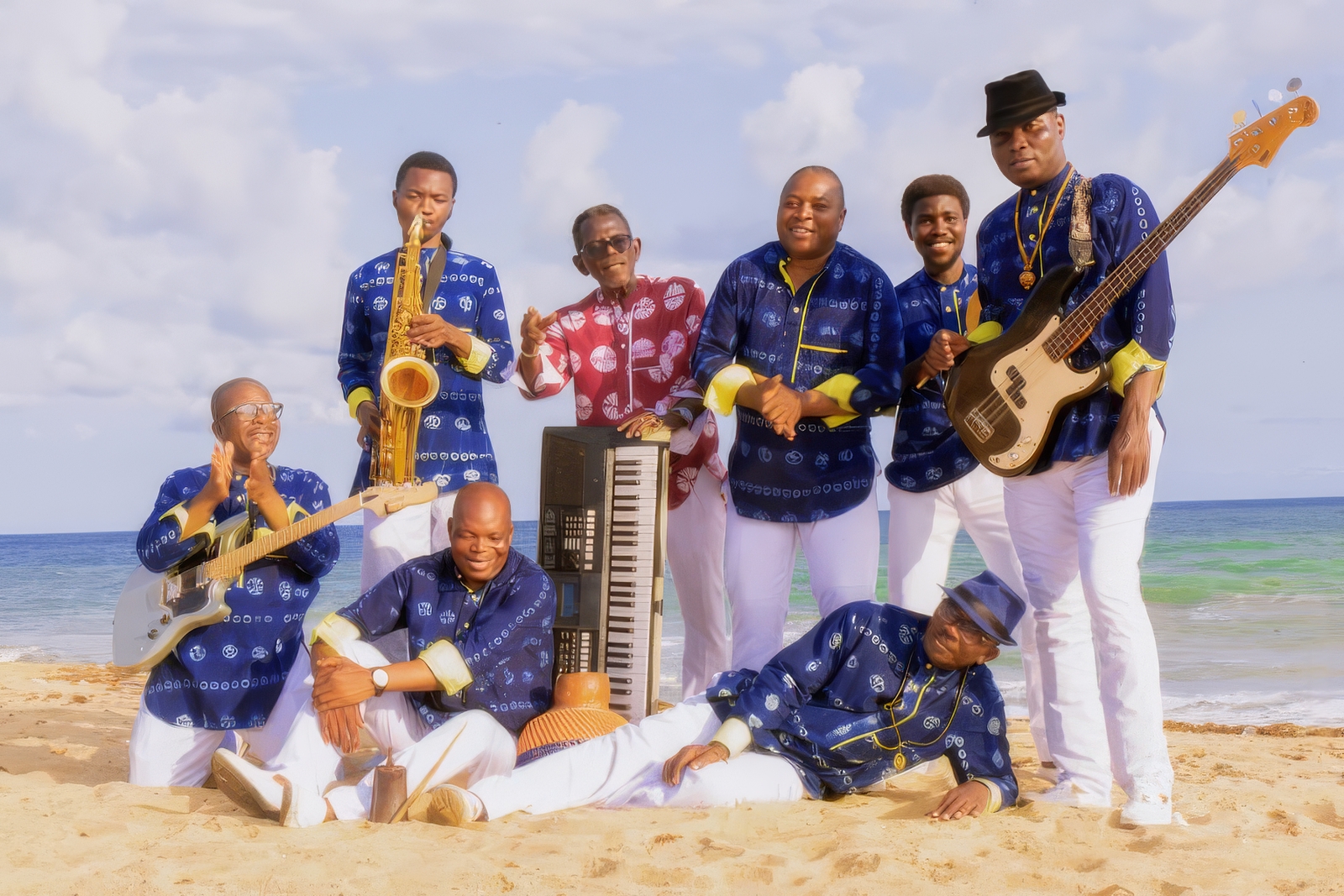
In Cotonou in the late 1960s, the world’s music arrived through a single loudspeaker. The national radio was the only window, and the young musicians who would become Orchestre Poly-Rythmo de Cotonou kept their ears pressed to it, waiting for whatever was new from abroad. James Brown, soul and rock came down the airwaves. The band took the best of it, added the rhythms of Benin, and built a funk of their own that would fill the clubs of Cotonou, Lagos and Accra for more than a decade.
That funk was still going strong in 2025, fifty-seven years after their founding in 1968, when the band returned to London’s Jazz Cafe in Camden, seven years after their first visit in their fiftieth-anniversary year. After the soundcheck, with the stage set for their show and the room ready for Poly-Rythmo’s tropical funk storm, we sat down in the venue with Vincent Ahéhéhinnou, the founding singer who now leads the band alongside fellow founders Gustave Bentho and Pierre Loko. He answered in French, with Claire Henocque of the band’s agency, Tour Makers, translating, and he began with the room itself. “I feel very good in my skin. It’s a real pleasure to come back to this venue. We came here a first time and it left us a very good memory. We’re happy to find this room again and this good sound. We’re going to have fun and entertain everyone tonight.”
The radio is where it all began. “Of course, in our time, the sixties and seventies, our only source of musical information was the national radio. We were glued to it, to find out what was new from abroad. We took the best of those songs and tried to add our own sounds, to give them a new face.” Everything since has been built on that foundation. “Today I believe nothing can be done without going back to that base. It sticks to us, it sticks to our skin. Those outside influences allowed us to make music, because in this group we are self-taught. We learned from what others had done. We are grateful to them, and today we keep asserting our music by being more original.”
Before the radio, there were the orchestras of Benin itself. Ahéhéhinnou grew up in a country where bands, not solo stars, ruled the dance floors, and he still names the ones that made him want to sing: the Renova Band, the Super Star de Ouidah and Les Troubadours de Ouidah. “In Benin, I listened to the old musicians, the old orchestras, because in our time there were no solo artists, only orchestras, and they were hugely successful. There was the Renova Band, the Super Star de Ouidah, the Troubadours de Ouidah, who made very good music, music that rocked me to sleep. And I wondered if one day I could do like them, so that people would listen to me too. God granted my prayer.”
More than half a century on, the sound has moved with the times without leaving its road. “Music lives in time. Everything changes, everything evolves. We try to adapt our music to the present day while staying faithful to our line, which is funk, giving it new sounds and new faces. But it is still the funk of Poly-Rythmo. The funk we compose today has a different face from what we had, but it is still original. The imprint has stayed. We have never left our path. We have kept the same line.”
That line has outlived many of the musicians who drew it. Founder and bandleader Mélomé Clément died in 2012, and guitarist Bernard “Papillon” Zoundegnon decades earlier. Yet replacing a member has never meant teaching the music from scratch. “Today we are the influence for other musicians. They refer to Poly-Rythmo in all their work, because we are their source of inspiration. We have existed for a long time, and in our country and in the region, all the musicians play Poly-Rythmo. So when we lose someone, it is easy to go and find someone who plays very well and bring him in to replace the one who has gone. Those who join us already know Poly-Rythmo before they arrive. It is in them, so the work is not complicated. You will see that even though we have lost many members, the music of Poly-Rythmo stays the same.”
The songs travel further still. After decades of near-silence outside West Africa, Poly-Rythmo were brought to a new audience by a run of compilations. First came Soundway’s The Kings of Benin: Urban Groove 1972-80. Then, between 2008 and 2013, Analog Africa issued a three-volume series dedicated to the band: The Vodoun Effect, Echos Hypnotiques and The Skeletal Essences of Afro Funk. The band returned to touring in 2009, and two years later released Cotonou Club on Strut, produced by the French journalist Elodie Maillot. Today their recordings are remixed, reissued and reworked by producers who were born long after they were made. Ahéhéhinnou takes it as a gift. “It is a renaissance. It extends my existence. I am very happy to know that my works, which are more than fifty years old, still interest people and are taken up by others. It lets me go on living another fifty years, because the minimum age of a work is fifty years. I am happy, and I keep working in that direction so that tomorrow it can still interest people. It is an honour and a pleasure.”
The crowds in front of the stage tell the same story. “I have always felt good about it. Since we re-started touring in 2009, I have been sure that our music interests young people more than older people. They told me so here in England. A programmer who worked with us at the start told me that we interest young audiences more than old ones, and that surprised her. There is something in music that young people are looking for, and they find it with us. These young people will carry on our work. If they love a Poly-Rythmo that is fifty-five years old today, you can see that in fifty-five years Poly-Rythmo will still be avant-garde.”
At home in Benin, the young are listening to their neighbours. “Today it is a music that came from Nigeria that influences the young. But that doesn’t stop them taking our songs and adapting them to today’s influences. Every day they go and dig into our songs to make their music. Poly-Rythmo is still current at home, because we have countless works that people discover as the days go by. So we keep acting on the young, without meaning to, and we are part of today’s music, even if very few of them play funk now. They grew up with Nigerian and Ghanaian influences. That is what is happening. But they never fail to go digging into our songs.”
What worries him more is what the new sound has left out. “Today, music in my country has shut out a lot of instrumentalists. You no longer hear the instruments in today’s songs. The drums are given no room apart from the beat. The keyboard no longer exists. Nothing exists, because it is all digital. I have said it is a crippled music being made today. But young people like it, and music follows its current. So I am here, I am watching.”
The band celebrated its fiftieth anniversary in 2018, and on the night we met, the sixtieth was just three years away. Ahéhéhinnou intends to be there, and beyond. “I am not a fortune teller, but I hope to still be here to shape the world of Beninese music, so that young people know the music that can last.”
That shaping already starts inside his own band, where young musicians now play alongside the founders, and he makes sure the audience gets to know each of them. “When I introduce ‘Africa Lolo’, I present the band one by one, and each of them tries to show what he can do, with a certain fire, and it gives the result it should. You will see the youngsters tonight. The youngest is twenty-seven, I think, so they have time, and experience still to gain. We are together to guide all that, presenting them to the audience and telling the audience what they are worth, and what they can be worth tomorrow. That is what we are working on.”
Their most recent studio album, Madjafalao, came out on Because Music in 2016
More on the band, their music and their upcoming dates is at poly-rythmo.com