

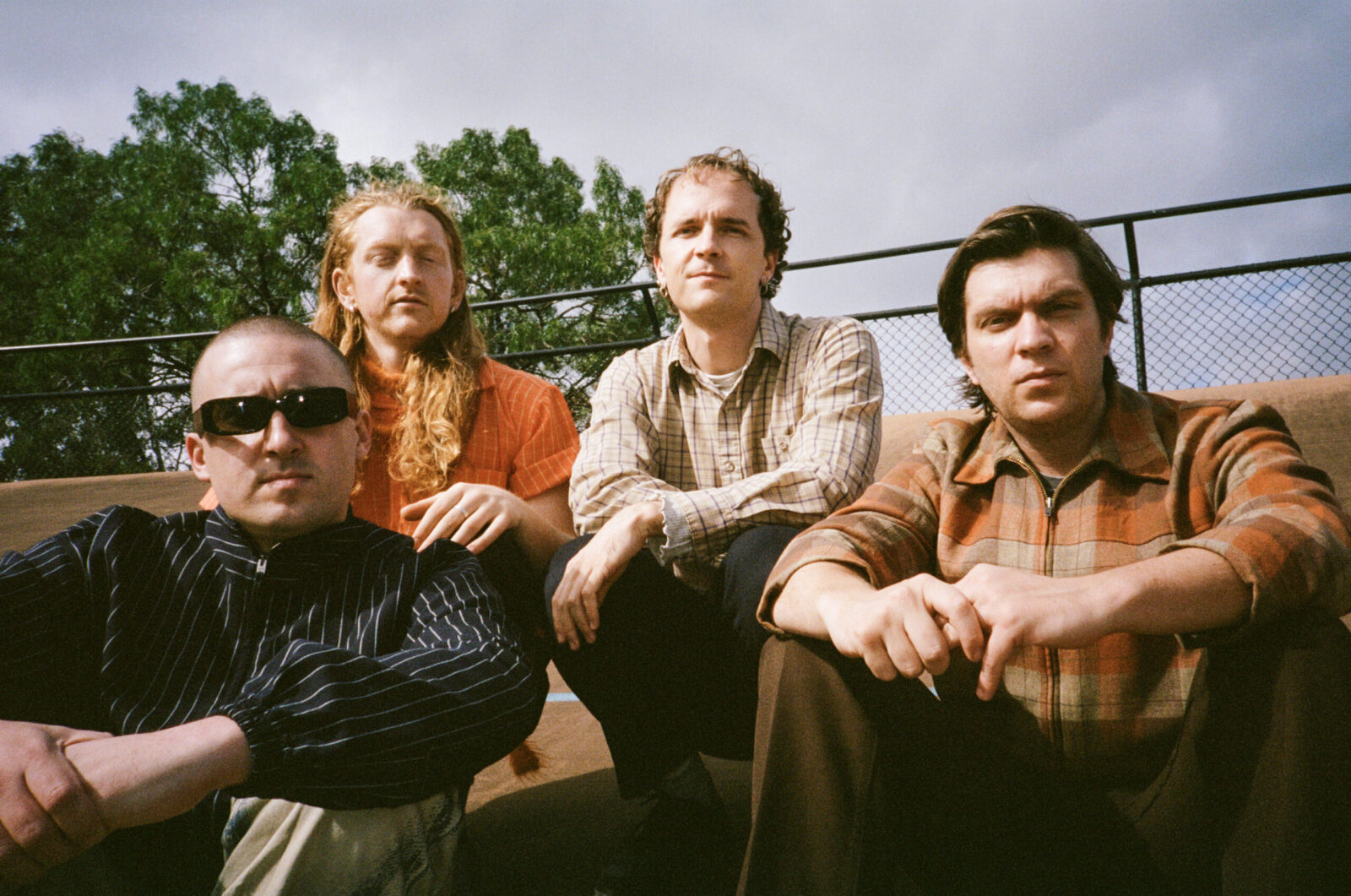
Karate Boogaloo have been playing together since they were schoolboys, in the same Melbourne high school maths class, which is the sort of fact most bands turn into a claim about chemistry. Ask what twenty years of it buys them and Henry Jenkins offers elbow grease and luck, and reckons anyone could do what they do. Except only they can…
What they do is instrumental funk and soul: bass, drums, organ and guitar, cut to tape, with nobody singing over the top. It runs in both directions. Across three volumes of the KB’s Mixtapes series the four of them play by hand the records hip-hop producers sampled, and away from KB, they cut new library music as Frollen Music Library for producers to sample in turn, which is how their playing reached ScHoolboy Q‘s “Smile” and Leon Thomas’s Mutt.
Access All Areas, out on 9 October, holds to that and clears out the rest. Eleven tracks, and as the release notes have it, “if a tune became convoluted, to the bin it went”. It comes through Colemine Records in Loveland, Ohio and College of Knowledge Records in Coburg, Melbourne, the second album the two labels have shared. For the first time the band handed the recording to someone else. Alex Bennett cut it at Sound Recordings in Castlemaine, on tape machines built between the 1950s and the 1980s, all of them kept running by his own hand.
Jenkins plays bass, Hudson Whitlock drums, Callum Riley organ, Darvid Thor guitar. They got here the long way, first as the rhythm section of The Cactus Channel, then Hold Your Horses in 2024.
With Access All Areas a few months out, we put a handful of questions to the band, and Jenkins answered for all four, correcting half the rules KB are known for, keeping Thor’s fugues off the record, and leaving the question of why Melbourne sounds like this to a local historian who does not yet exist…
You’ve been playing together since you were preteens in the same high school maths class, and the new record marks nearly twenty years of that. What can four people who’ve known each other that long do musically that a newer band simply can’t fake?
We’re afraid it’s difficult for us to make that claim, with a little bit of elbow grease anyone can do what we do. Luck has been the key ingredient, it has come careening our way on many occasions. It has to if you’re blessed to play music with your best mates for as long as we have.
KB started as the rhythm section of The Cactus Channel and got described early on as a “side project”. At what point did it stop feeling like a side thing and become its own animal?
We were originally a cover band and a cover band only. The Meters, Booker T & The MG’s, etc. Then one day we wrote a song called “Stay Healthy” and everything changed. We crossed the River Rubicon that day.
The band famously imposes strict rules and guidelines on itself: tape only, no plug-ins, no edits, mono releases, four instruments and no vocalist. Where did that manifesto come from, and does the discipline ever feel like a cage rather than a tool?
We’re suckers for strict rules but we’ll have to correct a few of those. We record to tape, however we do mix on the computer and we do use plug-ins. No weird plug-ins though, just Waves Doppler. The mixtapes are mono, the albums are stereo, and vocalists are expensive, rightly so. As all good manifestos are, ours is a work in process, and may it forever be. Some rules are carrots, some are sticks, KB needs both.
The KB’s Mixtapes series flips hip-hop samples and film and TV themes back into instrumentals. Talk us through how you pick what to reinterpret, and how far you’ll twist something before it stops being recognisable.
Imagine the film 12 Angry Men but with four guys arguing about which song to include on an obscure funk mixtape, now picture the exact opposite of that, it’s somewhere in between. When it comes to how far we’ll go, we’ll twist it until it breaks, put it back together, and then hit record.
You’ve said the aim with a cover is to bend a well-known tune almost beyond recognition but not quite. Is there one you pushed too far, or one you couldn’t crack no matter how hard you tried?
There’s a mountain of tunes we couldn’t crack, we can’t recall them all. We tried making an album called Come With Us, Let’s Terraform Venus and Mars, uncrackable.
Access All Areas is out on 9 October through Colemine Records and College of Knowledge Records, and you’ve called it a haiku where Hold Your Horses was an epic. What made you want to strip things down this time, and what got binned in the process?
All four of us were on the bus, the 504, and all of the people on the bus started singing “99 Bottles of Beer On The Wall”, we all locked eyes, inhaled, and in unison said: “Access”. Easiest decision we’ve ever made.
You’ve said anything convoluted went in the bin and only tunes that could be hummed by anyone survived. What’s an example of something you loved but cut because it failed that test, and did any of you fight to keep it?
Darvid composes fugues for fun, and they’re frighteningly beautiful. The world will be subjected to their majesty one day but not on this record. Darvid understands.
Access All Areas is the first record you’ve made with an engineer outside the four of you, working with Alex Bennett at Sound Recordings in Castlemaine. What changes when you hand even a small part of the process to someone else?
Of all Alex’s incredible traits, and there are many, perhaps the best is that from the first step into his building you feel like you’re at home and in a space you can be yourself in. It’s a wonderful studio and he’s a magnificent engineer. We could sing Alex’s praises all day.
Beyond the obvious Booker T & The MG’s and The Meters lineage, there’s a lot of European film music and library music in your DNA. Which of those less-obvious influences do people miss, and who should they be digging into?
A favourite at the moment is Jack Arel, a wonderful French composer who we can’t recommend enough.
Melbourne’s instrumental soul world is unusually tight, bands sharing members, one studio ecosystem, College of Knowledge Records holding it together. Why do you think that particular sound took root in Melbourne specifically, rather than anywhere else?
There are funky roots that go deep in this town, deeper than we know we’re sure. The answer to the question unfortunately evades us right now but something tells us there might be a lovely local historian on this very case! Eyes peeled everyone.
For readers outside Australia who maybe only know KB, Surprise Chef and a few other acts, which up-and-coming Melbourne acts should they be paying attention to right now, in or out of your immediate circle?
To name only the first that comes to mind, Kasinda Faase is a local legend, everyone must listen to Kasinda’s music or else.
How would you describe the state of Melbourne’s music scene right now to someone who’s never been? And where in the city should they actually go to feel it?
If Karate Boogaloo ran the world every record store owner and most live music venue proprietors would receive a wheelie bin full of Nobel Peace Prizes. Two bins for the places that do both! They’re the best and they’re the reason Melbourne feels great. If we listen to them we’ll all be swimming in non-stop good times.
Forget the funk canon for a second. What have the four of you actually had on repeat this year, and would any of it surprise us?
If we could forget it we would, trust us, it’s easier said than done. Just kidding, we don’t want to forget it at all! We love all kinds of music, the weirder the better. Except any music with even a skerrick of “A.I.” in it, that’s the other kind of weird. No thank ye.
Twenty years in, with a new album about to land, what does the next 20 years have in store?
If we play our cards right and we’re the recipients of even more luck that we don’t deserve, we might just get to do the same thing all over again. Hopefully we’ll all hear a voice from the sky bellow “pull it up!”
We always close with a tricky one. In a few words, how would you introduce Karate Boogaloo to someone who’s never heard you before?
Karate Boogaloo try to play stock standard instrumental funk music and miss spectacularly every time. Listen along as they work on their aim.
Access All Areas arrives on 9 October via Colemine Records and College of Knowledge Records
The album is available to pre-order, alongside the rest of Karate Boogaloo's catalogue, on Bandcamp