

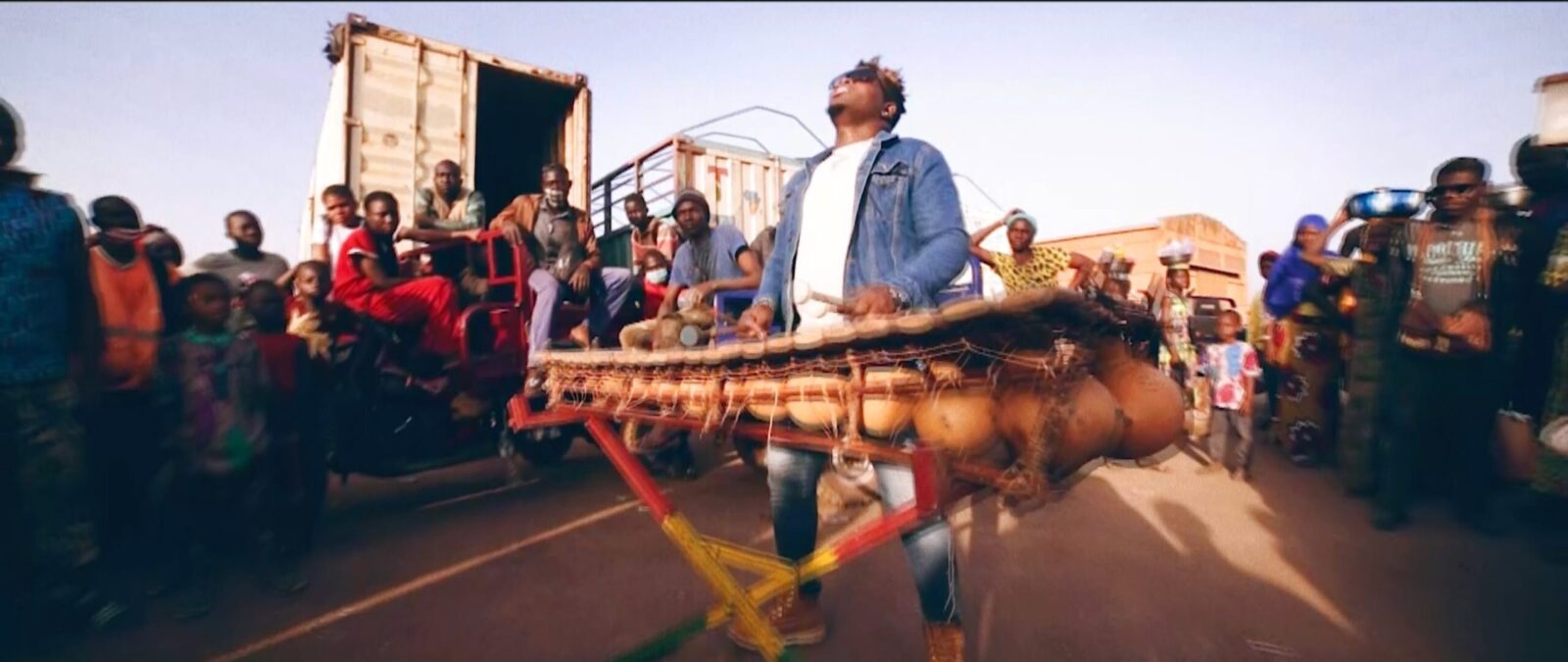
In the Sambla villages near Bobo-Dioulasso, in south-west Burkina Faso, the balafon speaks: Sambla players use it to address people directly, in phrases listeners hear as words. Seydou “Kanazoé” Diabaté grew up inside that practice, in a griot family in the Sambla village of Toronso. His father, Go Siriki Diabaté, taught him from the age of five and took him out to ceremonies and to the fields at harvest. After losing both parents before he was ten, he went to Bobo-Dioulasso and played alongside his uncle, eventually taking the lead balafon part himself. He plays the Dioula, Sambla and Toussian balafons as well as the diatonic djelibalan and the kamelen n’goni harp.
The name he performs under, and the one his Toulouse band Kanazoé Orkestra carries, belongs to another Burkinabè story. El Hadj Oumarou Kanazoé started out as a weaver and went on to build one of the largest construction companies in the country, laying roads and dams across Burkina Faso until his death in 2011. His wealth made him famous far beyond business circles, and Diabaté’s friends put the two men side by side. “It was my friends who gave me the name: ‘You don’t have the money, but you have the riches of the balafons.’ So that’s how it happened. It really became my nickname. Even my family calls me Kanazoé.”
He tells us the story over a video call. Two concerts into the tour, the band has a few hours back home in Toulouse before the road south-west to Bagnères-de-Bigorre, at the foot of the Pyrenees, for the third. In the kitchen of drummer Laurent Planells, the late spring sun pours through the window. Diabaté and fellow balafonist Mamadou “Madou” Dembélé sit back from the screen while Planells leans in close, carrying each question across to them in French.
Diabaté settled in Toulouse in 2010, and the city’s musicians gave him the reason for a band. “When I arrived here in Toulouse, I really wanted to mix African music with Toulouse musicians. That’s how we met. Slowly, slowly, we started rehearsing together.” The project began with a musician from home. Dembélé, who plays balafon, n’goni and flute and sings, had moved to Toulouse that same year. “I wanted us to do a project together, so he was the first person I spoke to about it.”
The idea came from the instruments he heard around him in France. “I love the instruments here, you see. Before, I always played really traditionally, so I wanted to mix them.” He also had a clear picture of where it might lead. “In my head, I wanted us to be a really well-known band, internationally. It was a dream. You dream in your head and you say, well, I want it to be like that.” A record was part of the plan from the start. “Also to make the album, to show what I am able to do.”
Kanazoé Orkestra took shape around the two balafons and a group of Toulouse jazz players and improvisers: Martin Etienne on saxophone, Stéphane Perruchet on percussion, Elvin Bironien on bass and Planells on drums. The griot singer Zaky Diarra joined in 2014, the year of the band’s first EP. The debut album, Miriya, followed in 2016. Its title means “thoughts”, and the band dedicated it to Diabaté’s parents. The sessions for it took place in 2015, with a group still finding out what a record asked of it. “When we made the first album, we just played the songs. We didn’t really think about making songs for an album. We just got together and played music.”
Each release since has pushed the work further into arrangement. Tolonso arrived in 2019, and Folikadi in 2022 brought in the French singer and rapper Gaëlle Blanchard, who has a background in hip-hop and soul. Planells describes a band that learned to write for the listener. “Since then, we’ve gone a long way on the arrangements: making sure everything is in its place, that the chorus is pretty, that people listen to the song and hear something.” For him the change runs through every member. “At the beginning it was new for everyone. We’ve all evolved over the past 10 years. We’ve all learned to think differently.”
Jazz entered Diabaté’s listening soon after he reached France, in a single evening. “On my first trip, I found myself one day in Lyon, in a small club, and jazz was playing. It influenced me a lot.” His ears have stayed open to everything since. “I also like listening to a lot of different music, and I like the mix.” Toulouse added its own voices, though the names slip away from him. “My problem is I don’t remember the names. I listened to him a lot in Toulouse. He made the songs. I love it.” Planells supplies the name: Claude Nougaro, the Toulouse-born singer whose chanson drew heavily on jazz and who remains one of the city’s most celebrated artists.
For Planells, the city itself explains a great deal. “What’s great about Toulouse is that there are a lot of influences and a lot of young people. It’s a big city with a cool scene.” He traces its depth to education and to the brass culture of the south of France. Music schools across the region run wind orchestras known as harmonies, and brass bands and marching bands sit alongside a large jazz community, Brazilian, Cuban and Colombian musicians, rock and hip-hop. Toulouse draws in young players from across the surrounding regions. “Anyone 18 years old and a musician from cities 100, 150, 200 km away ends up in Toulouse. So there are a lot of good musicians.”
The current six-piece line-up grew out of that pool. Diabaté and Dembélé share the balafons and vocals with the singer Losso Keïta, and every song still starts with the two balafonists. “We work a lot on the beginnings of the songs and the lyrics. He brings a lot to the melodies. Me and him, we work a lot together. How can I say it? He’s the head of the beginning.” The words are settled by all three singers together. “Then the singers: when we do the lyrics, we get together and decide what we’re going to say. There are three of us doing that, but he writes a lot.”
Martin Etienne has moved from saxophone to production. He left the band for a time and went to Ivory Coast to be closer to the music he was composing, and he now runs most of the production work. “It’s really thanks to Martin: he does most of the production work. The sound work we do together, both of us, a lot of it at home. But let’s say he’s the boss on that and I’m the assistant.” The bassist, Emilio Rudoy, joined more recently. “He’s younger, so he has a different eye on the music we make and on current music. He listens to other things. That brought another vision of the bass: its role, the bass lines, etc.”
A song passes through all of them in turn. Diabaté and Dembélé bring the melody and the words, the band tries out directions in rehearsal, and the two balafonists give notes on the details, down to where the bass line should fall. “Then Martin and I try to produce the songs and make them more modern with sounds, the computer, etc.”
Balabeatz came out on the Antipodes label in May 2025, and Diabaté treats every new record as a change of direction. “As soon as I make an album, I like to look for something else.” This time the title joins the two halves of the method: balafon and afrobeats, the Nigerian dance-pop style usually built by beatmakers at a computer. The band set out to make that music with players in the room. “And what’s interesting is that we did it in an artisanal way. We’ve always done it as a band. In a way we make computer music, but made by musicians.”
The stage comes first in the writing, and the studio follows its lead. “We think about the live first. Then, when we go into the studio, sometimes three or four of us play together to manage that. The drums, the bass, everything is played live.” Planells draws a line between the two jobs. “And it’s mostly the songs that work in the studio. The song doesn’t need so much energy there. Live is something else.” On one track, a balafon solo lasts a few seconds on the record; on stage the same passage stretches into a long build, timed to the crowd. “It’s arranged for live so that when the solo ends, people react.”
A year after release, the album lives mainly in concert. “We’ve been through a lot with this album and it’s going well. People are very welcoming. Even us, on stage, we take pleasure in playing it. If we take pleasure in playing it, it means people feel the same way.” For Planells, the recording belongs to an earlier phase, finished months before the release date. “The studio work is far away now. The memories are the memories of the live shows.”
Those concerts now take the balafon to audiences who have rarely seen one, and the reaction starts with the instrument itself. “There is no border with music. There are a lot of places we go where they don’t know the balafon. As soon as we play, they’re impressed and want to see what the instrument is.” Language levels the field, since French-speaking crowds follow the lyrics as little as anyone else. “We don’t sing in French. Whether it’s here or elsewhere, people don’t really understand the lyrics.” Planells puts the connection down to rhythm and to the three singers at the front of the stage. “And the music is very rhythmic, so people are carried by the rhythm, by the dance. And whether it’s Kanazoé, Madou or Losso, they have a lot of charisma on stage.”
The current tour stretches to almost 30 dates. It opened in April at Tallinn Music Week in Estonia and runs to the end of November, through a summer of European festivals and a July crossing to Montréal for the Festival International Nuits d’Afrique. For all the miles abroad, the stages the band loves most are back in the south of France, and for Diabaté one stands above the rest. “The biggest one is Rio Loco.” Every June, Rio Loco brings Toulouse’s world music festival to the Prairie des Filtres, on the banks of the Garonne. Planells’s list runs from the Bikini, the concert hall on the Canal du Midi just outside the city, to the Théâtre de la Mer in Sète, an open-air amphitheatre on the Mediterranean coast. “It’s an old building, like a fortified castle, with the stage at the top and just the Mediterranean behind it. I think it’s one of the most beautiful places I’ve ever seen.”
Sixteen years after he settled in Toulouse, Diabaté looks back over the whole run. “For me, it’s the dreams I’m realising. We’ve made four albums, we’ve played a lot in Europe, and today we’re still here. It’s working. I’m very, very, very happy. There were the lows, the difficult moments. There were great moments too, like in any job.” Each album has taken the band further from where it began. “If we look at it from the beginning until now, we’re on a path where we can’t go back. That’s for sure. We have to move forward, and we’re happy with that. There’s a lot of African music influence here in France, and I think we’re one of the first to do this kind of mixed music, with a lot of background. We’re proud of that.”
Recognition from home came later, with a trophy in Bobo-Dioulasso for artists from Burkina Faso working at home and abroad. “For a long time we didn’t have that opportunity. Now the authorities have seen the work we’re doing, and everywhere we go, it’s the flag of Burkina Faso we represent.” For Dembélé, the award carries weight beyond the band. “Receiving a prize like that warms our hearts. We feel the country is following us, supporting us, and that we’re together.”
Their listening stays anchored there too. Diabaté names Alif Naaba and Floby among the current generation of Burkinabè artists, and Dembélé reaches back to older recordings by the Frères Coulibaly and Georges Ouédraogo. “Old music always does something to us when we listen to it, and it inspires us. Today almost everything has been played, so we draw on the old to create something new.”
The next album is where the band itself once stood in Toulouse: at the very start, with the same two musicians.”It’s still in my head. I’m working on it alone, and with Madou we’re slowly looking for things. As always, we’re starting.”
Balabeatz is out now on Antipodes and available on Spotify and all major platforms
For tour dates, news and the band's full catalogue, visit the Kanazoé Orkestra website