

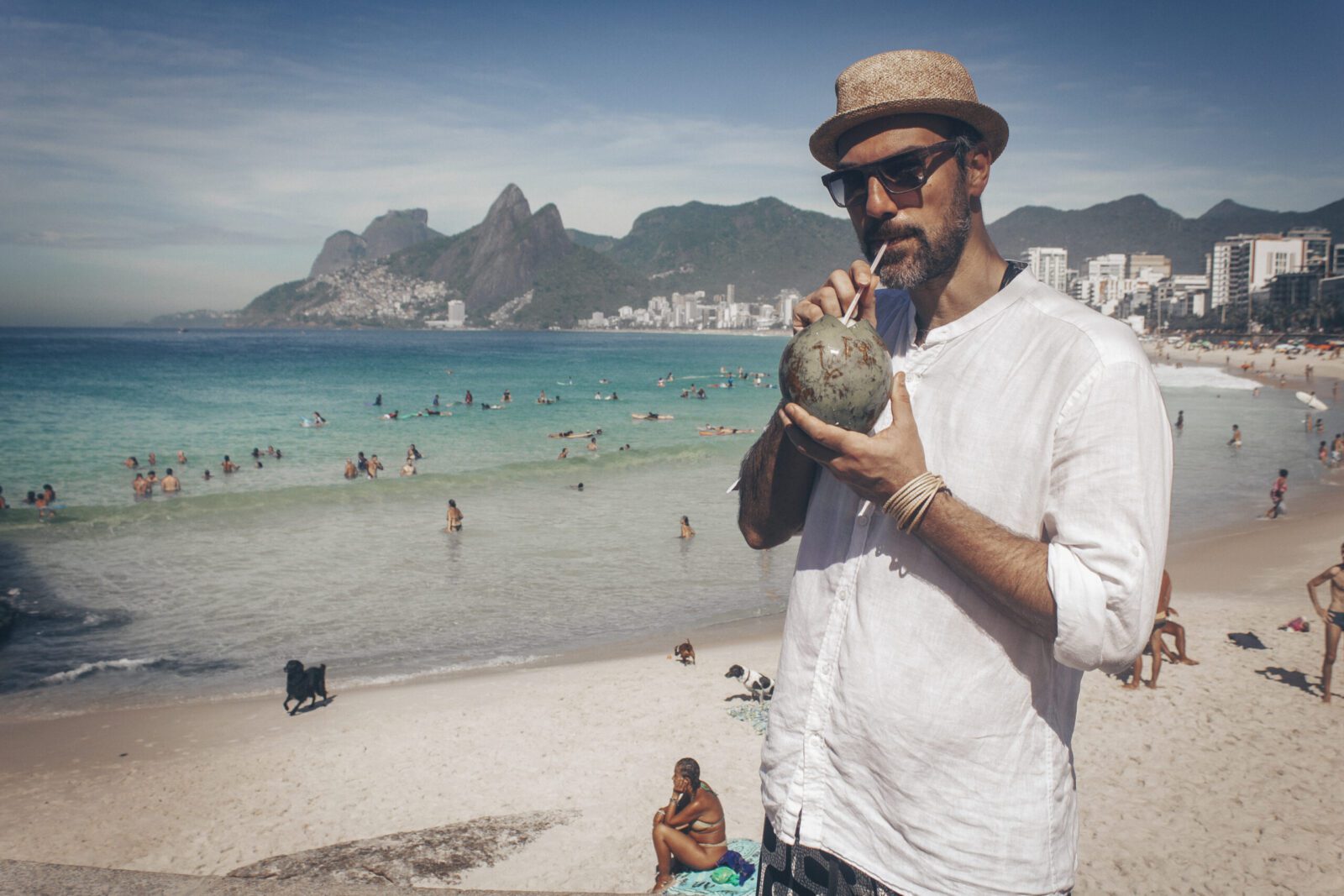
Being used to seeing João Selva with the usual traces of touring life, we noticed straight away that WOMEX in Tampere showed a different side of him. Inside Tampere Hall, in the middle of the early afternoon rush, surrounded by musicians carrying pre-show eagerness and nerves, meeting participants moving between appointments, conference panellists and attendees, interviewers and interviewees, he was wearing mentor clothes, seated at one of the speed-meeting tables and speaking with a young artist who had booked time to ask about the French live scene.
It was a simple scene, but it carried weight if you think back to his first WOMEX in Copenhagen in 2010, when he arrived as a newcomer trying to understand how the international circuit worked. Fifteen years and four studio albums later, he moved through the event with an easy confidence, fully aware of what the Worldwide Music Expo could spark and how its conversations continued long after the week was over.
When we sat down with him a few minutes later in a quieter corner of the conference centre, the conversation quickly widened. What began as a chat about his recent release Onda and his upcoming UK dates, soon opened onto the month he had spent travelling along the Brazilian coast while writing it, the instinctive studio sessions that shaped the record, the way the songs evolved on tour, the remix project, the new material he planned to unveil next year, and the working realities he saw every day in France.
Before moving into all of that, we asked him to look back at the first time he stepped into WOMEX. He smiled as he answered. “It’s been more than 15 years since the first time I attended Womex in 2010, I think. Copenhagen. And it’s always very inspiring to meet all those music heads from all around the world, people who are really passionate, curious about music.”
That curiosity remained central to how he experienced the event. He explained that he preferred to move between venues without checking the line-up in advance. “I like to just walk to the venues and not knowing what I’m going to hear and see. Most of the time, the music I wouldn’t go to naturally is what I appreciate the most.” The first night of showcases had already proved the point. “From last night I really enjoyed the Zawose Queens. How they were playing the mbira is just crazy. And they are the daughters of Hukwe Zawose, a master of it. It’s a tradition that wasn’t played by women before, so it was really deep.” He spoke with the same openness about AySay’s Turkish-rooted showcase. “I wouldn’t expect to hook on that, but it was really great.”
Another moment stood out to him. “Also, I was really happy to see Minino Garay with Fleures Noires. I’ve known his work about Ramiro Musotto, which was an Argentinian living in Bahia, that really was a game changer about Brazilian percussions, because he was able to mix, absorb different regional rhythms and put them together. He was one of the first guys to do this. He got that heritage from Nana Vasconcelos. Mini Mugaray played with him, and he’s really an amazing musician.”
From there, the conversation broadened towards the musical landscape more generally. That idea of constant motion shapes how he views the wider musical world. “It’s always changing,” he said. “But somehow the raw material is still the same. It’s just someone expressing emotions through music, so from that point of view it’s the same. But then the market is always changing.” A conversation during the expo came to mind. “We were just talking with Jay Rutledge from Outhere Records about the AI thing. The subjects around change, but the main thing, the heart of it, is still there.”
Those thoughts naturally led him to France, where he sees many of these pressures converge. “France, where I’ve been living for fifteen years now, is having lots of budget issues with the government. The market in France is kind of pessimistic about the future. And I remember that a few years ago, the Brazilian delegation was in this same mood.”
Which is why, for him, WOMEX carries a very real purpose. “It’s also good to put your head out a little bit and see what’s going on outside of your common horizon,” he said. “To see that the wheel keeps turning, and today’s bad, tomorrow’s going to be better, and then bad again. And it just goes on and on, and we just keep on moving forward.”
Audience behaviour, he added, mirrored those shifts. “From the gigs, yeah, I’m very surprised that there is a whole new generation coming and enjoying.” His daughters made the same point at home. “Maybe they listen to baile funk, but they will switch to some 60s band that they love, and it even doesn’t come from me. It’s just the way they consume music, because they have this worldwide catalogue on their hands with Spotify and others.”
Even with that universe available, reach was not guaranteed. “I think that the most difficult thing is still to reach people. You have this illusion now that you can just distribute worldwide and it’s just not enough.”
The need for guidance within that abundance was why he valued independent media. “A very important role of people like you at Rhythm Passport that are always highlighting some new music and new artists. There’s like hundreds, thousands of new tracks every day coming out. You just can’t listen to all of them. And yeah, the percentage of AI is growing, growing, growing.” Rather than discouraging him, it fuelled him. “All this just gives me more strength to keep recording and releasing new stuff, because I think we need this as humanity. We need music to keep standing.”
That determination reached back to his earliest musical impressions. “For me, I associate music as a culture of resistance. Oppression has been going on for millenniums and music was always there as a way to bring hope to the people, to make them chase the demons of the society.” He rejected the idea of the isolated creator. “I don’t have this idea of the artist as some kind of genius or having some kind of illumination. No, I think we’re just part of the society and we have a specific role on bringing people together and making them accept each one’s difference and be together and then give them hope to keep fighting the day-to-day life.”
For him, that role was carried by intention more than form. “That’s what I learned from traditional music. You can play a rhythm, like a rhythm that can call an entity, something mystic. But then if you don’t have the intention to call that entity, you can play the same rhythm to just play football and it will be the intention that matters. It’s not the form, it’s what’s behind it.”
He tried to hold onto that principle even in the studio. “Sometimes that first recording, that first version, has so much intention and humanity. It’s not perfect, it could be better, but that will touch people deeper. So I try to keep that in the studio and on stage too.”
That mindset carried through Onda. “I really wanted an album about big spaces and joy, because it was a counterpoint to the last one, Passarinho, which was written during the confinements.” To reconnect with that energy, he travelled the Brazilian coast. “I went to my birthplace, Rio de Janeiro, one week in Bahia, then one week in Pernambuco, then one week in Maranhão.” The writing arrived without pressure. “I didn’t have this pressure of having to write a whole amount of songs. I was just noting quotes and phrases that I heard, that passed by my mind. Some songs came, of course, entirely. Others, we had a chorus and a few words.”
Returning to France, he carried that momentum straight into the studio with producer Bruno ‘Patchworks‘ Hovart, the multi-instrumentalist and producer who helped João Selva shape all four of his solo albums. “I went directly to the studio with Bruno to keep the vibe, and we did the album very quickly. Like one song a day.” He leaned into the instinctive quality of those sessions. “We tried to be as natural as we could.” Each recording, he said, marked a single point in a longer trajectory. “It’s like you’re doing a cliché in an instant. Maybe one year after, the song will have changed and it will be something else.”
The remix project followed the same principle. “Once we tour, the track changes. And we want to see it changing, like the song as a child and as a teenager and as an adult. Remix is great for that because we always give the producers free… just do your thing.” One episode stood out to him when working with Blundetto. “I sent the stems and like the next day by night, he said, I love it. I did this and it was ready. I mean, the remix was finished.”
That openness carries naturally onto the stage. João Selva performs with the same musicians he has worked with for more than eight years, the group that has recorded all four albums alongside him and continues to shape his live sound. “I realised that the fact I play with the same musicians now for over eight years… we did the four albums together, so it’s like a band.” Their live arrangements come from that long familiarity. “We rearrange all the tracks for the live together and each one can bring his own ideas. And we feel free to improvise because we know each other so well.”
That long partnership gives the group a flexibility he relies on today. “As we played the four albums, we have built a big repertoire, so we are able to quickly adapt.” The shape of a set still shifts with the room. “We see we have a crowd that is more on listening, and so we can adapt the track list of the concert. Or if we’re playing at one in the morning in a festival and everybody’s already on fire, then we can do the one, one and a half hour show only with uptempo tracks.” He paused, weighing the choice. “This is also very… how can I say? Yeah, I mean, it’s cool to give the people what they want. But at the same time, it’s cool to surprise. We will always try to surprise, of course, and give contrast even if we’re doing an upbeat show.”
What sat behind that, he added, was a sense of responsibility toward the people in the room. “People struggle to have a little bit of money nowadays to then go out and enjoy themselves, so it’s rewarding to give them some good time.”
Certain pieces had become touchstones. “I think ‘Felicidade’ from my first album… it’s a song that puts everybody in the mood. I always say that happiness is a thing to share.” That openness also pushed him toward his first on-stage cover, built from a studio collaboration. “We did a version of ‘Love and Death’ of Ebo Taylor with Voilaaa Sound System, and we are playing it live also. It’s the first time I play a song that isn’t mine on my shows… yeah, first cover. I wrote in Portuguese the lyrics and we dreamed in a Brazilian vibe. But still is a cover.”
For him, the choice was about context as much as repertoire. “We were talking about how much music is released today, and it’s great to show where all this new stuff came from. So playing Ebo Taylor is just amazing.” His path into those sounds had been shaped by what reached him growing up. “I always was hooked to African music, but coming from Brazil I had more access to Angolan music, Cape Verdean music and maybe some São Tomé. But then Ghana is something I discovered later. And well, highlife is just amazing.”
These anchors helped explain why he saw Onda as its own chapter rather than a continuation of what came before. “No, no, no… we never cross the river two times the same.” What connected the albums instead was a wider horizon. “I could be in Lisbon, I could be by the Atlantic coast in France, I could be in Brazil. The Atlantic Sea is the same.”
That outward-looking journey ran alongside a quieter one. While finishing Onda, he had been writing another set of songs in a different emotional register. “I have many songs that I wrote like this… that mark some moments of my life. I’m really glad to share this other face of myself with the public. And I hope that the songs will also help people as it helped me.” He planned to unveil them in a solo concert the following February. “It will be half the show my songs, and half of the show playing a few tunes of artists like Gilberto Gil, Caetano Veloso, Chico Buarque, Vinicius de Moraes and all those masters.”
From there, our chat moved naturally toward the artists shaping his listening today. When he spoke about newer musicians, he highlighted Pedro Mizutani. “He’s probably doing the kind of music I was doing when I was his age,” he said. “It has this bossa nova influence, but also open minded with rock, with other stuff. And he’s a great songwriter, very sensitive.” He mentioned other names he returns to frequently, including Menahan Street Band. “I really love the way they think, their sound, you know, and their arrangements. It’s a lot with a lot of character on it.”
By the time our conversation in Tampere came to a close, his attention had already shifted toward the next stretch of travel. The Onda tour moves through the UK this week, bringing the album and its remixed versions to three cities in three nights: Manchester’s Band on the Wall on 13 November, London’s Hootananny on 14 November and Africa Night Fever at Brighton Dome on 15 November. For him, the stage is where the record takes its final shape, carried by the long-standing chemistry within his band and the months spent moving these songs between Brazil and Europe. When he sums up the project, he returns to the description he uses with audiences. “I like to say that it’s a raw disco with cosmic jazz, funk and Brazilian grooves,” he expalined. “It’s a very uplifting album. And the show is really heartful and soulful. And people can come with nice dancing shoes because they’re going to use it.”
Joao Selva's UK tour tickets are available HERE
You can listen to and purchase Onda HERE
Photo ©: Marcio Grafiti