

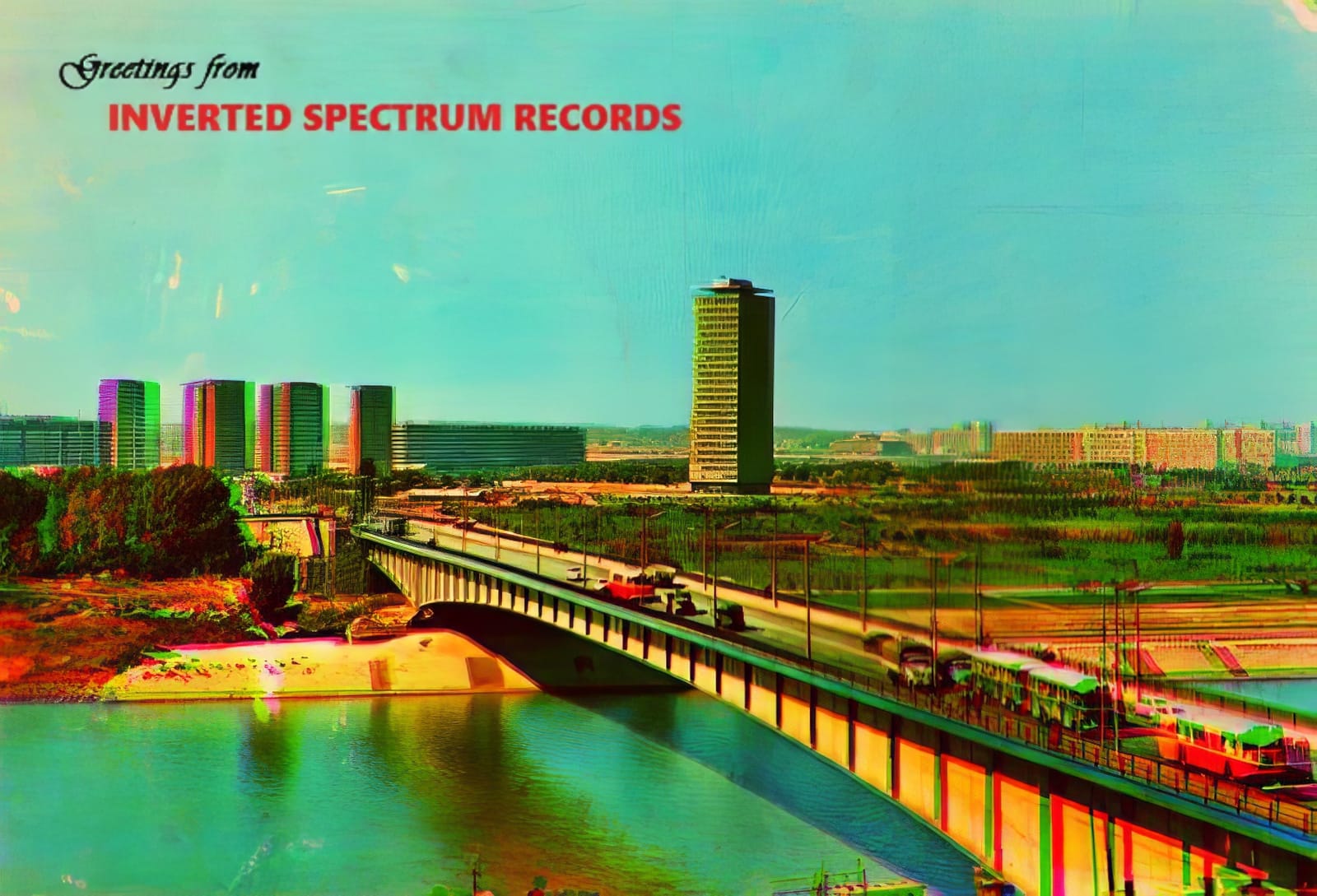
Belgrade’s underground is a world in constant mutation. One week it’s a punk bill thundering through a crumbling magacin in Dorćol, the next an improvised electronics night squeezed into a donji klub beneath Tašmajdan, or a noise-rock session spiralling out of a damp podrum on the edge of Zemun. Musicians, organisers and crowds keep redrawing the map, even as the spaces themselves vanish: closed by inspectors, flattened by the Belgrade Waterfront project, or lost to sudden rent hikes.
Out of this churn comes a sound that could only belong here: surf bands ripping through Yugo-pop hits, choirs turning to psychedelia, cassette loops dragged through distortion, folk refrains bent into noise and punk wired straight into free jazz. The scene mirrors the city itself: improvised, unstable, and charged by its political and social pressures.
Since 2018, Inverted Spectrum Records has been mapping this unruly terrain through The Music of the Secret Society that Owns Belgrade, a compilation and festival series (Društvo, The Society) that has become a touchstone for experimental sound in the city.
The label is a boutique operation with a wide reach. Operating between Hungary, Serbia and Turkey, Inverted Spectrum works as an independent label, booking agency and event organiser. Its catalogue cuts across psychedelic, folky, avant-garde and punk-leaning rock and jazz, through to synth experiments, electronic oddities and outsider sounds. At the centre is Işık Sarıhan — publisher, curator, promoter, and member of Hayvanlar Alemi — whose vision drives both the Secret Society compilations and the community orbiting them.
In this extended Q&A, Sarıhan opens the archive: tracing Inverted Spectrum’s DIY beginnings in Turkey, the detours through Hungary, and the moment Belgrade emerged as a fertile ground for experimental sound. Six volumes in, The Music of the Secret Society that Owns Belgrade works both as a record of the city’s underground and as a spark connecting it to regional and international networks.
Can you take us back to the beginning of Inverted Spectrum Records — what pushed you to start a label, and what kind of musical or cultural space were you hoping to carve out that didn’t already exist?
I started Inverted Spectrum Records ten years ago, after I noticed that there were a lot of DIY labels on Bandcamp and it looked like a convenient means for anyone with a vision of running a label.
One of my initial intentions was to self-publish one of the albums of my own band Hayvanlar Alemi. The album had been published physically a year beforehand by another label that was not doing digital releases, so I decided to take matters into my own hands.
The other intention was to promote material that would go unpublished or be forgotten if I didn’t publish or re-publish it. I was acquainted with some very good artists who would not record or systematically publish their music, and I was also familiar with strong material produced in a DIY manner but never put together as proper albums; the kind of work that had become submerged in the depths of inactive SoundCloud channels, reduced to broken links within the unburied corpse of Myspace, or preserved by a handful of people in the form of CD-Rs or mp3s. Many of these were from my home country, Turkey.
Even though I did publish several releases of this sort, many of the artists I wanted to publish were not very cooperative; it seemed as if I was more enthusiastic about their obscure material than they were. So my focus as a publisher shifted to other things, and the intention of “publishing material that no one else would” continued in a more curatorial and interventionist form.
What was it about Belgrade’s underground scene that caught your attention early on, and how did coming in from the outside help you see its patterns or possibilities differently?
At some point in the early 2010s, I coincidentally discovered the Serbian experimental band BICIKL and started to follow their Facebook page. Soon after, I received a message from one of their members who knew about Hayvanlar Alemi. This online encounter culminated in a joint tour in 2015.
The two bands didn’t sound very similar, but we were like-minded in many ways we approached music, especially in how we drew on various traditional, contemporary, and avant-garde sources, disregarding stylistic boundaries with a deconstructive and punky attitude. Through BICIKL I discovered another Belgrade band which shared members with them, The Cyclist Conspiracy — a multi-faceted psychedelic folk rock band and choir, which was newly formed at that time but now enjoys cult status. These two bands gave me the impression that Serbia might be fertile ground for the type of music I am interested in, and that there should be more to find out.
Around that time I was pursuing a PhD in analytical philosophy in Budapest. After I completed my studies in 2017, my Hungarian residence permit expired and I had to leave the country. For various reasons I didn’t want to return to Turkey, so I moved to Belgrade and stayed there for half a year. During that time I was briefly active in the music scene as a guest musician and also started to carry out research into the scene with the idea of putting together a compilation.
I was soon introduced to other musicians and bands doing very exciting things, such as Moussaka, a band that played heavy surf rock arrangements of Yugoslav folk pop hits; Hotel Makedonija, which synthesised poetry, punk, chanson, regional folk music and rebetiko in a postmodernist fashion; Vladimir Lenhart, who created noisy experimental folk music by looping and manipulating samples and old cassette tapes; and Crno Dete, a band that combined the more oriental elements of regional music with their noise rock roots and later with punk jazz.
This was a musical context similar in some ways to the one I grew up with in Turkey, and it made me feel nostalgic. Whereas the relevant scene in Turkey had begun earlier and had pretty much run its course by that time, the scene in Belgrade seemed to be producing some of its most interesting work, and my impression was that it was still not recognised as a proper scene even by its insiders. That nostalgia was naturally accompanied by discovery and curiosity, because despite the parallels, the music was happening in a different context and drew on not exactly the same sources.
The scene in Turkey I am talking about is one that began slowly in the 90s and reached its peak in the early-to-mid 2000s. A generation of musicians, whose musical background was some form of Western alternative music, started looking deeper into traditional music and popular genres influenced by tradition — including those considered to be “low art” or “bad taste” by the elites, or taboo to touch for one reason or another. Processing these influences with an avant-garde mindset and avoiding the clichés and artificialities often found in world music or folk fusion, they created very innovative, colourful, and expressive forms of art.
Among some of the names that characterise the spirit of this period we can count ZeN, BaBa ZuLa, Nekropsi, Replikas, 2-5bz, Fairuz Derin Bulut, Saska, İstanbul Blues Kumpanyası, Ayyuka, Kırıka, Anadol, and DAK. There was also a parallel movement at a more mainstream level. Many of these bands drew inspiration from the classic period of Anatolian rock, which was being rediscovered at that time both in Turkey and around the world. But compared to the Anatolian rock musicians of the 60s and 70s, the musicians of this later era drew from a much broader repertoire of sources, ranging from art punk to experimental electronic music to traditional music from other parts of the world.
It seems that this kind of scene appeared in Serbia later than in Turkey, and speculating on the reasons for this delay would be too long a digression. On the other hand, this musical development happened in Serbia earlier compared to many, or perhaps all, of its neighbours. In the ex-Yugoslav region, Serbian contemporary musicians were the first to “make peace with folk music”, to quote an acquaintance of mine from the Macedonian scene.
The Music of the Secret Society that Owns Belgrade is a name that sticks. Where did it come from, and what layers of meaning or humour are tucked into it?
I grew up with two types of compilations, both of which are less fashionable today compared to the past. One type was ethnomusicological, meant to document and preserve the music of a certain region or ethnic group, compiled by people who were outsiders to that musical culture. These often had descriptive titles beginning with “The Music of…”. The other type was compilations put together as acts of solidarity within an underground scene, usually made by insiders. I assembled the Belgrade albums with inspiration from both, switching between insider and outsider perspectives, and the style of the title is meant to reflect this on several levels.
The “Secret Society” part of the title has multiple references. First, it signals that this music belongs primarily to an underground scene that the prospective listener is likely unaware of, and promises to reveal it. It also refers to the fact that, especially considering the bands that dominated the first few volumes, this is a connected group of people. It also nods to some of these bands’ aesthetics: playing in masks, appearing under pseudonyms, being obsessed with themes of conspiracy and esotericism, and so on. Of course, as a compilation originating from the Balkans, it also makes a mildly humorous reference to the real and imagined conspiracies widespread in the region.
The final element in the title, referring to the ownership of Belgrade, was directly inspired by the political situation in the city at the time. When I was living there and working on the first compilation, one of the biggest issues was the Belgrade Waterfront project, a large-scale, expensive scheme of construction, urban transformation and gentrification centred on grand middle-class residential buildings in the centre of the city. It was perceived by many as a corrupt project, completely out of touch with Belgrade’s fabric. It was not halted despite huge public discontent, and if you go to Belgrade today you will immediately see its results on the eastern bank of the River Sava.
One of the venues that was an important centre for alternative art and culture — and where the release event of the compilation was going to be held — was endangered by the project (it survived, though in the meantime other venues disappeared as a result of construction or renovation). The reference to “ownership” of Belgrade in the title was inspired by this contrast between the political and economic power that reshaped the city’s physical fabric, and the ownership of the city’s artistic soul by a relatively invisible group of people. The musicians represented on the album were creating music that could arise only in Belgrade, music inspired by the city and, in turn, steering its cultural life in new directions. In this sense they were the owners of Belgrade. This claim of ownership should be taken seriously: when we look at music history, we see many instances where underground music, even when unknown to larger segments of society, has shaped broader cultural directions through indirect causal chains.
“The Music of the Secret Society that Owns Belgrade” also became the name of the associated festival for several years, but in the end I had to accept that for many people it was simply too long and complicated to process. For practical reasons I shortened it to Društvo (“The Society”). Satellite events of the festival, which bring together local and foreign acts, are named Društvo preko (“The Society Across”).
You’ve been curating this series since 2018. Has the role of the compilation changed in your eyes — is it still documentation, or has it become something more curatorial, even interventionist?
In line with the fact that the compilation and the festival series shift between insider and outsider perspectives, the documentational, curatorial and interventionist elements have always been mixed. From the start, the project aimed at raising the scene’s visibility locally, contributing to its momentum and strengthening internal bonds, while also introducing it into different contexts and exposing the scene to new sources of inspiration and collaboration.
As the years passed, the circle widened beyond the initial bands and the stylistic scope expanded. The project went beyond documenting a “secret society” and began actively “recruiting new members”. Such recruitment attempts did not always have lasting results (generational differences seem more significant than stylistic ones), but in some cases the encounters led to further bonds and even musical collaborations.
As Inverted Spectrum developed into a booking and promotion entity, active not only in Serbia but also abroad, many of the bands associated with the project appeared on stages outside Serbia for the first time, or shared stages with international artists performing in Serbia for the first time. Some of these encounters generated effects that extended beyond the moment. Intervention at this regional level is particularly important where distances and borders create psychological obstacles.
For people from smaller countries, distances matter more. As a musician and audience member from Turkey, travelling between Ankara and Istanbul to play or attend a concert — a six-to-seven-hour bus ride — has always been ordinary. I was surprised at how little exchange there is between, for instance, Belgrade and Budapest, even though the distance is similar, no visas are required, and most people in the scene can communicate in English. Connections are weak even between closer places such as Budapest and Bratislava, or Budapest and Vienna. There is more mobility in subcultural scenes such as punk or metal, but bands outside these identities rarely cross borders.
There is slightly higher mobility between ex-Yugoslav countries due to a shared history, and they also constitute a single market thanks to the linguistic connection. Language can be a barrier for lyrics-oriented music, but there’s little reason borders should be barriers for free jazz, psychedelic rock, avant-garde folk or experimental electronics. Showcase festivals have taken on a bigger role recently, which is useful but comes with limitations. Building cross-border connections in more organic ways, without the financial means of showcase festivals or funded projects, is not easy — but my experience shows it is possible to some extent.
Volume 6 marks a return to the folk-rooted sounds of the early releases. What pulled you back in that direction, and was it a deliberate shift or something that emerged from the artists themselves?
The overall focus in the latest volume was not planned, but it was not entirely random either. A compilation usually begins by inviting a few artists to contribute, and the rest follow in ways that cohere with the initial selections — a coherence that should also be reflected in the release festival. A long list of parameters influences the choices, some more practical than artistic: which artists have new material or are ready to record, which are available to play the festival, which have not participated before but should, even which venues are available to host the release. There are also longer-term considerations, such as which artists I want to build closer relations with for future collaborations. In this case, the main reason the volume had a vaguely folk-oriented theme was that some of the first invited artists were themselves folk-oriented.
Leaving that aside, I think there has recently been an increase in productivity in folk-inspired creative music in Serbia. Several new projects have emerged, such as the pentatonic psychtronica duo The Durians and the progressive folk rock band Ibar. One of the most impressive groups in the country, Ab Re — a theatrical jazz-folk-rock ensemble with a 25-year history — has also become more active and visible. In the last few years, many Russian musicians settled in Belgrade following the exodus of artists and intellectuals from Russia. Among them are Pavel Yeremeev, who contributed to the latest volume with his HolyPalms project (he is better known for his avant-garde folk rock band Usssy), and two members of the heavy psychedelic folk rock band Lucidvox.
Beyond Belgrade there is Stiff Buscemi, an oriental instrumental psychedelic rock band from Novi Sad, a city always prolific in music but not known for folk-inspired projects. Across borders, there is the very recent collaboration between Polish experimental guitarist Raphael Rogiński and three prominent Serbian musicians — Svetlana Spajić, Tijana Stanković, and Marina Džukljev — operating as Ružičnjak Tajni. Their debut album is one of the most interesting recent works in the avant-folk category.
Tracks on this volume move through everything from Serbian rebetiko to Kurdish tanbur to Latin-inflected electronics. How do you see tradition operating inside this current wave of experimental music in Serbia?
When we are talking about the ‘current wave’, we should note one thing clearly: most of these musicians are millennials or older. We are yet to hear much of this kind of music from the younger generation, music that engages with tradition in idiosyncratic ways.
One reason relates to the intersection of music and information technologies. The sudden availability of music and video uploading platforms, together with peer-to-peer file sharing, had a bigger effect on the older generation. There was a time when open-minded musicians and audiences suddenly found themselves surrounded by music from faraway places and past decades, which they previously would have struggled to access. Out-of-print folk recordings digitised from cassettes or vinyl appeared on blogs, wedding performances from Cambodia or Peru could be watched on YouTube, or the entire catalogue of Sublime Frequencies could be downloaded from Soulseek. This sudden abundance created surprise and exploratory hunger.
Younger people were born into a connected world where information was always available. For them, this abundance was not an exciting novelty. Equally, platforms like Spotify, with algorithms designed to hook listeners quickly, turned active musical exploration into a passive phenomenon. This also encouraged compartmentalisation in both listening and creation. Today we hear more bands referencing global sounds, but many resemble popular acts that have already travelled that path; they do not sound like the result of personal research and natural synthesis. Research on younger people also shows they are less willing to take risks than older generations, and music plays a smaller role in their identity. Crossing established musical boundaries as an expressive act does not hold the same interest for them as it did for earlier generations.
This volume touches on distant geographies — both sonically and spiritually. How do these cross-cultural threads come into play in your curatorial thinking, and are they always part of the plan?
The plan is to present and promote authentic music. By authentic I mean music where you can hear that the artist has created freely, unpretentiously and uncompromisingly. In many cases, the presence of cross-cultural elements is a natural outcome of that authenticity.
My impression is that the works we regard as most authentic sit at two extremes: they are either pure examples of traditional or subcultural music, or they are highly idiosyncratic. In today’s world, with access to music from so many places and times, it is inevitable that freely creating musicians will absorb disparate influences. I think there is also a correlation between authenticity in this sense and emotional expressiveness in performance. Musicians who are not constrained by stylistic boundaries are often also less constrained emotionally.
That a piece of music is authentic does not necessarily mean it is well executed; it may be poorly recorded or performed. But even then, there is often something interesting and enjoyable about it. And even when it is well executed, it does not mean it will find an audience, because many listeners do not seek authenticity. They seek comfort, familiarity, easy gratification, and socio-cultural belonging. There is nothing inherently wrong with that — even the most adventurous among us look for these things sometimes. But there are already more than enough publishers and promoters catering to that need. Inverted Spectrum exists for something different.
A majority of the tracks on Volume 6 hadn’t been released before. Do you think there’s a resistance in Serbia to putting this kind of music out officially, or is it more a matter of resources and visibility?
Some of the previously unreleased tracks on the volume remained so for superficial reasons: they were leftovers, live takes, or I caught the bands while they were working on material for future releases. But one track opens a more interesting discussion — the one by Hotel Makedonija. It was recorded specifically for this release, and probably would not exist if I hadn’t asked. They are one of the most unique and enjoyable bands I know, yet they still have a lot of unrecorded material.
Many excellent bands in the region hesitate to record and publish their work systematically. While resources can be a factor, my impression is that the hesitation often comes from an unwillingness to invest resources in music — rooted in disillusionment with the establishment. People feel the recognition they would receive is disproportionate to the time, effort and money involved. Promoting unconventional music, whether as a musician or as an organiser, is frustrating. It takes an exceptionally stubborn, even slightly irrational character to keep going. This can be even harder in places without established channels for such work.
In Serbia and elsewhere, especially among older generations, musicians are often less entrepreneurial or self-promotional. This lowers visibility, though the attitude itself might come from positive values — a less competitive, slower way of life that improves quality of life and society, even if it obscures artistic work.
There is, however, one major resource-related factor: immigration. I know many bands whose activity was halted or slowed when members moved abroad. Returning to Hotel Makedonija as a concrete example, one reason their recording activity has slowed is that a member emigrated.
Many of the featured artists are working completely DIY, with no management or label support. What does that tell us about the current state of infrastructure for alternative music in Serbia?
On the one hand, there are not enough labels or initiatives that care about this kind of music. On the other hand, for many reasons — some of which I’ve mentioned already — some artists are hesitant to approach labels, venues, bookers, or managers systematically, or to take matters into their own hands.
You’ve described Belgrade’s scene less as a unified movement and more as a web of connections. From your perspective, is that diffuse structure a strength, a survival mechanism, or something that needs to shift?
I think a shift is already visible in the younger generation, for example in what is called the Hali Gali scene. Named after a compilation and concert series that began in 2019, and associated with the Pop Depresija label and Kišobran events, this scene has strong stylistic coherence. It consists primarily of alternative rock and art punk, which are very promotable to a bigger and younger audience. That contributes to its functioning as a well-organised movement.
But I think the emergence and longevity of this scene also reflect a more entrepreneurial and professional attitude among younger musicians. In each volume of The Secret Society compilations and festivals I try to involve at least one Hali Gali band — partly because there are many interesting acts in the scene, but also to see what might come from contact between scenes and generations, musically and practically.
Whether the more diffuse and non-institutionalised structures in other musical circles are strengths or weaknesses is a question I’ll return to later.
Why did you choose the compilation format — rather than developing a traditional label model with albums and artist signings? What possibilities does this format open up, especially in a city like Belgrade?
When I started Inverted Spectrum I didn’t think of it as a label that would widely promote stand-alone releases. I thought of it more as an archive or repository, a curatorial space where good music that no one else would publish — or put together and present in a particular way — could exist in a quiet corner of the Internet, waiting to be found by curious listeners. Compilations are well suited to that purpose.
For a label that also curates events and functions as a booking agency, compilations are also good ways to forge connections: between the label and musicians, between audiences of different bands, and among the musicians themselves. When bands approach me about publishing individual releases, I often tell them they would have higher visibility with another label. But recently I’ve had more cases of bands insisting on publishing through Inverted Spectrum regardless. As one put it, they wanted to “be part of the community that Inverted Spectrum has created”.
Every volume so far has been tied to a multi-day release festival across different venues. What kind of role do these festivals play in sustaining the scene, and what have they taught you about local audiences?
I think these festivals increase the visibility of bands, especially those that play rarely — often because no one invites them, and they don’t take much initiative themselves. In some cases, the festivals also strengthen bonds between bands.
There are things I like about the Belgrade audience that are harder to find where music scenes are more developed — more bands, more venues, better technical conditions, and so on. In Belgrade, more people are open to multi-genre events, whereas in other places genres or subcultures are more closed. Also, more musicians attend concerts, whereas elsewhere they can seem uninterested in what their peers are doing. Maybe that’s ego, competitiveness, or lack of solidarity — I don’t know. But being active musically in Belgrade gives me the feeling of participating in an open, socially connected community.
For a couple of years, I also organised events in Budapest, where I now live. Despite stronger organisational and promotional resources there, I couldn’t recreate the community feeling I found in Belgrade, and eventually I gave up on trying.
Looking at the festivals over the years, what shifts have you noticed in how venues engage, how audiences show up, or even how acts approach performing this kind of material live?
Compared with when it started eight years ago, my impression is that there is now a bigger audience for unconventional music in Belgrade, and venues are more open to hosting it. But Belgrade is a city in constant fluctuation, and it is hard to talk about venue continuity. Each year I find myself and others discussing new strategies for finding and booking spaces. Venues that emerge as centres for alternative culture often become more commercial once they are established. It doesn’t mean alternative events become impossible, but they do become more expensive, complicated, and frustrating.
Recently, much of the most interesting music has been happening in odd or grey-zone venues, often non-profit. But these spaces rarely last long — whether due to tax problems, neighbours, or urban transformation. Buildings get taken over, bridges under renovation close down spaces beneath them, and so on. Unlike some neighbours, Belgrade lacks stable alternative venues like Močvara in Zagreb or MKNŽ in Ilirska Bistrica, Slovenia — institutions that found a way to survive financially and bureaucratically without losing their role as homes for edgy music.
Event series can be more resilient than venues. In the absence of stable institutions, long-running festivals are crucial for continuity. Ring Ring Festival is one example, and even non-music events, like arts or comics gatherings connected to the underground scene, play a role in sustaining culture. Despite the lack of institutions, I find Belgrade’s scene more interesting than many others. Without romanticising it too much, I think the city’s instability and unpredictability feed into a tension that makes its music more passionate, eclectic, and authentic.
As for audiences: as both a promoter and musician, I’ve seen how the visual aspect of communication has overtaken musical and textual aspects. Promotional messages have been simplified — a slick poster works better than a curatorial idea; a catchy 15-second video works better than an album link or biography. This is strongest in countries and generations where Instagram dominates socialisation. Turkey is extreme, Serbia somewhere in between. I see this as a negative development, eroding art and society in ways too many to list here. For years I resisted opening an Instagram account for the label, but eventually I had to, despite finding it inconvenient for promotion.
You’re now taking Volume 6 abroad. What kind of response are you hoping for from international listeners, and do you think there’s a clear audience for this work outside the Balkans?
For works originating in local or less globalised scenes, understanding cultural references or being situated in the same socio-musical space may be necessary for full appreciation — or at least for one kind of appreciation. That doesn’t mean there is no audience outside the original context, or that they cannot be appreciated differently.
Take Lenhart Tapes, one of the most unique acts to come out of Serbia. It could only have been created by a particular person with a particular musical background, vision, and context. I think there is a difference between someone encountering Lenhart Tapes at a world music festival abroad, and someone growing up with it in Serbia’s underground, with a deeper grasp of its development. But even so, Lenhart Tapes has found a bigger audience abroad than at home. Many other acts in the region could do the same, if they had the right gateway. The difficulty is that artists and labels from non-Western contexts face countless hurdles before being heard abroad at all.
Recently I’ve asked myself whether we should spend so much effort seeking visibility in such a competitive international environment, or whether we should just enjoy “slower” musical careers — embracing the warmth and relative ease of operating locally and regionally.
Speaking purely of content, another challenge in presenting The Secret Society series internationally is its stylistic scope. For me, the selections make sense in context and are sequenced to flow smoothly. But I admit it is harder to find an audience equally interested in, say, the downtempo folktronica of The Durians and the dark, lo-fi post-punk of Izleti.
After six volumes, do you see The Secret Society continuing in the same form? Or are you already imagining different shapes — new collaborations, formats, or thematic focuses — for the future?
I hope that at some point the series will see a vinyl release, just to ensure the music it represents is taken more seriously. Personally, I’m not very interested in physical releases. They look nice, they feel good in your hands, and they make useful merch items — but it’s sad that music is often judged by whether an artist or label can afford to produce vinyl or CDs. Many of the great artists I work with have never had their material on physical formats, or only for part of their careers.
The series had a thematic focus only in Volume 5. After realising that the first four volumes featured only a few women artists, I set myself the challenge that every act on the next compilation and festival should either be female-led or include female members as significant contributors. It wasn’t a musical theme, but it did shape the music. It gave me an excuse to temporarily set aside some of the long-standing bands and expand into territories I hadn’t explored closely before — areas with more female artists, such as avant-garde pop or the more academic side of experimental music. Someone half-jokingly said I was doing it to apply for European funding. If any future volume has a theme, I will make sure it doesn’t look like that. There’s nothing inherently wrong with funding — it’s necessary in some contexts — but this festival will always remain DIY, free from constraints and political controversies that funding can bring.
And as the name of the compilation series suggests, there might also be hidden agendas behind the project that will never be revealed. This is a very personal endeavour. Occurring once a year, it provides a kind of anchor in my life. It gives me excuses to return to Belgrade. The festival will remain local, celebrating Belgrade’s underground creativity, and I will resist the temptation to turn it into something larger than it should be. But its satellite events and related projects will become increasingly international, helping to connect the Serbian scene with its neighbours and beyond.
Earlier I mentioned the balance between striving for international recognition and enjoying local and regional activity. For me personally, the project is also about balancing growth and professional perfectionism — complete documentation, bigger production, wider promotion — with things that have purely personal meaning: artistic fulfilment, community, friendship, and the pursuit of a happier life. My feeling is that the older I get, the more I will lean toward the latter.
Step into Inverted Spectrum’s catalogue
and uncover all six volumes of The Music of the Secret Society that Owns Belgrade HERE