

Marseille never shuts up. It is a port city that runs on noise: traffic grinding through the hills, markets calling in French, Arabic and Comorian, football nights, club sound systems, rap coming out of car windows, ferry horns and PA calls for ships leaving for Algiers and Tunis. La Friche la Belle de Mai sits inside that as a vertical version of the same city, a former tobacco factory where studios, offices, venues, a skatepark, kids’ spaces and conference rooms all operate at once and bleed into each other. In late March, Babel XP slotted part of its showcase programme and conference into that working building, adding expo stands and short sets to a site already full of overlapping sound.
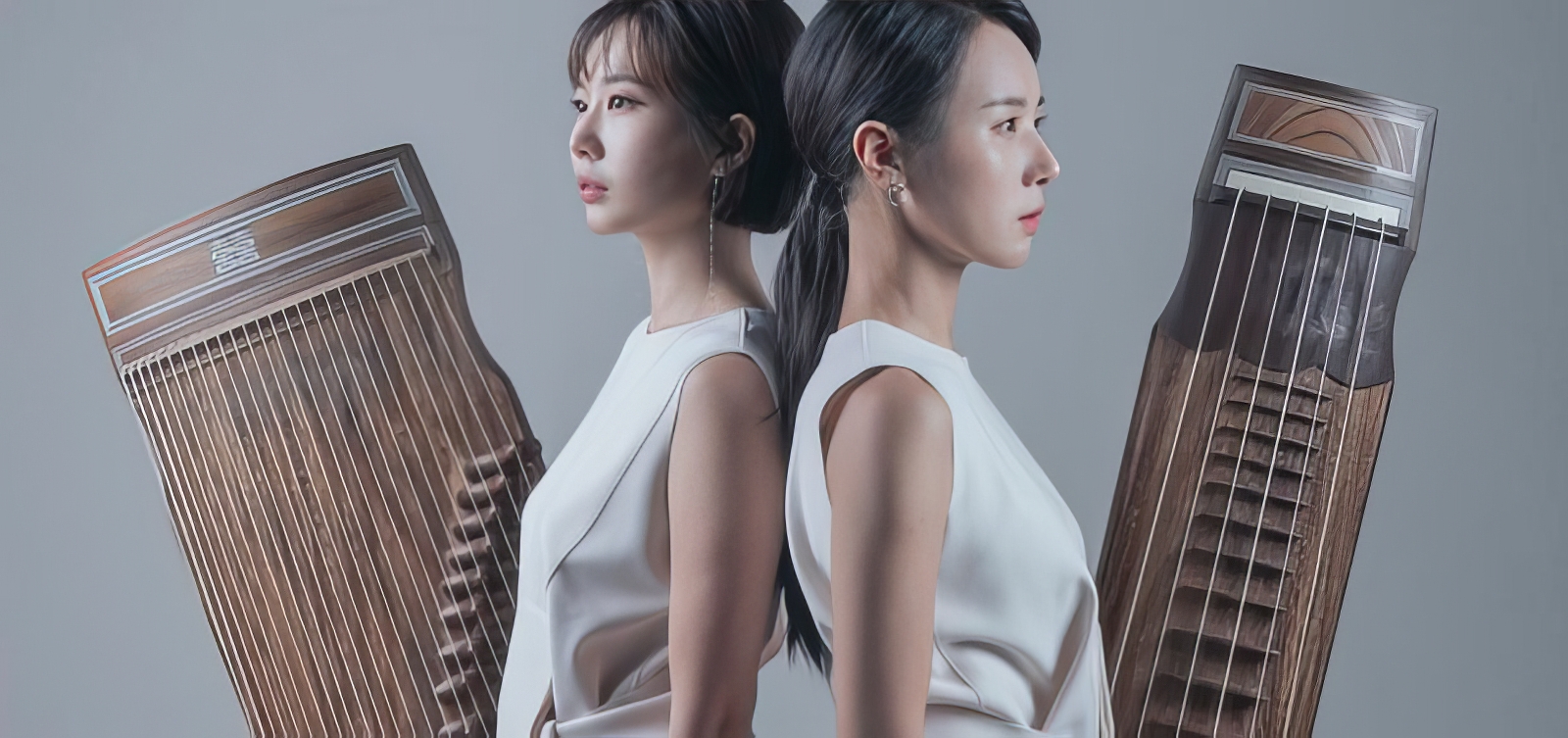
Into that noise came Dal:um, two musicians from Seoul whose music works differently. Ha Suyean and Hwang Hyeyoung play gayageum and geomungo, Korean zithers built for notes that bend, ring and die away slowly. No drums, no bass, no electronics, nothing to cover the gaps. Where Marseille stacks noise on noise and La Friche stacks uses inside one shell, Dal:um write with pauses, silence and tight control between two instruments. Their albums are called Similar & Different and Coexistence, titles that fit the city as well as they fit a duo built on two instruments sharing the same silence.
In the early afternoon, the day after their Babel XP showcase, we met Dal:um in a small and temporary production office inside the Babel XP expo area at La Friche, the hum of the conference audible through the prefab walls. By then, the ideas behind Similar & Different and Coexistence had already been tested on the road. They had toured Europe straight after the second album’s release in October, then spent the following months back in Korea, away from stages. The second album’s reception was the first thing they brought up. “Actually we were worried about our second album’s reaction,” Hyeyoung said.
“But after we released it, we had a European tour, so we can see the audience’s response. We also asked our agent, our European agent, how do you think about our new album, and we asked our label founder, and they said, oh, it’s better than the first one! That was really good for us, because we were really worried about it, and we struggled working on our new album.”
Dal:um changed how they worked from one album to the next. On Similar & Different, some pieces were written by the duo and others by composers they invited into the project. For Coexistence they set themselves a stricter rule. “In the first album, some pieces we wrote ourselves, some pieces were written by other composers,” Suyean said. “After that, for the second album, we talked about how it should be better than the first, so we decided to write the whole album ourselves. While we were writing, we just kept asking, is it okay, is it okay, is it okay?” That loop of comparison and doubt sits inside Coexistence as much as the written pieces themselves.
Working on Coexistence wore them out. By the time they arrived in Marseille, four months after the album came out on tak:til, the instrumental imprint of Glitterbeat Records, new material was on hold. “It was a really hard time for us to write the second album, so Hyeyoung and I both want to take a break, and then we can get back to work on better things,” Suyean said. Their project name means “keep going forward, keep pursuing” in Korean, which for them also meant knowing when to pause.
Korean traditional music, gugak, is the world Dal:um come from. Hyeyoung described it in two broad groups. “In Korea, there is a divide between the traditionalists and the innovators,” she said. “The traditionalists learn from their teachers and then teach their students. The innovators try to express their own identity using traditional musical elements to make their own music.” For her, the biggest changes are happening among those innovators. “Now many new musicians have appeared very quickly, and there are a lot of new projects. The scene in Korea is very big.”
Government support sits behind a lot of that activity. “In Korea, the government supports every year new music based on gugak, and also just traditional music at large,” Suyean said. “There is a competition for new original music based on traditional Korean forms, and it has a huge prize. Many university students want to participate. They make a team, write their songs, and after that they want to continue playing as artists.”
Within that system, Dal:um’s path was shaped by older artists. Jambinai use haegeum, a two-string fiddle, piri, a double-reed pipe, and geomungo inside a loud post-rock band sound. With the duo su:m and then on solo albums like Communion and Philos, Park Jiha writes minimalist music for piri, saenghwang, a free-reed mouth organ, and yanggeum, a hammered zither, and takes that repertoire to international festivals and album catalogues. Gayageum player, Kyungso Park, plays both traditional sanjo and improvised, cross-genre projects with jazz and contemporary musicians in Korea, Europe and the US. “They are our senior musicians,” Hyeyoung said. “Kyungso Park is also my teacher. I look up to them.” The senior generation showed that traditional instruments could carry full sets and full albums on international stages; Dal:um take that lesson and reduce the instrumentation to two zithers working in close dialogue.
Younger artists keep forming new groups around gayageum, geomungo and other traditional instruments. As Suyean put it, “Actually, there are so many artists in Korea. There is Hilgeum, a new trio, and there is an interesting artist named SamSam.” SamSam is a young singer-songwriter and multi-instrumentalist who plays gayageum, haegeum and danso (bamboo flute) and writes songs somewhere between Korean indie-pop and contemporary folk, while Hilgeum is a trio for gayageum, geomungo and haegeum whose 2022 album Utopia frames those instruments in tightly written ensemble pieces at the crossroads of contemporary gugak, minimalism and chamber music. Dal:um are an integral part inside that crowded field, keeping the focus on two zithers where many peers work with larger line-ups.
K-pop, Korean cinema and TV have changed who turns up at Dal:um’s European shows. In the last few years, those exports have made South Korean artists much more visible across Europe and the United States, and the duo feel that shift at their concerts. “Sometimes we have a concert in Europe, and some audience members are really big fans of K-pop or K-culture,” Hyeyoung said. “They wonder, oh, what is Korean tradition?”
That same question surfaced in Marseille too, but inside a different landscape: a port where North African, South Eastern African and other diasporas already share markets and neighbourhoods, so gugak arrives not as an exception but as another live tradition in a place already used to different cultures sounding next to each other. It also raises a different question: among all those cultures, why has so much Korean music and film travelled so far. For Suyean, the answer sits in what happens inside Korea. “Korean people are really hard-working people,” she said. “Many people want to work hard. In different arts, whether film or music, many Korean people want to do their best. Even us, we want to do that. And there was government support. I think it matched with a good time.”
Dal:um’s own route into Europe runs through Glitterbeat Records and its instrumental imprint tak:til, the home for both Similar & Different and Coexistence and has also issued key albums by Park Jiha. The label works closely with artists who stretch local traditions in contemporary ways, and its base in Ljubljana has given the duo a concrete European anchor. “The founder of Glitterbeat, Chris Eckman, is really kind to us,” Suyean said. “Our communication is really quick, and feedback is fast. He introduced our European agent too.” That link has strengthened over several visits. “We have had concerts in Ljubljana three times,” Hyeyoung added. “When we have a concert there, Chris comes to our show, and after that we grab a beer and talk.”
Touring has shown them how audiences respond differently to the same music. European crowds tend to react loudly, with shouts and ovations between pieces. Audiences in many Asian venues stay quieter and more contained, closer to the way Dal:um’s music behaves in the room. “We receive incredible energy from the audience,” Suyean said. “From Asian people, the reaction is often quieter and a bit shy. But in the USA and Europe, the reaction is really big.” For Hyeyoung, that contrast does not change what matters. “Many people do not know about gugak,” she said. “We can introduce our traditional music, and they are moved, they are touched through our music.”
Experiences like that shape what happens when they return to Seoul. Back home, both musicians continue formal study of Korean traditional music while tracking new releases. Hyeyoung focuses on folk songs alongside Korean indie artists. Suyean follows K-pop and emerging Korean groups. “Many emerging artists are developing their music, so I try to listen to new songs,” she said. Daily listening, structured study and touring feed into their sense of how their own project relates to the wider scene.
After talking about audiences discovering gugak for the first time, we asked what they actually hope people carry away from a Dal:um concert. Hyeyoung answered first. “I hope their hearts are warm,” she said. “Sometimes I just want to give a small comfort. A little consolation. I want to give a little power. Not something strong or big, just a little power.” Then Suyean added her own measure. “We hope they can remember us,” she said. “Sometimes I hear music, I don’t know the name, but I remember that it was really good. If people feel that with our music, we are satisfied.”
The night before our conversation in that small production office at La Friche, those aims had already been tested. Dal:um had walked on stage at Babel XP with two zithers and nothing else. Outside, Marseille carried on at full volume. Inside, for an hour, it narrowed to two players, two instruments and the silence between their notes.
You can follow where Dal:um’s two zithers go next via the duo’s official website
and listen to Coexistence and similar & different through Bandcamp