

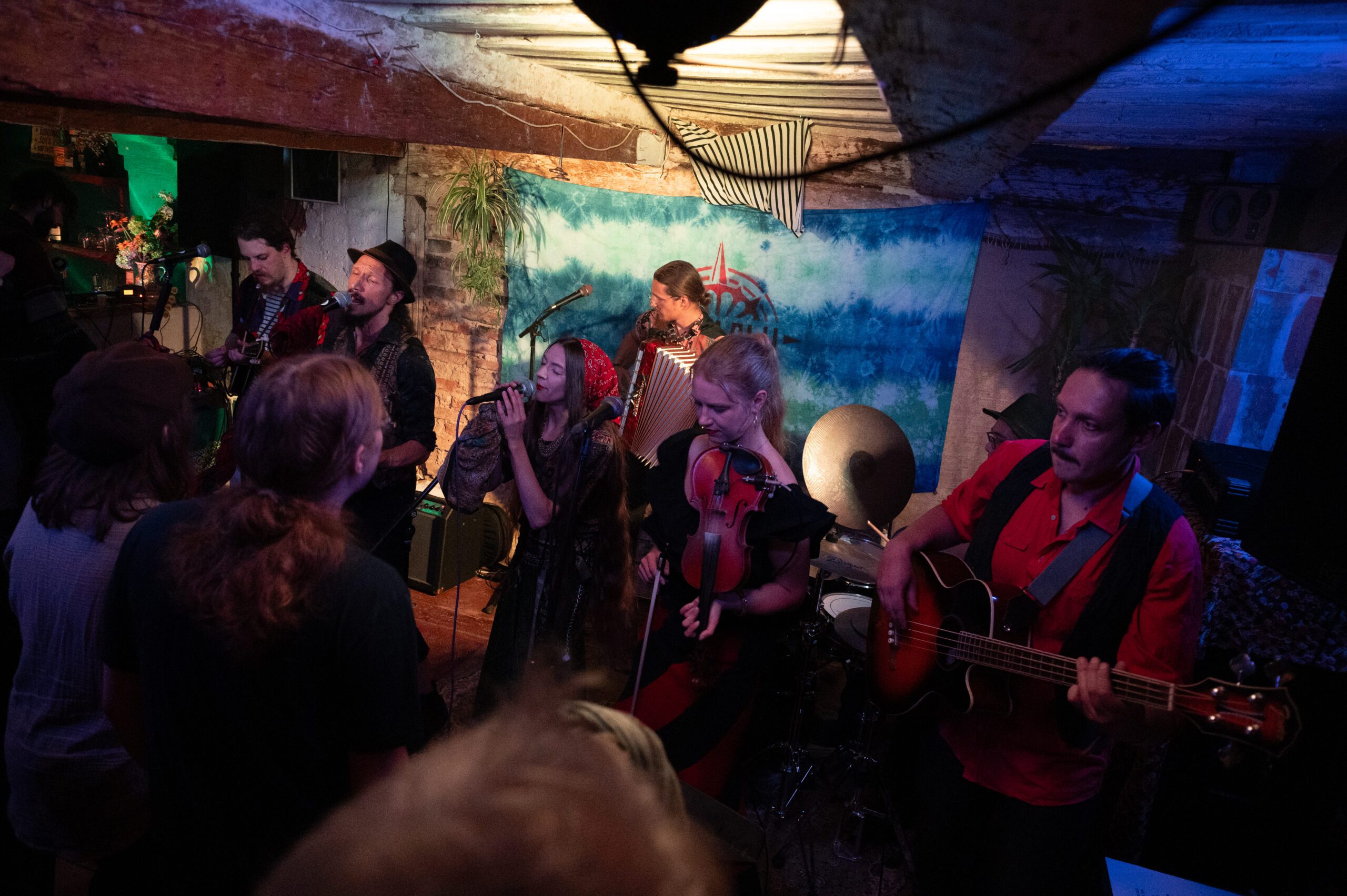
Alum Alu formed in Riga, Latvia in 2020, when borders slammed shut and movement gave way to whatever could be built locally. The first edition of Riga Music Week offered a neat marker of how far they have travelled since then. On the festival’s cold, wet November opening night they set alight the Outdoor Folk stage, driving Hungarian Romani tunes and Balkan folk songs through Latvian lyrics at near-punk speed until a crowd that had arrived hunched in raincoats and windproof jackets was crammed close to the stage, moving hard enough to forget that the Baltic winter was approaching.
Cafe Leningrad is gone, closed for several years now, though its afterlife runs through the band’s repertoire. In Saimons’ telling, their first real conversation happened there over a beer, when familiarity from old shifts turned into an exchange about instruments and songs. “We were just talking about music, and I mentioned to him that I’d brought a mandolin back with me, because I used to play mandolin when I was in the UK in a band called Loreley. It wasn’t the time we first met. We knew each other because we worked together, but we didn’t know each other very well.” Alex was already deep into Balkan and Romani folk recordings, and Saimons’ own listening had been circling similar territory through Gogol Bordello, Goran Bregović and Dubioza Collective.
Saimons’ route into folk music also runs through Britain. He talks about it as a steady drift rather than a sudden switch. “I’ve kind of always been interested in folk music. I grew up on rock and roll, I’m a big rock and roll fan, personally. But through my parents, and the time when I lived in the UK, I got quite into English folk music. Bands like Show of Hands and Bellowhead, for example, are big influences for me, proper British folk music.” From there his listening moved further into European traditions and into research. “I studied Ethnomusicology for my Master’s in Sheffield, and I wrote my dissertation on Eastern European, specifically Russian folk music in the Soviet Union, and also from the Baltics, and from Ukraine and Belarus a little bit.” His current listening still sits between folk, punk and psych. “I’ve been on a big Frank Turner binge the last couple of weeks. If you know Frank Turner, he’s a singer-songwriter from the UK. I’ve also been really into King Gizzard and the Lizard Wizard, the Australian psychedelic band. I went to see them in Lithuania a few months ago.” That mix shapes how he sees Alum Alu at home. “There aren’t really any other bands that do it here, so it’s quite niche.”
The Latvian capital’s own cultural memory offered another entry point. During the Soviet period, Yugoslav films were widely watched in Latvia, and their soundtracks still sit in the ears of older listeners. Saimons points to Emir Kusturica’s Black Cat, White Cat as a reference many people here recognise, and links it directly to the first Alum Alu rehearsals. One of the first tunes he and Alex tried together was indeed “Bubamara” from that film, a song they played for a long time but never recorded. The connection helps explain why their audiences cut across generations. “It really depends on what kind of place we’re playing at. A lot of older audiences find it nostalgic because they have this link from a lot of films that used to be popular, I think. Younger people come because it still feels fresh and new and unlike what other bands are doing”
When Saimons describes the sound in plain terms, he goes back to the phrase the band now use everywhere. “We usually call it Nomad Folk Rock these days. We take Balkan traditional songs and some originals, translate them into Latvian and make a kind of rock and roll version of folk songs.” The reference points stay concrete rather than abstract. “We took inspiration from Gogol Bordello, tried to mix it with a bit of rock’n’roll, and make traditional Romani Gypsy songs faster and harder-hitting.” One song works as a shorthand because it came up in the set and in the conversation. “Especially ‘Vientuļš Eju’, for example, the last song we played at Riga Music Week. It is a traditional Hungarian Romani folk song, but we essentially made a punk version of it.”
As the duo expanded, they drew in musicians already embedded in Latvia’s folk world. Saimons starts the introductions with Aleksis. “So I told about Alex, he’s our frontman who I formed the band with.” From there he moves on to the next voice. “Eli [Eli Ellere] is our other singer. They’re also playing in Saucējas, another ensemble performing at Riga Music Week.” The group, formed at the Latvian Academy of Culture in 2003, focuses on unaccompanied traditional singing in older village styles, built from field transcriptions and archival recordings, and has released several albums as well as winning national awards. “They sing unaccompanied Latvian folk songs in a women’s ensemble.”
Then he follows Eli into their other group. “They also play in Sun Horse, which was part of the Riga Music Week’s bill as well, together with our drummer.” That project runs Latvian folk material through a lean two-person set-up: Ellere on vocals and flutes, Jachin Pousson on synths and drums. “They’re doing folktronica, pairing very traditional Latvian, Baltic, and Latgalian kind of songs, with electronic music elements.”
From there the focus shifts to the players who hold the dance side of the band together. “Janis [Janis Zemgus Jatnieks], our accordion player, and Egija [Egija Laura Preise], our violin player, both play folk dances down at Folkklub Ala every other Wednesday,” Saimons says. “They play a lot of Latvian music, but they also play a lot from all around Europe, Hungarian dance tunes, a few Ukrainian dance tunes, and some Belgian and French as well, I’ve heard them play.”
The rhythm section comes from different directions again. “Outside of folk music, our bass player, Rihards [Rihards Rikmanis], and our drummer, Jachin, both of them, as far as I know, don’t really play in other folk bands. Rihards used to be a bassist for a rock band called Pussy Rock here in Latvia many years ago, and he’s also playing in a couple of other kind of acoustic, light, soft rock bands, but not really folk projects. And for Jachin, our drummer, this is his only folk project along with Sun Horse. He’s also playing in a jazz band and a metal band.”
Saimons likes that the band does not share one single background. “There’s a lot of different influences coming in,” he explains. “It’s quite nice, because we all have very different backgrounds and different things we like. I bring in quite a big rock and roll influence, I guess, because that’s what I grew up on, but also a more western folk vibe as well. Eli and Janis, for example, both bring in more of the Latvian music.” The map behind that is wide. He grew up in the UK and has lived in Georgia, Azerbaijan, Spain and Australia. Janis is American-Latvian, raised in Wisconsin before moving to Latvia. Jachin is American-Singaporean and now lives in Riga after marrying a Latvian. Aleksis spent many years in the city and has since moved back to the countryside.
When he talks about what they have put on record so far, he starts with their self-titled debut. “The first album that we released is ten traditional songs, one original, one Ukrainian song, ‘Limonchiki’, and one cover of Markscheider Kunst, ‘Kvaasa Kvaasa’. Four or five of the traditional tracks Alex wrote new lyrics to, and the rest use words taken from the source languages. We found versions in English from the originals and then reworked those into Latvian. And some of them, either we didn’t like the wording, or we couldn’t find an English version at all, so Alex wrote new words instead.”
This year, the writing has moved towards a more collective process, with less reliance on a single person arriving with a finished map. Saimons describes a four-day workshop in the countryside as a practical reset. “We had a creative workshop in the summer, where we all went to the countryside for four days, and we each kind of tried to bring a song that we liked, whether it was a traditional song, or whether it was just an idea that we’d had in our head for a while, that we thought, oh, maybe we can make a song out of this.” They set up around a table with instruments and worked through each idea without a fixed hierarchy. “We all kind of tried to bring at least one idea that we had, and we all just sat down around a table with our instruments, and just tried to play it, and tried to think, OK, what can we do with this? By the end of the weekend, we got about four songs finished: one we’d been playing around with for a while and two or three that were completely new to most of us.”
At the same time, Alum Alu have taken their traditional songbook beyond the Balkans. Alongside Balkan material and Hungarian Romani songs, they have started working with Latvian Roma songs, brought in through members already involved in folklore projects. Saimons sees it as growth rather than a break. “We’ve started incorporating a few of those elements, but still trying to keep them within our remit. Especially more recently, I don’t feel like we’re trying to stick just to traditional Balkan music. We’re doing a lot more original songs as well, but trying to keep the same kind of style and the same kind of feel with them.”
Riga shapes both how their music lands and where it grows from. For Saimons, a city of around 600,000 people in a country of under two million is the right size for a band like Alum Alu. “In my opinion, Riga is the perfect kind of size of a city for playing music. It’s not too big and it’s not too small. You go and try and play in a city like London, you’re not going to get many people unless you’re really well known, because there are so many other things going on that people want to go to at any given moment. In Riga you’re always going to be competing with something, but you’re not competing with everything.”
It is also a city where rooms matter but rarely stay fixed. Cafe Leningrad has already gone, and at the time of the interview another legendary club, Depo, was getting ready to close its then location and relocate. Saimons leans on the idea that the scene will rebuild itself. “I like to think that every time somewhere closes down, somewhere new usually comes to take its place. Generally, if I have a browse on Facebook events and I see something I’m interested in, it doesn’t really matter what the venue is, I just go to the event. Sometimes there’s one place like Aleponija here in Riga that books a lot of interesting bands, usually smaller folk-ish bands on tour, and Folkklub Ala here in the Old Town as well. So if I really feel like listening to some music, or specifically that kind of genre, then I will go there, because they’ll probably have something good on.”
Those same rooms often throw the same faces together. The band’s social map includes long-running friendships and local cross-pollination, and Saimons spells it out himself. “There’s a lot of bands that we’ve played with quite a few times. For example, Oranžās Brīvdienas are quite good friends of ours, because we’ve played a few shows with them, and Alex went to India to sing with them.” From there he shifts to the punk-leaning side. “There’s a nice folk-punk band called Grēcīgie Partizāni that we’re actually playing with tomorrow. They play folk-acoustic punk music, like if you know Days N Daze, that kind of thing, with acoustic guitar, violin and a washboard.” Another name comes just as quickly. “Otherwise, another band, Rīta Stienis as well, quite good friends of ours, but they’re playing more kind of ska music than folk music, so ska, punk. There’s a lot of punk rock bands here in Latvia, I think there’s a good scene for that.”
The same network of bands sits inside a wider turn back to folk. Latvia’s folk revival runs through much of what Saimons describes, and he talks about it as part of daily musical life, not heritage on display. He notes that Tautumeitas represented Latvia at Eurovision this year and suggests that the last couple of years have made folk language feel more urgent across the Baltics. “I think, honestly, it could be tied to the Ukrainian war, because there’s definitely a big feeling in countries like Latvia, Lithuania, and Estonia, there’s a big sense of holding on to our roots and holding on to the culture there, because it was almost erased during the Soviet times, for example.” In the same breath, he points to a recurring national focus point, Latvia’s huge song and dance gathering held every four years. “We have the biggest song and dance festival in the Baltics, the Latvian Song and Dance Festival” For some musicians in Alum Alu, that week reshapes their whole working life, with rehearsals, performances, dancing and choral commitments taking over their schedules. Saimons spells out the scale. “It’s the biggest event in the country. It only happens every four years because I think the country would break if it happened every year: the entire population of the country shows up, essentially.”
From that broader folk frame, the conversation comes back to what Alum Alu are planning next. When Saimons looks ahead, he stays cautious about the format but clear about the work already done. “I don’t think we’re quite ready for a second album yet, but we’re getting ready for it. We’re planning to release a few songs at the start of next year. We’ve been recording all through the summer and now we have five or six songs that are just about finished, then another three or four that we’ve started recording but haven’t really got close to finishing yet, and there’s another few that we haven’t started recording.” One track already has a visual counterpart. “We’ve shot a music video already for one of the finished ones. We shot that at the end of the summer in the countryside. It’s hopefully going to come out at the start of next year, January, February kind of time. We’re going to plan some kind of video party here in Riga, show the video somewhere in a bar on a screen and maybe have a jam session afterwards.”
Touring plans sit alongside the studio work. “2026 is going to be quite a busy year for us. We’re going to do as many festivals and concerts as possible. We have a few contacts in Finland from a festival we played in Estonia a few years ago that really wanted to get us there, so I think next year we’re going to finally do a tour of Finland. Hopefully we’re going to go to Lithuania more, we’re going to go to Estonia more, maybe further to Poland or Hungary. It’s all still a work in progress…” The release structure follows the same open-ended logic. “We’re hopefully going to be releasing new music as we go, release a couple of singles every couple of months while we get new material ready, and then maybe at the end of next year or the year after there will be enough for a full album. Single by single for now and then we’ll see how it goes.”
By the time the bar starts to get too noisy for a chat and too crammed to sit, we finish our drinks and close the recorder case as Saimons circles back to the line he reaches for whenever someone asks what they are. “We usually call ourselves Nomad Folk Rock these days.” For Alum Alu, that means Balkan and Romani folk songs translated into Latvian and set alongside Latvian Roma and other local folk repertoire, driven by mandolin, accordion and drums in small Riga rooms where the crowd stands close enough to shake the floor, then carried further out to countryside barns, Latvian and Baltic folk festivals and, if the plans land, venues in Finland, Poland and Hungary and further ahead…
Follow Alum Alu’s latest news, shows and release HERE
Listen to and purchase their debut album HERE
Photo ©: Anders Gardangs