
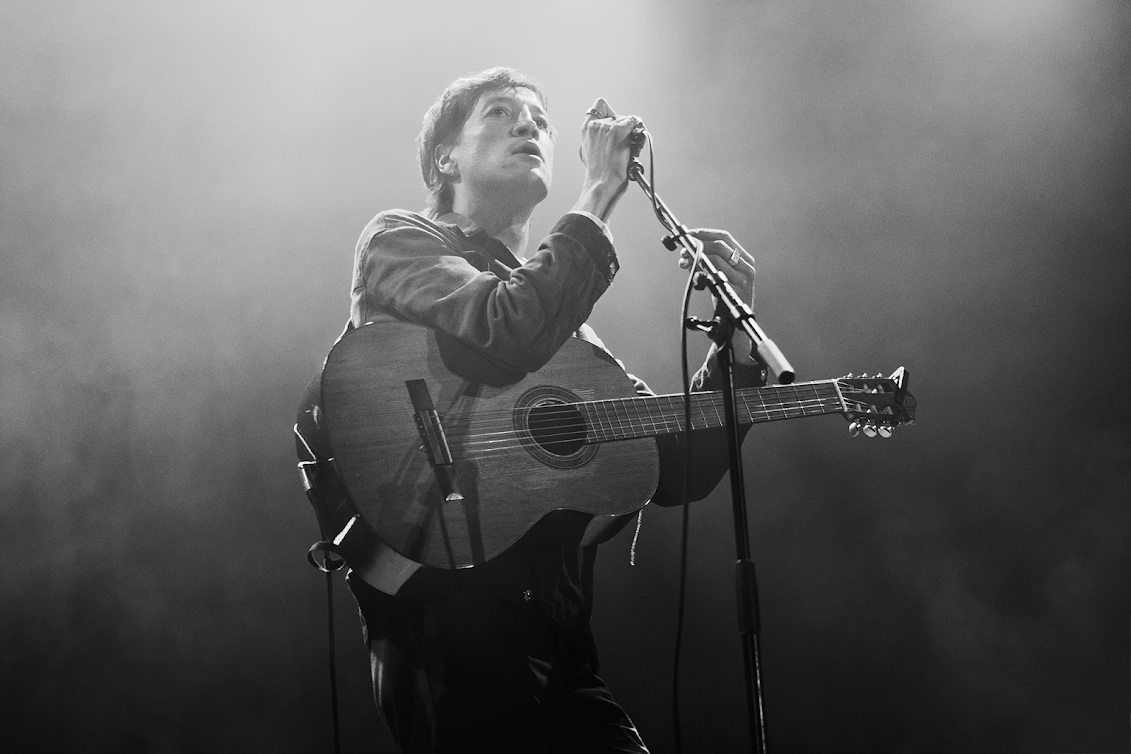
Halfway through Wednesday’s set, Marlon Williams sent the Yarra Benders offstage and sat down at the piano alone. What followed was ‘Kāhore He Manu E‘, the tender Māori-language ballad that features Lorde on record, stripped to just his voice and the keys. He filled both parts himself. The room didn’t need anything else.
That moment was the centre of a night London’s Kiwi expat community had been waiting for, and they weren’t the only ones. Williams is a singer-songwriter from Lyttelton, of Kāi Tahu and Ngāi Tai descent. He brought Te Whare Tīwekaweka to this sold-out, 700-capacity Victorian hall for its first major London outing. The record is his fourth solo album and the first original Māori-language LP to top the New Zealand charts. For the expats packed into the Islington Assembly Hall, it was as close to home as the city gets.
The sense of anticipation had been curated from the start. Support came from Melbourne sisters Maggie and Elsie Rigby, performing as The Maes, whose banjo, fiddle and close harmonies settled the room into a receptive, folk-inflected stillness before Williams even walked out. When he did arrive, opening with ‘E Mawehe Ana Au’ and ‘Ko Tēnā Ua’ without preamble, the Yarra Benders were locked in from the first bar. This long-term backing unit has spent years refining a telepathic shorthand with Williams. Gus Agars on drums and Ben Woolley on bass gave the set its backbone, while Dave Khan moved across fiddle, mandolin and electric slide, giving the newer material a depth and texture that older hits like ‘Easy Does It’ and ‘My Boy’ simply didn’t match. ‘Huri Te Whenua’ hit harder than either, as did ‘Rere Mai Ngā Rau’. The Māori-language material carried more weight throughout — richer arrangements, a driving sense of belonging that the English-language catalogue couldn’t quite reach.
Then came ‘Kōrero Māori’, an upbeat number rooted in Māori pop tradition. Williams used kapa haka call-and-response as the hook: “Hope, Ki raro! Hope, Paiahahā!” Hands on hips, hands down, attention! It is a comic nudge toward belonging that Williams described as a reminder to himself to stop overthinking and just speak. In a room full of New Zealanders, nobody needed telling twice.
The solo piano stretch followed. After ‘Kāhore He Manu E’ he played ‘Come to Me’, a lyrical pop turn that showed the other side of his range, then brought out ‘The Ballad of Minnie Dean’, the old country-folk collaboration with Delaney Davidson. His voice shifts with each register: declarative in te reo, the vibrato used with precision, leaning into a note until it almost breaks before pulling back to a whisper. Then ‘Kuru Pounamu’, soaring and communal, the whole room singing it upward.
The encore brought The Maes back out to cover ‘Losing True’ by The Roches, before closing with ‘Pōkarekare Ana’. The song dates back to Māori soldiers training near Auckland before shipping out to the First World War, a love song about separation, about water between two people and the longing to cross it. For an artist who spent five years making an album to reconnect with his language and his home, and a room full of people carrying their own version of that distance, it was the only song that could have ended the night.
Cover Photo © Jessica Bartolini / jessicabartph