

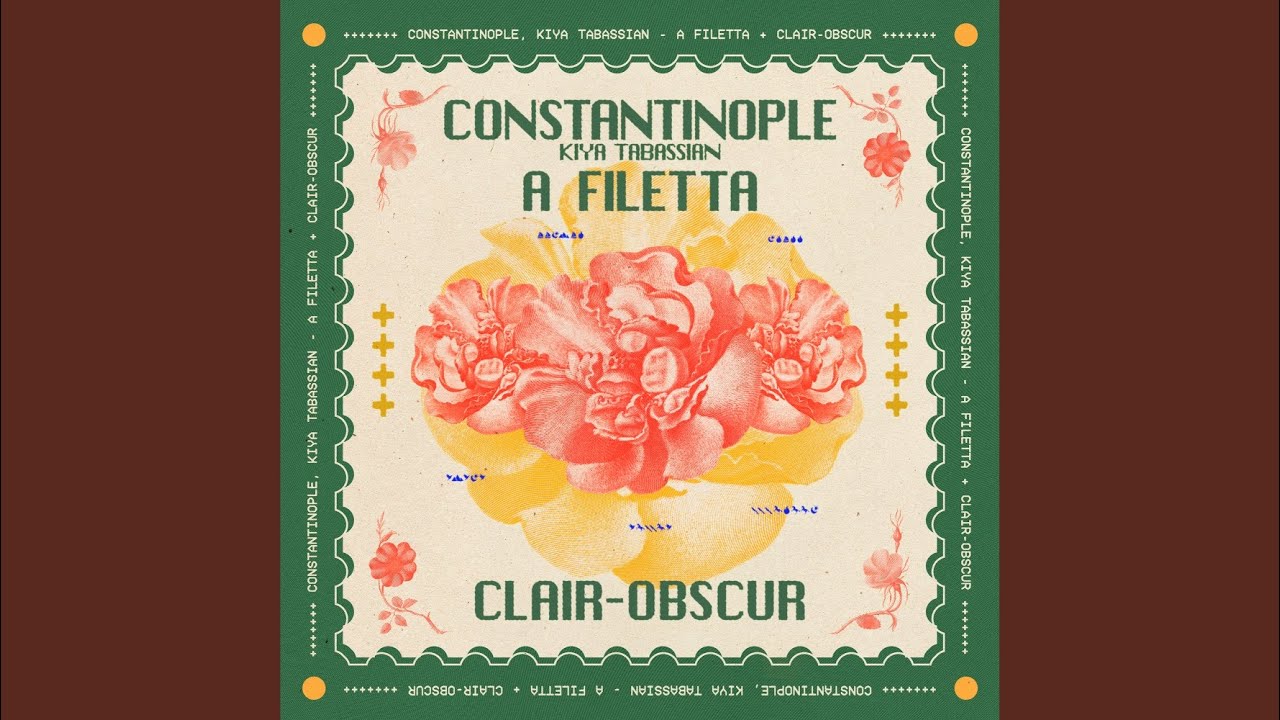
On “L’Abbriu”, Corsican polyphony and Persian strings meet over the words of Primo Levi, the Italian writer who survived Auschwitz and bore witness to it in his books. Constantinople, the Montreal ensemble led by setar master Kiya Tabassian, opens the track with a long instrumental passage before the voices of the Corsican sextet A Filetta take up “Meditate”, a setting of Levi’s text. The track falls halfway through Clair-obscur, the album the two groups released on 25 September on Constantinople’s own label, three weeks after the first single, “Senza Tè”. Levi’s lines bring the record face to face with the violence of history, among texts that range across Corsican and Persian poetry, Seneca and Hafez.
On the album, each group bends its own tradition towards the other. A Filetta’s six voices, dense and close-packed, bend into the Persian modes, while Tabassian reshapes the phrasing of his setar to follow the ornamented lines of Corsican singing. Jean-Claude Acquaviva, who has sung with A Filetta since 1978, sums up the method: “We deconstruct something that already exists, then rebuild it by bringing the other into it.”
A Filetta formed in the Balagne region of north-west Corsica in 1978 to save an oral singing heritage that was slipping away, and have since sung for film, theatre, dance and jazz projects. Tabassian arrived in Montreal from Iran at 14 and built Constantinople into an ensemble that moves between Persian classical music, Mediterranean traditions and medieval manuscripts, winning a Juno Award, Canada’s national music prize, in 2024. On the album his setar is joined by Didem Başar’s kanun, Tanya LaPerrière’s Baroque violin and viola d’amore and Patrick Graham’s percussion.
“L’Abbriu” is Corsican for impetus, a word A Filetta had already put in the name of their 1987 album In L’Abbriu Di e Stagioni. The project behind the track first reached the stage in 2021 and grew through residencies in Corsica and Canada before the musicians recorded the album in the church of San Quilicu at Poghju di Venacu, in central Corsica. They brought the programme to the Collège des Bernardins in Paris on 6 November, as part of the Festival Villes des Musiques du Monde.
Listen to “L’Abbriu” and the rest of Clair-obscur HERE