

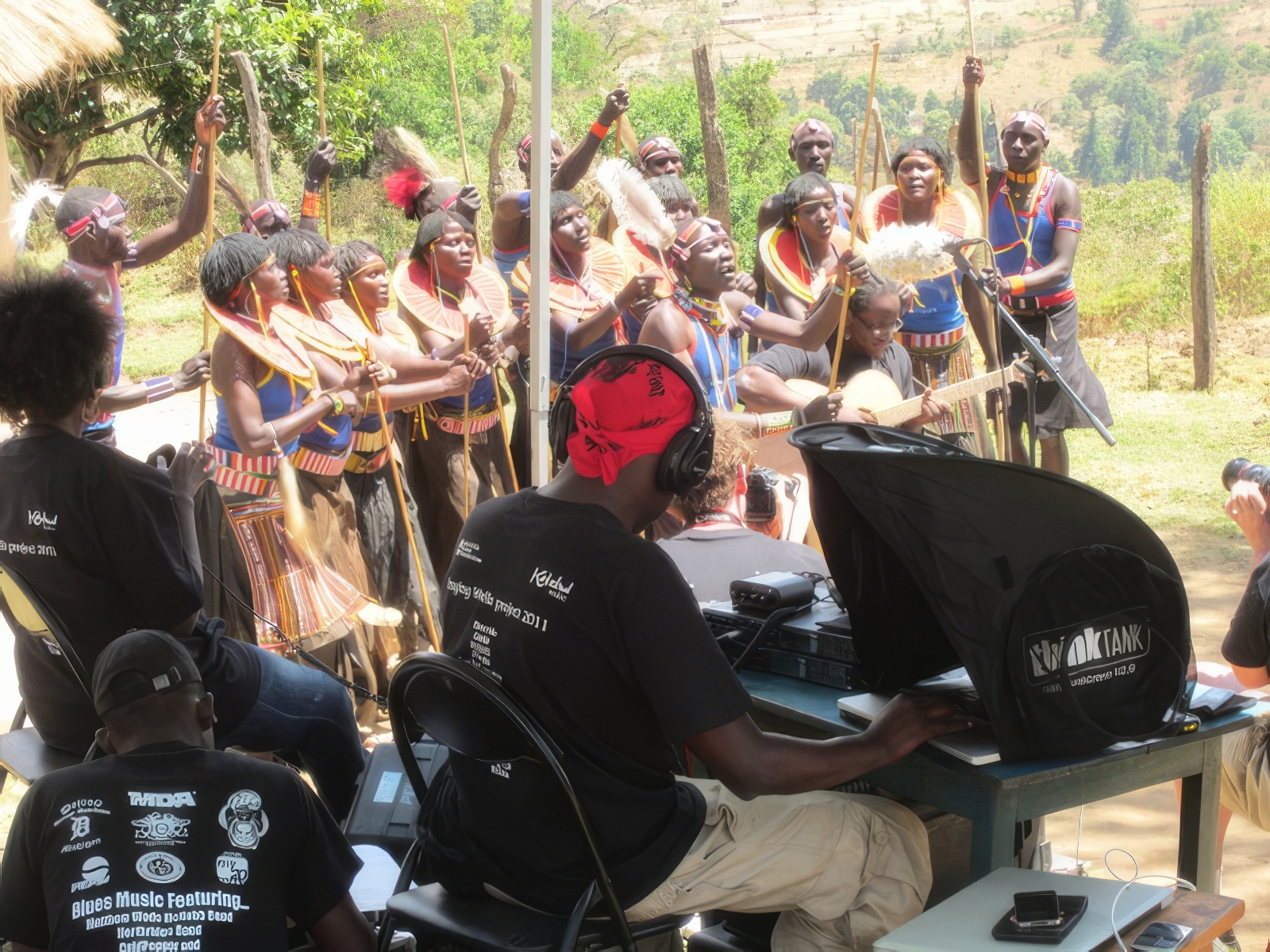
When James Allen travelled to Kenya with his in-laws for their 50th anniversary, he was not expecting to have his life rerouted. On the last day of the trip, there was an extraordinary performance by members of a Maasai tribe. He went behind the scenes to see if he could buy some CDs as a gift and discovered they had never been recorded. More importantly, there had been no Maasai recordings at all. “My background is in music, I have a record label, and it was just incomprehensible that these people were far more talented than any talent I’d ever seen.” He did some research and found something that shocked him: while Africa has an exceptional musical heritage constantly in the commercial airwaves, East Africa had virtually zero commercial use of its heritage music compared to West, North and South Africa. “I just thought it was an interesting business problem.”
A friend connected him to someone at the Ford Foundation who knew Tabu Osusa, one of Kenya’s most respected music producers and cultural custodians. They suggested he call him. What followed was not, at first, an obvious partnership. “If we’re going to be frank, when I reached out to Tabu, Tabu thought: oh my God, another idiot wanting to have a life adventure. He’s going to be a flake and he’s never going to follow through. Tabu gets a hundred of these calls a month and everyone doesn’t pan out. It’s someone that just wants a sexy trip to Africa or something.” Tabu, for his part, does not deny it.
But Allen was not a “flake”. In early January 2026, speaking from the United States and Nairobi, the two men looked back on what grew from that call: Singing Wells, a 15-year field recording project that has quietly become one of the longest-running cultural documentation efforts in East Africa. Tabu, who had spent decades trying to solve precisely this problem, recognised something worth pursuing from the start. “I think Jim is really underplaying what he did. Without him, this wouldn’t have happened at all. It was very expensive initially, and it took a lot of sacrifice from the Abubilla Music Foundation that Jim heads. We don’t take that for granted.” James, characteristically, deflects: “Think of me as the very junior, ignorant bag carrier to this legend of a man.”
The problem Tabu had been wrestling with long before James called was simple to state and almost impossible to solve. East African music, in all its extraordinary diversity, was disappearing. “Most of our history is oral, and we realised that when a whole generation goes, it goes with them.” At Ketebul Music, his Nairobi-based production house, he had been running a programme called Spotlight on Kenyan Music, a kind of talent search that sent teams out to the villages to identify musicians and bring them back to the capital to record. It didn’t work. “When we brought the musicians back to Nairobi, we took them away from their comfort zone. They were not the same people that we saw when we were doing the auditions in the village.” The solution, he had always believed, was to go to the musicians. What he had lacked was the means to do it.
The first pilot of what would become Singing Wells took place in March 2011, on the Malindi coast. The ambition was enormous, and the execution was, by everyone’s admission, a mess. “We were probably quite inspired by Hugh Tracey,” James says, referring to the legendary 20th century ethnomusicologist, “and initially thought our job was to be ethnomusicologists providing audio recordings.” They arrived with two van loads of equipment: a full MIDI interface, a large laptop computer, a generator, 11 microphones, 200 metres of cord to keep the generator far enough from the recording. “We all had cameras because we were interested in photographing what we had done. And we realised very quickly that we were wrong. This was not an audio recording. This needed to be audio and video.” The recordings were great. The videos were not. “Our poor guys who had to turn video from the junk we had done…oh, that was not good.” They went back, changed the whole approach, and started again.
There were other early lessons, some of them absurd in retrospect. The clapperboard, for instance. “I had no idea what a clapperboard was for,” Tabu admits, “just to realise that it was a very important part of the recording. For you to sync the sound on the video, you really needed one.” And the spelling of the group name on that clapperboard turned into a matter of principle. “Because they have the local dialect, the group always determines the final spelling. Always phonetic, always from them. As soon as we leave that village, there is never a single human being that agrees with how we spell it. The online comments to this day are full of people saying ‘you don’t know how to spell X’, and it’s literally because if you can’t trust the person who’s written the song and is telling you how he’d like to spell it, who are you going to trust?”
The first musician they recorded in Malindi, Nyerere Wa Konde, passed on not long ago. “It’s only the recordings from Singing Wells that exist when we talk about him,” Tabu says quietly. “That’s what it is.” It was the proof of concept they had not wanted to need. The urgency was real, and it shaped everything that followed.
James is clear that there were always two distinct goals. “We always knew there were two missions. The first mission was, we need to collect these performances with a sense of absolute urgency. Our perspective, having a Kenya focus initially, was that these were all going to be older groups and that we needed to move quickly.” But as the project expanded into Uganda, the assumptions shifted. “In Uganda, the youth were still heavily involved. We realised our mission was different depending on the region.”
What they were discovering in those early years was that their assumptions about what they would find were almost entirely wrong. “One of our presumptions was that we would somehow be getting to the roots of music, and that music would be naive, primitive in some way. None of that was true. The music is unbelievably sophisticated. And there’s no root, it’s all cycle.”
The moment that crystallised this came early, when they were commissioned by the UN to record the Batwa, the displaced peoples of the Virunga Mountains, who had been incorrectly blamed for destroying the mountain gorilla habitat and removed from land their people had lived on for 100,000 years. “They were probably the greatest musicians we had ever seen.” The problem came when they tried to isolate the vocals, extraordinary vocals, from the clapping. They brought in their sound engineer Steve Kivutia, who kept trying to establish a click track. Every time, after a few bars, the Batwa would abandon it and return to their hands. “Steve kept saying: Tabu, they’re not keeping time. And Tabu said, no, we just haven’t found what they’re doing yet.” What they were doing, it turned out, was using different time signatures every eight bars, with a full loop of 48 bars before it returned. “It took hours to figure out. And then once we found the click track, they were like: cool, thumbs up, and they played the most beautiful music.” James pauses. “That was a very early lesson about the paternalism we had brought with us, whether we knew it or not.”
The Batwa would provide another lesson, this one in a recording studio back in Nairobi. The five women whose vocals had been so stunning were brought to Ketebul Studios for further recording. Patrick Ondiek, the project’s videographer and sound engineer, and Steve kept hearing something they couldn’t place, a faint, mysterious sound threading through the recordings. They checked the mics, went outside to listen for passing trucks, at one point got on their knees looking for cats on the studio floor. “And then finally one of the women stopped, [she gestured], and all five of them shifted babies that had been on their backs, that none of us had ever seen, to the front. Nursed them. Shifted them back. Kept recording. Five women, five babies, and we had never known.”
What the Batwa taught them, technically and otherwise, shaped how the crew would work for years to come. Patrick Ondiek’s own story is, in its way, as remarkable as the project itself. He joined as a young sound engineer and videographer at Ketebul with no experience of field recording. He is now, as James puts it without any apparent exaggeration, probably the most experienced mobile recording professional in Africa. “There isn’t a single human being on Earth who has done more mobile recording in Africa than Patrick. When he goes to a village, he’s already been on the recce. He knows that this musician is going to use that instrument, the middle eight is going to be there, camera two gets that, that group is going to dance to the left and won’t be in the wide shot, so camera three follows them. That’s a guy who’d never done any of this until 2011, and today you’ll never find a more experienced guy.”
That expertise, built over a thousand recordings, has transformed not just the quality of what Singing Wells captures but the economics of how they work. The original cost of a field recording was $2,000 a song. Today, the same thing, full recording, video, posted online, costs around $200, all in. Setup and breakdown, which once took up to two hours each way, now takes about 16 minutes. “That difference in what you can do is extraordinary.”
But the technical evolution has brought with it a subtler kind of sophistication. “You have to use the physical proximity of people as your mixing desk. If in the recce they understand that these three drums always overwhelm the vocal, you have to put them 12, 15 feet behind. We are now extremely sophisticated at that.”
The learning curve has not been purely technical. Some of it has been embarrassingly basic.”We are the most left-brained, analytical males arriving at a place, and we have had more complaints because we forget to tell people what we’re doing. So we’ve learned to always have people in charge of explaining to the groups what’s happening, what it will feel like. Because putting a bunch of sound engineers in the field does not make for a good village experience.”
Tabu’s knowledge of East African music and his network of contacts across the region shaped every decision about where to record and what to prioritise. “Tabu always had a very clear vision that we would be recording our best representation of the major styles and instruments of East Africa,” James says. “Sometimes we wish he had looked at maps in his ambition. I don’t think he ever fully understood how far between places in Tanzania various instruments are.” Tabu laughs.
As they expanded beyond Kenya into Uganda, Tanzania, Rwanda and Ethiopia, each region brought its own distinct challenges. In Uganda, the key figure has been James Isabirye, who has done work equivalent to Tabu’s in his own country. “The specific challenges of Uganda were the destruction of the kingdoms under Idi Amin. The kingdoms were the primary way in which music was conducted. They would sponsor a village to make the instruments, a village to play the instruments.” Reviving that has been a years-long process. The great Buganda royal drums, the mujaguzo, had not been played since 1963. “They were tuned to the pentatonic scale, so when they played, it wasn’t just rhythm. It was music.” They eventually found Musisi, possibly the last surviving royal drummer, who had learned the tradition from his father as a teenager and was still alive six decades later. He helped train a new generation of players.
Isabirye also brought in Shaban, a professional drummer and one of Uganda’s leading percussionists, to work on the revival. He arrived, by James Allen’s account, slightly dismissively, assuming it would be a straightforward favour for a friend. That changed once Musisi began teaching him how the royal drums worked, with pitch and stress carrying melody as well as rhythm. “He was like: I have never been more challenged as a drummer in my life.” Shaban later went on to lead the new band built around the revived royal drum tradition, the Royal Entenga Drummers.
Every village has its own story. In northern Uganda, in Gulu, during a recording session with a group of fairly young musicians, Tabu stepped away to stretch his legs and noticed an old woman sitting some distance from the recording, playing something he could barely hear. “The way she was using her chin as part of the tuning, I moved a bit closer, and then I came back and told the team: there’s a very interesting lady over there. Let me call her.” The group were not enthusiastic. They could hardly hear what she was playing. “Until she was mic’d. And then it was magic.” Her name was Anyim Lac. James Isabirye later fundraised and built her a house.
The reception that Singing Wells receives in villages today is a far cry from those early days of scepticism and careful explanation. “Initially it was a bit difficult, but right now it’s much easier because people can see what we’ve done. They really want to be part of it. In fact now we’re even in a dilemma. Any time we go to record, so many people want us to record them that we have to keep saying, we’ll be back, we’ll be back, because there are too many. Some of these artists have become village superstars.” On a recent trip, a musician they had spotted during the recce had, by the time the full crew arrived to record him, organised and assembled his own group. He wasn’t about to miss his chance.
The approach to communities has been built on principles that James and Tabu established early and have never deviated from. “We pay everybody a studio musician rate, every single performer, for every single performance.” Release forms are signed, explanations given, the purpose of the project made clear. “Our main goal is really to make their music be out there so that at least they are known, and to safeguard and archive the music.” Any commercial use of the recordings, documentary makers, licensing, returns 100 per cent to the artist. YouTube revenue that cannot practically be paid individually goes into an artist fund for next-generation scholarships. “We never collect anything for ourselves.”
And then there is the philosophy James describes simply as “chickens and children”. Village leaders sometimes tried to quiet children or remove animals from the recording area, assuming the crew wanted a sterile, studio-style take. They didn’t. “We love chicken and children. We’re recording how the music actually lives in the village. If the children run in because they remember the dance, we want them in the shot. We’re happy for all the chickens to be there too.“
James has spent enough time in these villages, he celebrated his 50th birthday in one, and would have celebrated his 65th there too, had his first grandson not arrived at the same moment, to speak with some feeling about what the experience means. “As a visitor coming into East Africa, it’s very hard to see the villages in a way where you’re welcomed. The way tours work, it’s horrible. You go to see a Maasai village and they don’t want a group of people coming in with their cameras, and you feel it immediately. You realise you’re intruding, you’ve interfered with village life. This is the opposite. They’ve invited you in. They’ve been given the opportunity to show off the village in the most positive, beautiful light. I feel like I’ve had the rarest front-row seat on African life that anybody could possibly have.” Not to mention, on one occasion, being presented with a live rooster that he admired innocently before it was immediately dispatched to become his birthday soup. “Quite an honour, actually.”
Not every memory is so warmly comic. There was the night in Kisoro, Uganda, when James woke at 3AM under what felt like a weighted blanket, only to discover he was covered in six inches of locusts that had entered through a hole in the window, drawn to the light of his laptop. “I had to start getting them off, then shuffle in my shoes, with six inches of locusts on the ground, to get to the door, open it, and call someone to start shovelling them out.” A dog at the hotel spent the next five days eating them. Tabu and Patrick ate them fried, over drinks, that same evening. There was the Paradise Hotel in Malindi, whose shower had fungus of such alarming depth that the entire team wore shoes and socks into it for the duration of the stay, and whose guests turned out to include a significant number of retired Italian mafia hitmen.
And there was the small matter of the Batwa, whose land, given to them as displaced peoples, was accessible only via a 300-metre vertical hike. With a generator. “Pato [Patrick] is a big man, and I’m a big man, and we were trying to bring this generator up, slipping down the mountain, getting about five feet up and sliding back down. And these Batwa, who on average are four foot two, no kidding, come running down. One of them takes grass off the ground, puts it on his head to create a holding mat, picks up the generator, puts it on his head, and runs up the hill. Then his friends, not to be outdone, come down, take one pellet case in each hand, and run up the hill. Done in 90 seconds. If the three of us had been left to do it, we would still be there.” Hence the phrase that has become a kind of motto for the crew: “You ain’t fit until you’re Batwa fit.”
Singing Wells has now documented over a thousand recordings across East Africa, of which 770 have been published. The YouTube channel has accumulated more than 21 million views, without a single piece of marketing. The archive spans Kenya, Uganda, Tanzania, Rwanda and Ethiopia, and reaches into musical traditions that, in some cases, had barely been documented before. “Think of that. 21 million views and we’ve never done one thing of marketing. I don’t want to imagine what would happen if we really pushed.”
The project has operated for nearly 15 years without government funding, without tribal alignment, without scandal. Tabu made the call early: no governments. James’s summary is blunt. “What role do we expect from governments? Stay the hell away from us. One of the reasons this has been successful is Tabu very early made the call that we would not work with governments. It would inevitably get involved with tribal politics, it would inevitably be seen as the work of one politician and therefore rejected by the counter-politician. We’ve been incredibly careful about that, which has sometimes meant we’ve missed some of the big showcase things, but we’ve purposely stayed away. I think it’s one of the smartest decisions we made. I don’t know a single cultural program that’s gone on in Africa as long as we have with no taint to it.”
Over two million dollars spent in East Africa, with exactly $500 ever misappropriated. They all remember it. They needed to rent a jeep for one of their field trips, and the provider demanded payment in advance. They broke their own protocol and paid upfront because they urgently needed the vehicle. “We disobeyed most of our normal ways of doing it and paid in advance because we needed that jeep, and the guy was a swindler. It was a moment we learned from.” Against the scale of what they have done, it remains the only loss in 15 years. “We’ve emerged without a single scandal. You won’t find a musician that says these guys ripped me off.” They have recorded in northern Uganda not long after revolutions, in Rwanda during periods of tension, and across regions where music is routinely co-opted for political purposes. The decision to remain neutral has allowed them to operate continuously and without interference.
Kenya is changing, Tabu says. The young creatives have understood something that West Africa has known for decades. “Nigeria, from the 1920s, had juju music, very traditional. Then in the ’70s Fela Kuti started afrobeat, which was juju mixed with funk. Right now the young Nigerians are playing afrobeats, but it’s all rooted in the traditional. The Rwandese are doing the same thing, taking traditional music and playing it in a contemporary way, whether hip-hop or whatever genre. South Africa has gone from marabi to kwela to kwaito to amapiano, and it’s all rooted in tradition. Kenyans were always looking up to the American sound, which was not a good thing. There’s no way you can sell that kind of music to Americans. But now the young musicians are going back to their roots. They’re bringing in the orutu sound, the nyatiti, an eight-stringed lyre instrument. They are woken up. And I think it’s thanks to Singing Wells, by the way.”
The next generation is now at the centre of the project’s thinking. The last few field trips have focused explicitly on school-going young musicians, around 20 recordings across three schools on the most recent visit. But the ambition goes further than recording. “What we’re trying to do is identify young musicians who are playing traditional instruments and not simply have them play like their fathers did. We would rather get them a scholarship to learn contemporary music in a conservatory, so they can understand: how do we play our traditional music in a manner that is more contemporary, so that we can reach a wider audience? The West Africans did that very well. When you listen to how they play the kora, it’s very traditional but it’s also very modern.” There are also practical questions of instrument-making and tuning to resolve. Traditional drums, tuned by warming over fire, are impractical on a European tour, as one African group discovered when they set off a fire alarm. “We need to look at tuning with pegs, the way the kora has evolved. We need to do all that kind of research and workshops. That’s the next generation.”
The funding challenge of sustaining that kind of long-term commitment to individual musicians is, James acknowledges, of a different order to anything Singing Wells has faced before. “It’s a lot easier to spend money going in and recording something from a village than it is to create a school of teachers and students who stay for a period of time, because you’re making a commitment to a 12-year-old that if they choose this course, you’re going to be with them for a decade. We better be a lot smarter about it.” James has begun consulting work to generate income that can be redirected into Singing Wells. One recent commitment from a restaurant founder has brought in more support than the project has ever received from a single source. “My highest and best use now is to get the money secured. I’m selling my soul to do consulting for day rates to get the money in.”
The second challenge is visibility. The 21 million YouTube views are distributed across hundreds of videos, most with between 1,000 and 10,000 views, a few with significantly more. The next step, both men agree, is to create festivals, collaborations and platforms that bring the music to wider audiences and generate sustained interest beyond the archive.
Tabu will turn 72 this year. He is thinking, gently, about what retirement might look like, perhaps a small studio built in a village, artists coming to record, a quieter rhythm to things. “It’s about time to let the young ones take this to another level. But in the meantime, we’re still there.” He is proud, he says, in a way that is not uncomplicated, proud of what two people from opposite ends of the world, with no obvious reason to find each other, built together. “I think it was just a coincidence that Jimmy and I met, and I think that coincidence has really changed East African music. I couldn’t have done it on my own, and maybe if Jimmy had met the wrong type of artist or producer, he might have been discouraged. So I think, to be honest, we have to give ourselves our own flowers.”
James, who will not be drawn on his own retirement plans except to say that securing the project’s future funding is the precondition for any of it, puts it slightly differently. “Singing Wells is a legacy kind of project. This is something that will matter 50 or 100 years from now. That’s quite special.” He thinks for a moment. “And when you ask what we’re doing for the next 15 years, whatever you want. We’re ready!”
Singing Wells has published over 770 recordings and continues to add more...
The archive is freely available online through its website and YouTube channel
and the project runs regular field trips across East Africa,
with a major recording session planned for autumn 2026.