

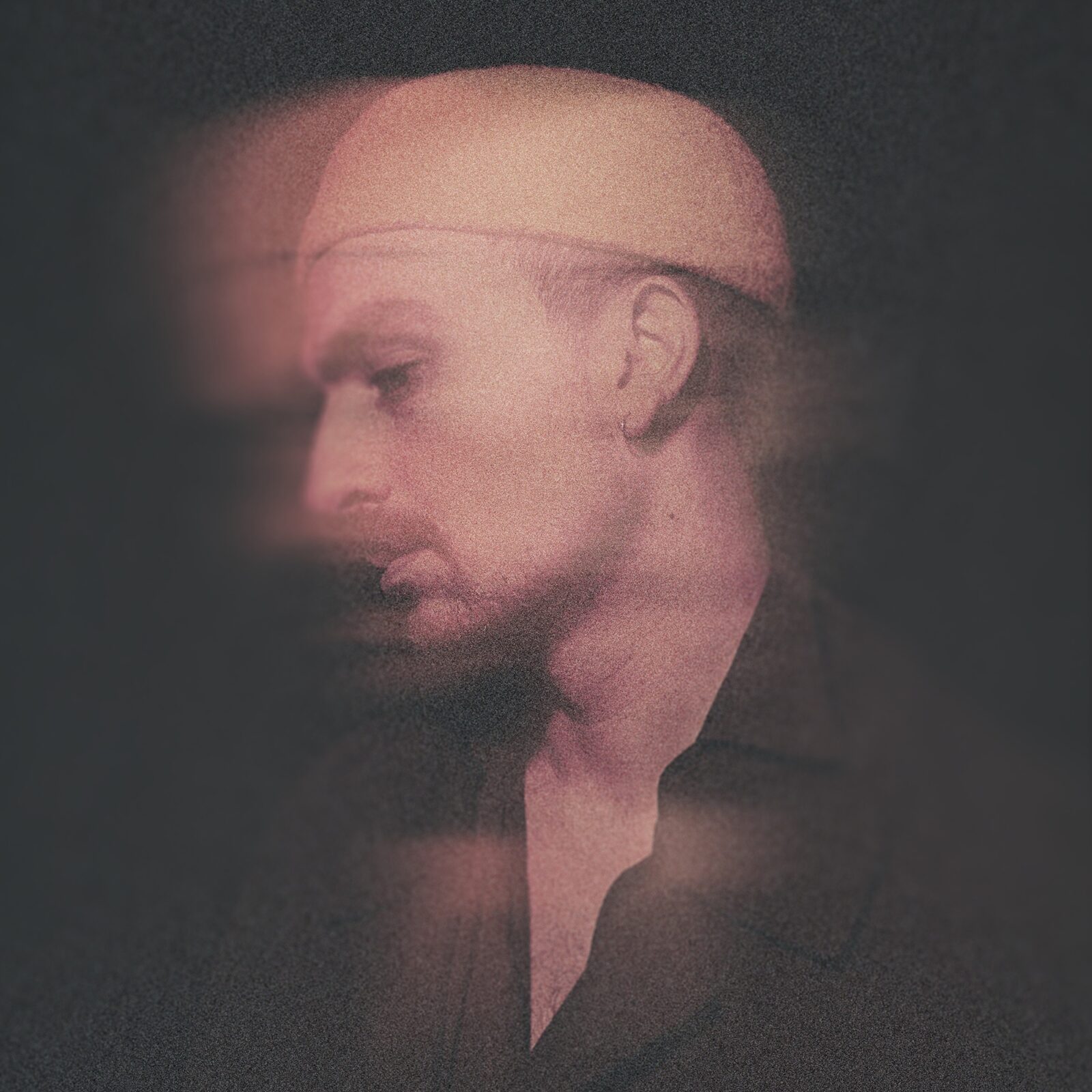
Three years ago, Tarek Zarroug returned to southern Tunisia for the first time since he was eighteen. The trip was his mother’s idea, a family visit, not a research trip. He did not record in studios or seek out musicians. He visited relatives, sat in houses where older people spoke Arabic he could not follow, and looked at landscapes he remembered only in fragments from childhood. By the time he got back to Germany, something had shifted. The music he had been making under the name Taroug, a blend of live drums, electronics and instruments from various traditions, started turning inward towards those fragments. The result, finished by early 2025, is Chott, a ten-track album named after the vast salt lake near his father’s village.
We met Zarroug at Tallinn Music Week in April, the morning before his set. He had arrived the previous night with a small backpack and the focus of someone who had spent months inside the same material. The Tallinn show would be only his third concert as Taroug, and for the first time he would play two tracks from Chott in front of an audience.
He grew up in Germany after early childhood in the Tunisian desert. He studied jazz drums, surrounded by musicians from different scenes, and his first album grew out of that environment, pieces built on his laptop and drum kit, with friends adding saxophone lines or vocals when needed. On stage he combines live drums with electronic production, field recordings, analogue synthesisers and occasional vocals, working within an increasingly tight conceptual frame. “I like the idea, in general, of having a concept when I create an album, and not just a collection of tracks,” he said. “Because the previous album also had, like, this concept.”
By the time his debut album, Darts & Kites, came out, Zarroug already felt distant from it.. Sitting in a café close to the festival venues, he described the lag between making and releasing. “I released it one year ago, but it was finished already two years before,” he said. “The composition, the mixing, the mastering, everything. But actually, the day when it was released, I was already on a different level.” While listeners were discovering those tracks for the first time, he had moved on, producing new material, preparing single tracks, checking out what he could do next.
Some of the pieces on that first record had already started to point back towards Tunisia. He mentioned “Queen of Carthage” and “Deguech”, both linked to his family background. “Degueche is the village where my father comes from, where my family lives,” he said. The artwork for the album included an illustration of the mosque in Degueche, a visual sign that the project had started to circle around his origins, even if the record still felt to him like a group of tracks built over three or four years, with long pauses in between.
By Tallinn, the next phase was already finished. “Now I have a full album finished, a new one,” he said. At that point he was still talking about a hoped-for January release with three or four singles during the year. Since then the schedule has settled: his second album, Chott, will be released on 27 March 2026 via German label Denovali Records. The title comes from Chott El Djerid, the large salt lake in southern Tunisia. He connected that choice directly to his changing relationship with his background. “During the last couple of years, I began more and more to interest myself in my Tunisian roots,” he said. “I grew up in Germany, in Western civilisation, and now, when I’m older, I travelled to Tunisia three years ago. Before that, the previous time was when I was 18, so very long ago, because of army reasons.”
That return visit, made with his family at his mother’s wish, underpins much of Chott. “This new record is all about this,” he explained. “Stories from my childhood when I travelled there, images I have in my head from this area in southern Tunisia.” Across ten tracks the album stays with those stories and images, moving between sparse, melancholic sections and raw, bass-centred passages. Traditional instruments appear alongside live drums, drum machines, analogue synths, field recordings and close-miked voices, linking the desert surroundings of his childhood with the electronic scenes he moves through now. The title track includes an original Arabic poem spoken by his father, recorded specifically for the album. “1995” looks back to early childhood memories in Tunisia. Pieces such as “Saraab” and “Sirocco” work with sound tied to heat and wind, while “Nakhla” reshapes recordings of palm trees into repeating patterns that echo the constant motion of southern Tunisia’s palm plantations, where mechanical and organic sounds run together.
The artwork for Chott keeps the same focus on memory and place. Zarroug worked again with architect and designer Marie Brosius, who assembled an experimental collage from old personal photographs of Tunisia. By cutting and combining those family images into a new layout, the cover keeps the album’s attention on heritage and remembrance without spelling out the full story in the frame.
For Zarroug, research for this shift has taken place in language as much as in sound. Six months before Tallinn he began learning Tunisian Arabic. “It’s very hard,” he said, with a short laugh. “But I want to learn it because that’s one thing I never learned, to communicate with my Tunisian family. Some people speak French or English, but the older people just speak Arabic, and I want to talk to them.” The process has been demanding, but it has opened another way of listening to the voices he records from family members and to the vocal material he places inside his music.
In parallel he has been paying closer attention to current Tunisian and North African electronic work. Preparing radio mixes for Dublab and Radio Raheem gave him a reason to search more systematically. “This was, for me, the first reason to explore some Tunisian music and bring it into my work,” he said. Through that work he came across artists such as Azu Tiwaline, who lives in the same village as his father, and Nuri. Another important name for him is Deena Abdelwahed. “When you listen to her music, it’s so wild,” he said. “Sometimes it’s too crazy for me, but it’s so intense, and when I listen to it, I see a Tunisian wedding in the village of my father, where everyone is dancing. They use lots of traditional elements in the music. You can hear that.” He pointed to the use of metal castanets across the region. “In Morocco they call it karkaba, in Tunisia it’s krakep, but it’s basically the same.” At the same time, he avoided overstating his own ear for borders. “I don’t know if I could always identify if something comes from Tunisia, or Algeria, or Morocco.”
His listening patterns shift depending on how intense studio work becomes. “I don’t listen to music that much,” he admitted. “In the last half year, I had to listen to my music all day. In the evening, I’m done.” When he does listen for himself, certain artists return regularly. “I’m listening to the new Darkside record. I always love listening to Thom Yorke, to Radiohead. And one huge influence in the last couple of years is Rival Consoles. I love his sound design, how he creates his synths. It’s really beautiful.”
For now, his own presence in Tunisian venues remains a plan rather than a memory. “No, never,” he said when asked whether he had played there. “I was there with my family. It was my mother’s wish to go back to Tunisia with my family.” Earlier trips had followed the same rhythm, with days organised around visiting relatives rather than music. Looking ahead, he wants to change that. “I try to make it this year, and explore a bit more, and also try to visit people like Azu Tiwaline, because she lives in the same village as my father,” he said. “Next time I go there, I want to explore more. Last time, and when I was younger, it was always about visiting my family, not exploring culture. I would love to play a concert in Tunisia.”
He does not pretend to know exactly how his work will be received there. “It depends totally on the audience,” he said. “If you play in Tunis, they have spaces for experimental stuff, and the right people will come and enjoy it, hopefully. But if you play in a traditional venue where people are used to traditional Tunisian music, they would be very confused.”
Germany provides the other fixed point. Zarroug lived in Cologne for around ten years before moving to Düsseldorf two years ago, a short train journey that still changed his working context. “Cologne was always more interesting in terms of venues and general music culture, more mixed,” he said. “Düsseldorf was always more like an art city, but they have artists like Kraftwerk and Joseph Beuys. There’s a little bit of development now, some new spaces opening up that are interesting, booking good stuff, but in general it’s not something where I say, okay, this is my base.”
Live performance as Taroug is still in its early stages. The Tallinn appearance was only his third show under the project name, and his first as a duo rather than solo or trio. “It’s quite new, everything’s quite new,” he said. For Tallinn he brought the same drummer and singer who appears on “Queen of Carthage”. “For the very first time, there will be two tracks from the new album, which is exciting for me. And we never played in a duo setting before.”
He keeps the stage separate from the studio. When thoughts about how to perform a piece start creeping into the composing, he cuts them off. “Sometimes I feel like I start thinking about it and then I say, no, stop. I just first have to make the record and then figure out how to do it live.” The shows that follow move away from the studio detail. “I don’t want to replicate how it sounds on the record. The live version has much more energy, it’s more intense, a bit techno-y.”
That separation between recorded and performed also reflects the wider arc of his approach. His background as a jazz drummer runs through both records, but in different ways. The first album drew on the network of musicians he met in studies and sessions. “I wanted to involve my friends because I studied jazz drums, and I was always surrounded by many musicians,” he said. “If I need a saxophone for one track, I send it to a friend and he does it. My drummer is with me here, and he’s the singer on ‘Queen of Carthage’. I don’t want to do everything by myself if I don’t have to.” For Chott he changed that approach. “For the next album, there’s just one small collaboration. The rest is just me.” In his view, that shift is audible. “The next album is much more one piece. It’s still colourful and diverse, but you can hear that I wrote it completely within six months.”
Even so, he resists reducing the project to one fixed sound. “It’s really hard to say, because it’s so diverse,” he said. “It’s a combination of experimental electronica with live drums and some oriental elements. Sometimes with vocals, mostly instrumental.” He knows that working across different approaches can complicate things. “I cannot concentrate on doing one genre or one thing. Sometimes I feel it’s not good to do that, because it’s maybe overload. But I don’t know if you know Darkside. They just released a new album, and it’s so full of surprises all the time. Not like you heard the first two songs and then you know what will follow. I like this way much more.”
That night in Tallinn, two tracks from Chott were played live for the first time on the Afrika NOW! stage at Fotografiska. The setting, a dark standing room of concrete pillars, rough stone walls and black drapes, was far removed from the family houses, village roads and salt-flat landscapes that run through the record. But on a stage built around African and diasporic music, that distance became part of the point. Zarroug’s songs were no longer just carrying family memory from southern Tunisia — they were being heard in relation to a broader map of movement, inheritance and return
Chott will be released on 27 March 2026. Pre-order HERE