

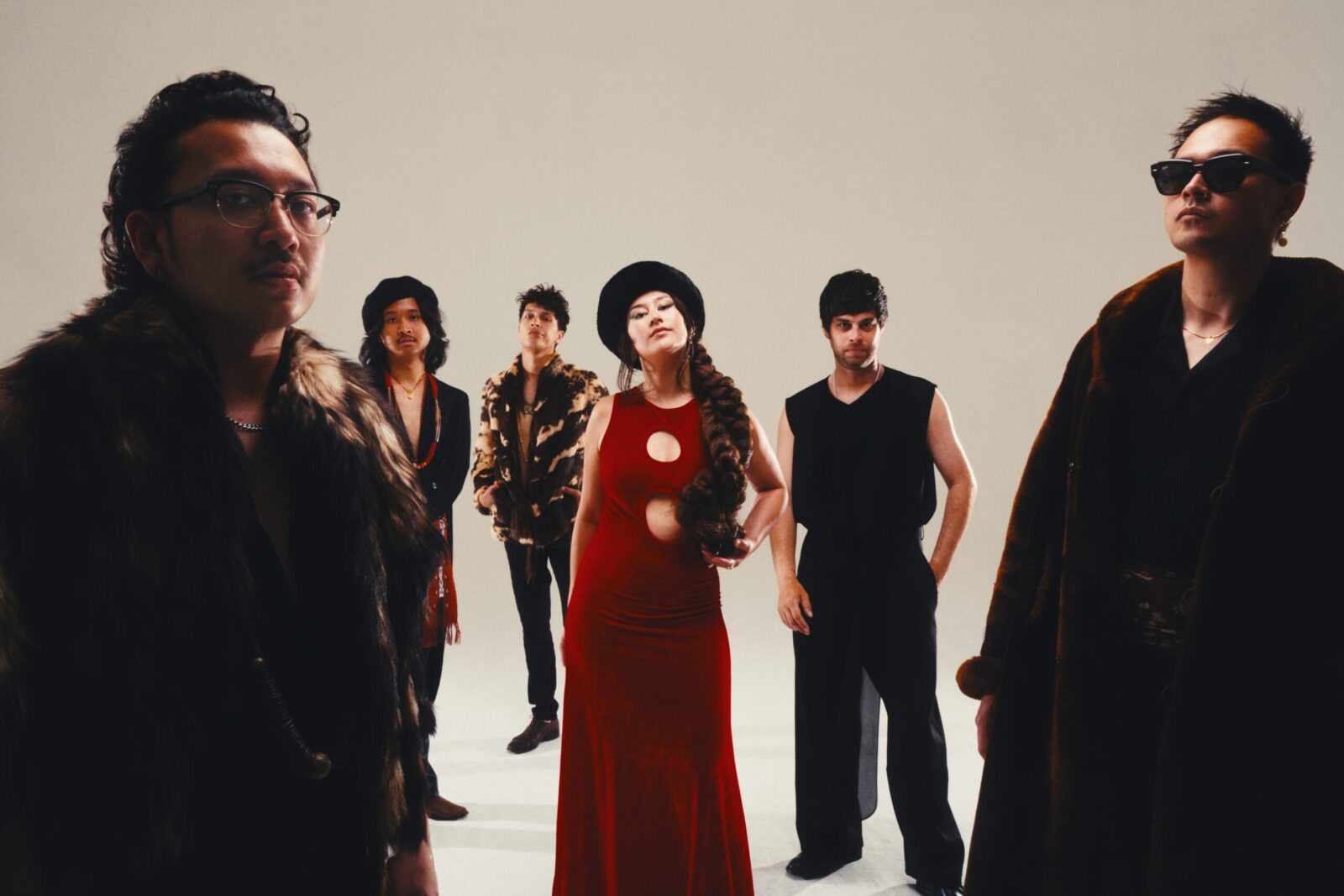
In Budapest, we sat down with Jordy Sanger, guitarist and one of the band’s main arrangers, and Rouzy Portier, guitarist and keyboardist. The Budapest stop-over was part of a wider stretch of performances across Europe and Asia, all of them growing steadily through word of mouth and a handful of singles. They were in town for Ritmo, the city’s annual showcase for forward-looking global music, a week when the centre fills with concerts, talks and late-night sets. Inside Klub Akvárium, Nusantara Beat were only minutes from their debut Hungarian show, yet neither musician seemed in a rush. From the first answer, it was clear they were ready to get into what drives the band.
“We all have Indonesian blood running through our veins,” Rouzy began. One member, bassist Michael Joshua Yonata, was even born in Indonesia. “He only recently got a Dutch passport, so while we can’t say he’s fully Indonesian anymore in legal terms, he was born and raised there.”
Jordy followed the thought. “The rest of us grew up in the Netherlands, but always surrounded by Indonesian culture.”
Rouzy added, “Through our families, yeah. And interestingly, each of us – without really knowing it from each other – always had this urge to explore our heritage musically.”
That idea, first shared during lockdown, became the foundation of Nusantara Beat. “Mid-to-late pandemic, we started to connect and thought, maybe we should try to make Indonesian music,” said Jordy. “People started bringing examples. Rouzy brought in Sundanese music, which I didn’t know much about at the time. It was intense.”
The more they exchanged, the clearer the picture became. “Everyone had their own personal link to Indonesia,” Rouzy explained. “The culture is so wide, and each of us had access to a different expression of it through family.”
Each member traces their story to a different part of the archipelago. “My family’s from West Java, between Jakarta and Bandung, the Sundanese region,” said Jordy. “Megan too, she’s from Bogor. Michael was born in Bandung and spent many years there. My family is from Manado,” added Rouzy.
That diversity inspired their name. “The band name — Nusantara Beat — comes from Nusantara, which means the Indonesian archipelago. It’s vast! And each region has its own musical identity,” said Jordy. “Right now, we’ve focused mainly on Sundanese music from West Java and we’ve explored a Balinese piece too. But we’ve started researching the Minahasa region in the north, where the instruments are completely different. And of course there’s Sumatra, Kalimantan, and everything east of Bali, still lots to dig into.”
Before working on original material, Nusantara Beat released reinterpretations of well-known Indonesian songs from the 1960s and 70s. Their singles on Bongo Joe Records linked back to Sunda-pop, the movement that blended Sundanese traditions with Indonesian pop and Western styles. “So far, we’ve leaned into 60s–70s vintage Indonesian music, especially Sundanese classics like ‘Warung Pojok‘ or ‘Sabilulungan’. They’re almost like nursery rhymes, songs our grandparents would’ve sung,” said Jordy.
Rouzy smiled. “The first time we went there, we were staying at a hotel and one of those songs was playing while we had breakfast. It was surreal.”
That moment of recognition carried into their first performances on Indonesian soil. “It was crazy,” Rouzy recalled. “I’m not usually nervous, but right before our first show — in Jogja — my hands were sweaty. The audience understood every lyric. Some of us are still learning the language, so it was intense. But people sang with full hearts.”
Jordy continued, “At the Jakarta festival, people were going wild. Singing along. It was really heartwarming.”
Rouzy laughed and turned to him.“That was your first time in Indonesia, right?” Jordy nodded. “Yeah, totally mental.”
From those shows came a sense of direction. Their music wasn’t about reconstructing the past but about allowing those rhythms to exist in new contexts. “It’s quite different from what’s usually happening,” said Rouzy. “But people seem to like it. Maybe because it’s something unique, something they haven’t heard before.”
He went deeper into the work behind the reinterpretations. “The whole process is about exploring those old songs and blending them with our own flavours, keeping the tradition alive while fitting it to now.”
Jordy followed on. “Those originals already sound so rich: tapes from the 60s and 70s with all that saturation. We try to honour that sound. We can’t fully recreate it, obviously, because we’re not in that time anymore, but we do aim to get close.”
The point, they agreed, was understanding how that older music imagined itself. “Once we understood how they were trying to sound, we felt more confident to adapt it and bring in our own identity.”
As they spoke, it was clear how quickly their project had grown. “I think we’re doing something a bit pioneering,” Jordy said. “We’ve been invited to play in Japan, Korea, Scandinavia, and we’ve been to Indonesia twice now. It’s surreal. Clearly people are curious.”
Rouzy followed with a comparison that seems to stay with him. “In the end, it’s all just music. It’s universal. I always compare it to food: food’s for your tongue, music’s for your ears. Indonesian cuisine is globally known, so maybe the music from that region deserves some of that recognition too.”
Only after talking through the bigger picture did we circle back to where it all began. Amsterdam shaped the band long before Nusantara Beat had a name. Several of the musicians were already woven into the city’s musical networks: Megan had been singing with EUT, percussionist Gino Groeneveld had just stepped away from Altin Gün (also on the Ritmo line-up), and Sonny Groeneveld had spent years drumming with Jungle by Night. Those paths fed directly into the band’s early identity.
“Amsterdam is such a musically and culturally diverse place. Living there we are exposed to a lot of different musical genres, but at the same time the city isn’t that big, so most people within a scene know each other and inspire each other.”
Jordy put it plainly: “There’s actually a big Indonesian community in the Netherlands, but no other band here is really doing what we’re doing. That helps.”
And curiosity, they said, doesn’t flow one way. “It’s also cool if other bands start doing similar things. Maybe we inspired them, or maybe they inspired us. It’s a two-way street.”
By the time they arrived in Budapest, they had four singles behind them and their debut album almost wrapped. “We haven’t released a full album yet, just four singles so far,” said Rouzy. Jordy added, “All with Bongo Joe Records. Big shout out to them: great label, great people, and really supportive.”
Rouzy picked the thread back up. “We’ve just finished recording our debut full-length. It’s due for release later this year. The singles were rearrangements of existing material, but the album is fully original, all our own compositions.”
That night in Budapest, Nusantara Beat stepped onto an Eastern European stage for the first time. As soon as they began, their identity was clear: guitars carrying that sharp Sundanese bite, synths giving a light psychedelic haze, and percussion working between kendang-style phrases and hand-played patterns while Megan’s voice cut cleanly above it. The crowd didn’t wait; movement spread through the room almost instantly. It was the kind of showcase that doesn’t need explanation: musicians, festival organisers, promoters, programmers and a full house catching something new in real time. For the band, it showed that the sound they shaped in Amsterdam could travel and still hold its centre.
When we reconnected a few weeks ago, in late October, the centre of gravity had moved. What began as a project rooted in reinterpreting Indonesian classics had become a body of original work. Their debut album, out on 14 November through Glitterbeat Records, gathers eleven new compositions informed by Sundanese music, pelog tuning, and the textures of gamelan instruments the band recorded and sampled themselves. It’s the clearest sign yet of the direction they’ve carved.
Gino and Michael took the lead in explaining how that transition unfolded. “It’s two fold. On one hand it’s a direction we wanted to go towards and something that came naturally because of jams during soundchecks and rehearsals. We’d record those jams and turn them into songs.” They went on to describe the other side of that shift. “On the other hand, it was exciting to make that shift and still keep the inspiration from the covers, to combine that more traditional sound with styles we love to play. In the end, it feels like we struck a nice balance between traditional Indonesian sounds and more modern influences.”
The new material moved differently. Ideas didn’t sit in place for long. They travelled from sketches to full songs at a pace that felt new to them.
“There is room for all emotions on the record,” they carried on, explaining the other side of the process. “When writing we usually start with the instrumental part, and Megan would sing melodies over it. Everyone has their own influences and taste. We collect all the demos and decide which ones connect the most. Later, we see if anything’s missing. ‘Cinta Itu Menyakitkan’ and ‘Ular Ular,’ for example, were added later because we felt they completed something we didn’t have yet.”
Working without pre-existing material changed how the group interacted. The edges were less defined; their instinct was more important.
“Obviously it works differently now because we’re working on original material instead of existing songs. The styles of each band member come through more clearly. It’s exciting because there’s less of a grid now. The process keeps evolving. As soon as you think you have one style, it can be dangerous to get stuck in that idea. We just make music that interests us, and the album shows that. It’s pretty diverse.”
Some songs connect directly to personal lineage. “If there’s one track that shows that most clearly, it’s ‘Kalangkang,’ Gino explained. “Michael wrote the lyrics in Indonesian because of his familiarity with that style of storytelling, and Rouzy translated it into Sundanese because of his roots in that region.”
For Megan, making the record became a way of stepping further into her own cultural background. Her reflection arrived as the project’s emotional centre. “Because I’m still learning the language, it was too difficult for me to write directly in Indonesian at first. I started by writing in English, with melodies and words, to create an atmosphere and emotional base that I then worked on with Michael. From there, we shaped the lyrics into something more poetic in Bahasa Indonesia.” She continued: “That process helped me make sure the intention behind the words was right, even in another language. It let me sing from the heart and connect more deeply with my heritage. Every time we make something new, I feel closer to my family, the band, and myself. It’s like with each song we discover a little more of who we are.”
Before closing our exchange, the band turned to how the album might be received. “We hope our listeners in Indonesia can hear how Indonesian music has influenced us, and recognise those traces in what we’ve made. Maybe audiences in Europe will notice the songs sound foreign or tropical, and be drawn to the language, while listeners in Indonesia can connect with the meaning behind the lyrics.”
They added a final thought about home: “Within the community here in Amsterdam, there are second, third, even fourth-generation people with Indonesian heritage who might feel something similar, curiosity, maybe even pride. But most of all, we hope people can appreciate the music for what it is.”
Nusantara Beat’s debut LP is out now via Glitterbeat Records. Listen and purchase your copy HERE
Their ongoing European tour will bring them to London on 30 January 2026 for a show at MOTH Club
Photo ©: Pasqual Dominic Amade