
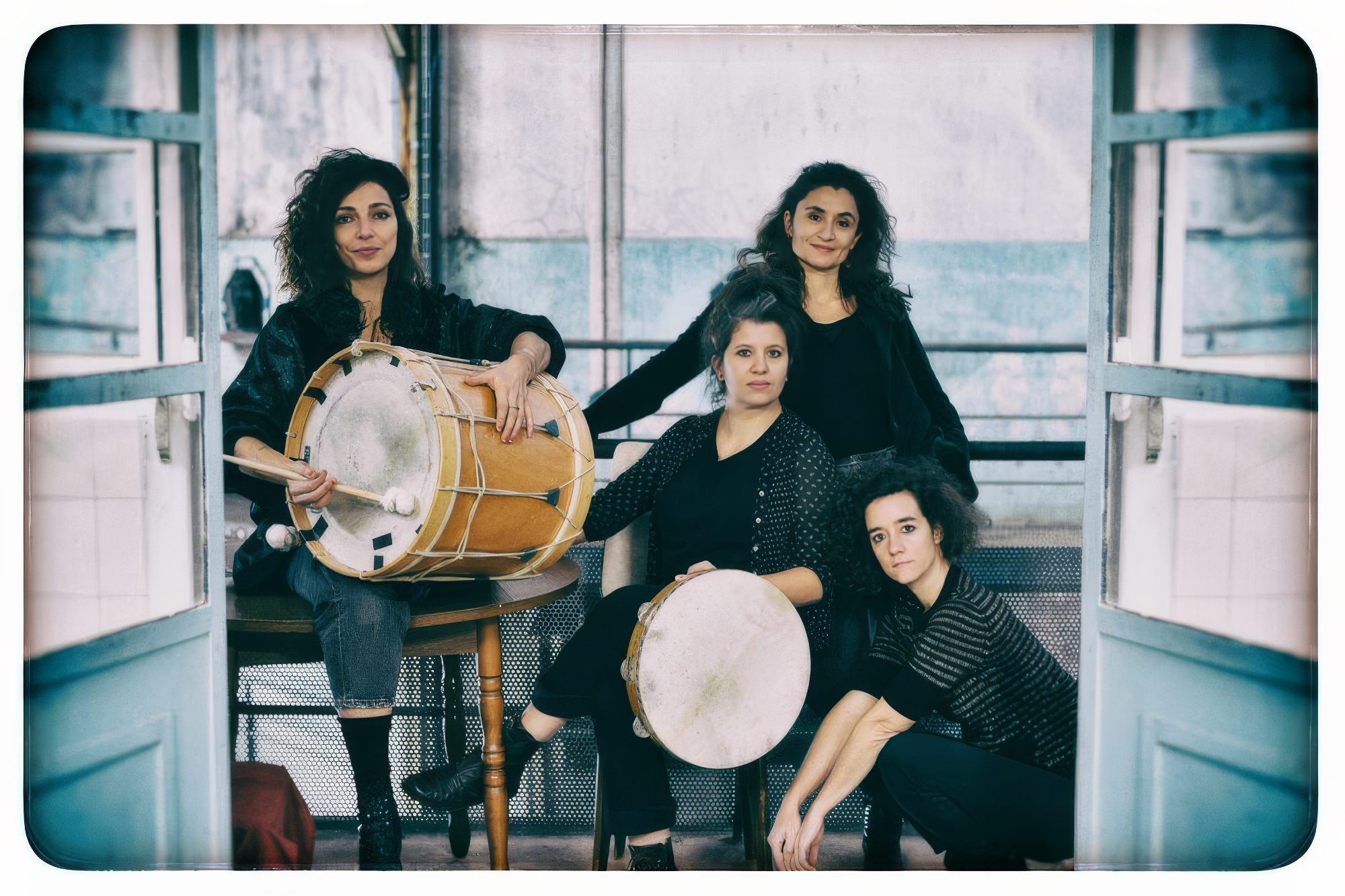
Inside the office area of Dock des Suds in Marseille, the Babel Music XP production team is still at its desks on the last day of the 2025 edition, closing files, answering calls and fixing final details for the night’s showcases. Between two rows of computers they clear a corner for La Mòssa, the four-all-female voice polyphonic and percussive ensemble from Avignon, to sit for an interview before the evening sets begin. It is late March and the venue is only weeks away from closing as a concert hall after almost thirty years, so their appearance falls into the final run of nights on a stage that has hosted generations of Marseille events including Fiesta des Suds and Babel Med. Around a pushed-together desk, singers Lilia Ruocco, Emmanuelle Ader, Sara Giommetti and Aude Marchand switch between English, French and Italian as Ruocco translates, outlining how a semi-amateur choir project grew into a group that now treats voices, percussion and language itself as its main instruments.
Their story runs back to a polyphonic singing studio in Avignon that grew out of a larger choir. It begins with a chance meeting. “Aude met Sara, because we were doing a show together, and then we met around a polyphonic world singing studio,” Ruocco recalls. “And by doing this work together, we realised that we wanted to work together. So we separated ourselves from this great initial choir, which was more of a semi-amateur choir, in Avignon.” That separation marked the beginning of what they call their story of movement, a project initially built entirely on rearranged traditional songs supported by musical research into percussion. Over time, the limits of that approach became clear. “Then we realised that our identity needed something else. And so we started to go towards the direction of composition and creation.”
Their first album, a moss!, released in 2019 on La Curieuse, set out the original framework. The record draws on traditional songs from Bulgaria, Finland, Albania, Réunion, Argentina, Ireland and the United States, reworked for four voices and percussion. Pieces such as “Tarantella pé sbarià” and “Dona Mariquinha” connect Italian and Portuguese lyrics with dance forms like tarantella and forró, while songs including “Sedenki” and “Käppee” come from Bulgarian and Finnish sources. The lyrics deal with marriage, mismatched couples, gossip and communal dances, reshaped by the ensemble’s timing, phrasing and vocal harmony.
From that base, La Mòssa gradually shifted towards original writing. The change manifests most clearly in their second album, Wanda Pétrichor, released in October 2023. The record contains primarily original compositions, with only two covers: one traditional Apulian song and one piece by Swedish nyckelharpa player and singer-songwriter Emilia Amper, both rearranged according to the group’s own methods. The compositional process distributes across all members. “We compose everything, and we compose at home. And we each bring a composition, or write a text and have it translated. Because we write, we sing in different languages. Or sometimes we use texts from poets to write,” Ader says. The languages span Portuguese, Italian, Occitan and others, a deliberate palette that expands with each project.
When they look back at the early phase, they insist that percussion was already part of the core set-up. “At the beginning there were only rearranged traditional songs. Also in terms of percussion there was a musical research,” one of them says. Over time that research became central to how they hear the group. “In our music, it’s not just polyphony. There is still a very rhythmic thing that takes it to a fairly modern place. Because there are melodies, harmonies, as with the instruments. And then there are also four percussions. In fact, we are eight, we are not four.” On stage, La Mossa sound indeed closer to an eight-piece band than a quartet, with four voices and four percussion parts hitting together as if there were twice as many musicians.
Giommetti takes up the thread of why multilingualism sits at the core of their work. “As Lilia said earlier, we met around traditional singing. A lot of the Mediterranean basin, but also Brazilian, etc. And we realised like that, with this experience of different languages, that each language necessarily had its own musicality. Its particular sounds.” She links that directly to the writing. “That is, to use languages as a raw material, as a range, as a colour. Because we don’t write the same when we write in Italian, than in Spanish, than in Occitan. It gives us other ideas.” Ruocco adds a simple image. “It’s really like an instrument in itself. It’s like an instrument or a scale. We have percussions, voices, but the language is also part of it. I would say it is the third ingredient of La Mòssa.”
The selection of which language suits which story follows both thematic and sonic logic. Marchand describes the choice of language as something that comes directly from what each song talks about. “For example, I wrote a song, a text, about women, thinking about Afghan women, what they are going through at the moment, and thinking about an Afghan friend. I initially wrote the text in French. But what was the most coherent language to tell this story? It was Dari, which is one of the languages spoken in Afghanistan.” That song eventually became “Ba Shaklé Ké Métona”, translated by Yama Iliassi and sung in Dari and dealing with the condition of women who do not have the possibility to choose.
From there Marchand moves to a piece by Ader, “Canzone Rò Curtiell'”, which follows a different path. The group had been working on the ancient Neapolitan “Coro delle Lavandaie del Vomero“, revived in the 1960s by Ettore De Mura and Roberto Murolo and then set to music by Roberto De Simone in his 1976 musical La Gatta Cenerentola, but felt that lifting the piece from its original theatrical setting would flatten it. That frustration became a starting point. “We had started working on the Secondo Coro delle Lavandaie, but we realised that redoing that piece without the theatrical context would have been less interesting. So the project reshaped itself through Emmanuelle’s creativity. She said, I would like to talk about street stalking. There was also a very personal element, this anger at having experienced it, which we had all experienced in some way. We said, ok, what do we do? There was this frustration of not having been able to do the Secondo Coro delle Lavandaie, but at the same time there was this idea, and there was the Neapolitan dialect and bam! It came out…” The result is a contemporary text on male harassment sung over a tammorra pattern.
The relationship between language and musical composition is central for La Mòssa, but it still shifts from song to song. Sometimes music arrives first, sometimes lyrics. Giommetti shares a recent example, a song written in Gascon Occitan that illustrates the personal dimension of linguistic choice. “For example, there’s a new song that has just arrived. It’s written in Occitan but in Gascon. It’s about a terrible thing that happened to my aunt. I’ve always heard Gascon spoken since I was little. So when I wanted to tell her this story, which is really terrible, I said to myself, to think of her, we’re going to sing in this language that she spoke. And I heard her speak this language a lot. So that’s the relationship.”
Since most of the repertoire is not in French, French audiences often ask what the songs are saying, and that curiosity eventually feeds back into the performance. “There are pieces that we feel we need to say a little word, to present them, to say what they are about, what language it is,” Giommetti explains. For them, the key measure is how a room listens. “The quality of listening to the audience is something instinctive. You feel it when the audience is with you and when the audience is not with you.” When asked about a theatrical dimension on stage, Marchand draws a line between presentation and theatre. “There is no theatrical dimension in our work. No, it’s a way of presenting. It is very musical and within the music we let go of what we are on stage. So each of us has her own natural theatricality in the interpretation of the song.” The creative process gives priority to live development over studio construction. They work songs on stage first, then record, reversing the more common album-to-tour sequence. “For us it is rather the opposite, which means that we arrive in the studio having more of an idea of what we want,” Marchand explains. In the studio, technical precision matters, but not at the expense of vitality. “Among all the takes, because when we record an album there are different takes, we hear when there is something that is alive and when there is something that is a little more technical. So in the choice, we look for this balance between what seems more perfect to us on a technical level and when we feel that there is life.”
Throughout its life, the group has contracted from six members to four, a shift they address directly. “At the beginning there were six of us, now there are four, but we are fine. It’s a group life, like a family life, like a life among friends. We spend a lot of time together, we are very close friends.” Tensions are part of that life, but dialogue remains central. “It is clear that there are tensions, but we know how to dialogue and this is our strength.” The current line-up brings together different music backgrounds, from jazz, folk and rock to roots and chanson, and those paths meet in the shared focus on voice and percussion rather than on external instrumentation.
Each member brings distinct influences to the ensemble. They point to electronic music, hip-hop, rock, pop, traditional music and French chanson as part of their listening. Ader describes her contribution in simple terms. “What I like to bring to La Mòssa, in the compositions, is to stay in something quite raw. I listen to a lot of electronic music where the percussion or the work on the voices will be very worked. What I like about La Mòssa is that we stay in something very raw, but that through the writing and the way of singing we will bring something modern and a bit rough.” That description matches the way the second album positions itself: vocal lines and hand percussion remain at the centre, but arrangements use compact forms and lyrics that address present-day subjects.
Their way of working has sometimes caused friction with programmers, particularly in the traditional music sector. “There is this thing in France, in Italy, but I also think in many other countries, this distinction between trad or not trad that is pretty strong, but we are not traditional,” Ruocco states. “We started with this, especially for the first album, we had a certain type of problems, especially with the traditional programming. Because we were a bit like the girls who don’t have an identity, it’s like you don’t have a clear root.” The group resisted pressure to specialise in one cultural identity, maintaining their sonic and musical coherence instead. The second album clarified that position on their own terms. “Then in the second album we really solved the problem, because now it doesn’t exist anymore. We do the polyphony, we do the percussions and we write our songs. We have this freedom to choose the languages, so it’s no longer world music, it’s really music composed in which one of the musical instruments is the language.” Language selection now follows multiple factors, untethered from obligation to tradition. “But we don’t have the problem of saying, ah no, to sing that language we have to be bound to that tradition. No, for us this is not a problem.”
Even with some Italian blood running through the group and Italian language and dialects threaded through their lyrics, they have never taken the project on tour in Italy. When asked about this, Ruocco responds plainly. “No, never! No, we’re trying, I’m trying, but it’s difficult to go to Italy. We have contacts with festivals, but if we don’t find other dates…” They mention connections with Gigi from the Etnos Festival and acknowledge two friends, Enza Pagliara and Dario Muci, who performed the previous day and will attend the Marseille showcase. “But, actually, we’re not very well known in Italy. I don’t know why that is, but for now we have difficulties.” For the moment, their main touring network remains in France and neighbouring countries, often within festivals or series dedicated to contemporary vocal and polyphonic projects.
Even if touring abroad remains complicated, one work has travelled particularly far: the November 2022 session filmed by Vincent Moon in Sorgues for his Territoires series, which captures the then five-voice line-up performing “Canzone Rò Curtiell’” and “Granada” with voices, frame drums, feet and hands, tying together southern Italian roots, García Lorca’s Spain and Occitan material. “Yes, that’s one of our most successful works. Both in France and abroad, it’s what gave us great visibility,” Ruocco affirms. But she also insists it does not represent the full album. “It’s not the only one. And the pieces of the album are very different from each other, even if there’s a common sound, which is our… the alchemy that is created by our voices. This is a common factor to all the pieces. But, in terms of style, the pieces are very different.” That range has opened space for what comes next.
A third album is already in development, though release timelines remain uncertain. “We don’t know when, because we have to write all these pieces. But, let’s say, in two years, one year or two” they say, effectively settling on 2026 or 2027 as the likely window. New pieces already exist, some unpublished, and at least one will premiere at the Babel Music XP showcase that very same evening. The group continues to write individually and then test material in rehearsal, choosing which songs to keep, which to rework and which to leave aside before bringing them to the stage.
That stage work centres on direct presence. “The fact that we sing in polyphony, that it’s only voice, already, that right away, it immediately creates an exchange,” Marchand says. “We are all four singers who each carry a word. We are very frontal, you will see it tonight, with the audience. Our eyes are open, we sing, so there’s an exchange. It’s not like we’re playing the guitar, you see, or we’re in our corner. We are really the voice. The voice touches people’s hearts, I think, right away.”
That sense of contact also shapes how they speak about polyphony itself. The word carries baggage in France, where it signals Corsican tradition to many listeners. Ader addresses this head-on. “When we talk about polyphony, when someone asks me, what do I do? Ah, you make music. What do you do? Ah, it’s Corsican songs. Polyphony for people in France is trad, it’s Corsican.” She would tell newcomers to expect something different. “I would say to people, yes, it’s a polyphony project. But we also accompany each other with percussion. And it will surprise you. Because we all have a priori on polyphony as something a little dusty or trad. And while there are now a lot of super beautiful and very modern things in polyphony like San Salvador for example, in our music, it’s not just polyphony. There is a rhythmic drive that pulls it away from the dusty image.”
When the interview wraps, the production team is already calling La Mòssa towards soundcheck. A few hours from now, four voices and four frame drums will fill one of the last nights at Dock des Suds. The musicians have never needed more than that: voices that move between languages like instruments, percussion that doubles their number, and the kind of directness that makes a room listen. “Tradition is always renewed,” Ruocco says. “Join us and be surprised.”
You can follow La Mòssa HERE
Listen to or buy their music through their releases with La Curieuse and on their Bandcamp page
Photo ©: Marc Ginot