

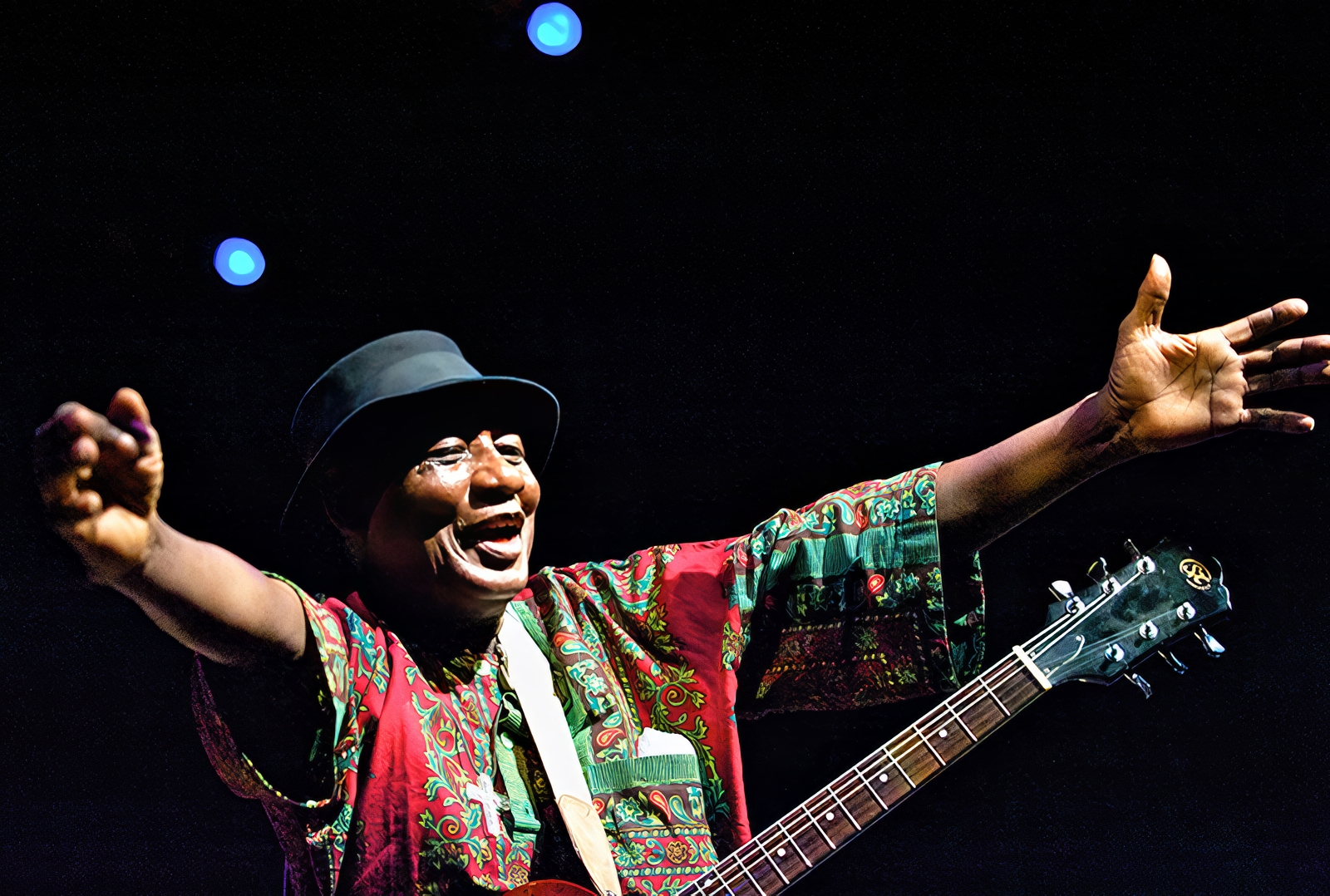
Over a career spanning nearly six decades, Ebo Taylor, who has died at home in Ghana aged 90, recorded an impressive discography of music spanning highlife, afrobeat and more. From classics such as “Love and Death” which has become something of a jazz standard for students of the genre, to deep cuts sought out by samplers and producers in search of a hook, here Rhythm Passport remembers Ebo Taylor through his recordings.
A bandleader, rhythm guitarist and lyricist in a class of his own, Ebo Taylor was born in Cape Coast in 1936 and would live in the nearby coastal town of Saltpond for the majority of his life. His first instrument was not the guitar but the piano, and as a child he was exposed to popular music of the day such as palm wine music as well as traditional music such as Fante fishing songs.
Soon swapping 88 keys for 6 strings, Ebo became a sought-after sideman for bands such as The Stargazers as highlife, with its optimism and elegance, swept across Ghana providing the soundtrack of independence.
London was calling though, and the early sixties saw Ebo relocate and enrol at the Eric Gilder School of Music in Soho. Returning home in 1965 he began fronting his own bands, and this is where we catch up with Ebo in 1975 for his debut album, My Love and Music.
Released on Gapophone Records in a limited pressing of just 500 copies, My Love and Music plays like a statement of intent from Ebo. A joyful feast of a record, it opens with “Maye Omama” with its elegantly arranged brass and a Hammond organ providing a staccato shuffle that pushes the song along.
On the title track, “My Love and Music,” we eavesdrop on a romantic conversation between Ebo and a female voice: an early example of his signature storytelling approach to songwriting, not to mention some tasty guitar.
My Love and Music also demonstrates how Ebo would effortlessly code-switch between highlife and afrobeat during his career, as with the swaggering “Odofo Nyi Akyiri Biara” with its harder, more aggressive sound and minor key.
An assured debut and a nostalgic listen, My Love and Music is a great place to start if you’re new to Ebo and his music.
Fast-forward to the eighties and Ebo is in exile in Nigeria following Jerry Rawlings’s coup d’état. Pressure makes diamonds though, and it was during this time that Ebo fortuitously met influential impresario Chief Tabansi of Tabansi Records and recorded the second of our selections.
The seven songs of Palaver were recorded in a matter of days and are effectively a time capsule of Ebo’s songwriting during this period.
Opening with the title track, “Palaver,” Ebo encourages the listener to mind their business and not meddle in things that don’t concern them. The song showcases Ebo’s advice-laden lyricism and some of his best brass arrangements committed to tape.
On cuts like “Make You No Mind,” Ebo counsels like a calypsonian, and his delivery and arrangements on these recordings suggest a cross-pollination with diasporic music. In this sense he was not unlike his contemporary Fela Kuti, who welcomed funk home to create afrobeat.
However, these tapes would go missing for decades for reasons that remain unclear, before this mid-career gem was finally released as part of Ebo’s next-century renaissance.
That renaissance began with his first international release, Love and Death, released on Strut Records in 2010 and recorded by Ebo — now in his seventies — with the Berlin-based Afrobeat Academy.
Where My Love and Music is sunny and sepia tinted, Love and Death is beautifully melancholic in places, such as on the title track, which first appeared on Ebo’s 1980 album Conflict.
Featuring a harmonic intro that has become iconic, “Love and Death” is a masterclass in brass, whilst with age Ebo’s talent for narrating a story only seemed to improve.
Full of fuzzy guitar and syncopated brass, tracks such as “Mizin” are heavyweight afrobeat, whilst “Kwame” is an elegiac tribute to one of the founding fathers of Pan-Africanism and Ghana’s first president, Kwame Nkrumah.
A more produced record, Love and Death is a greatest hits of sorts and essential Ebo.
Our final selection, Yen Ara, was released in 2018 and represents a passing of the torch to Ebo’s children — and is where we say farewell.
Recorded with the Saltpond City Band featuring two of his sons, Yen Ara, meaning “we” or “us” in Akan, was cited by Ebo as one of his personal favourites. On tracks such as “Poverty No Good” and “Mumudey Mumedey,” Ebo sounds as urgent as ever, offering sage words over the fiercest of afrobeat.
Touring the record with his family band, Ebo received his flowers at festivals and concert halls but always returned home to Saltpond.
“I have a contract with my people and I can’t effectuate that from anywhere else,” he would insist, and indeed Ebo honoured that contract and opened the door for many over the course of a life well spent in service to music.