
By the time La Linea Festival closes in London on Wednesday 6th May, someone will have danced through La Yegros’ nu-cumbia at the Fox & Firkin in Lewisham until 3am, someone else will have sat in pin-drop silence at Union Chapel as Silvana Estrada holds the room, another crowd will have caught Renata Flores bringing Quechua and Andean reference points into trap and pop at The Jazz Cafe, and a room full of children will have learned bullerengue call-and-response in the Barbican foyer. That is the festival in practice: seventeen days, a dozen venues, and a programme that lets Latin music stay as sprawling and contradictory as it really is.
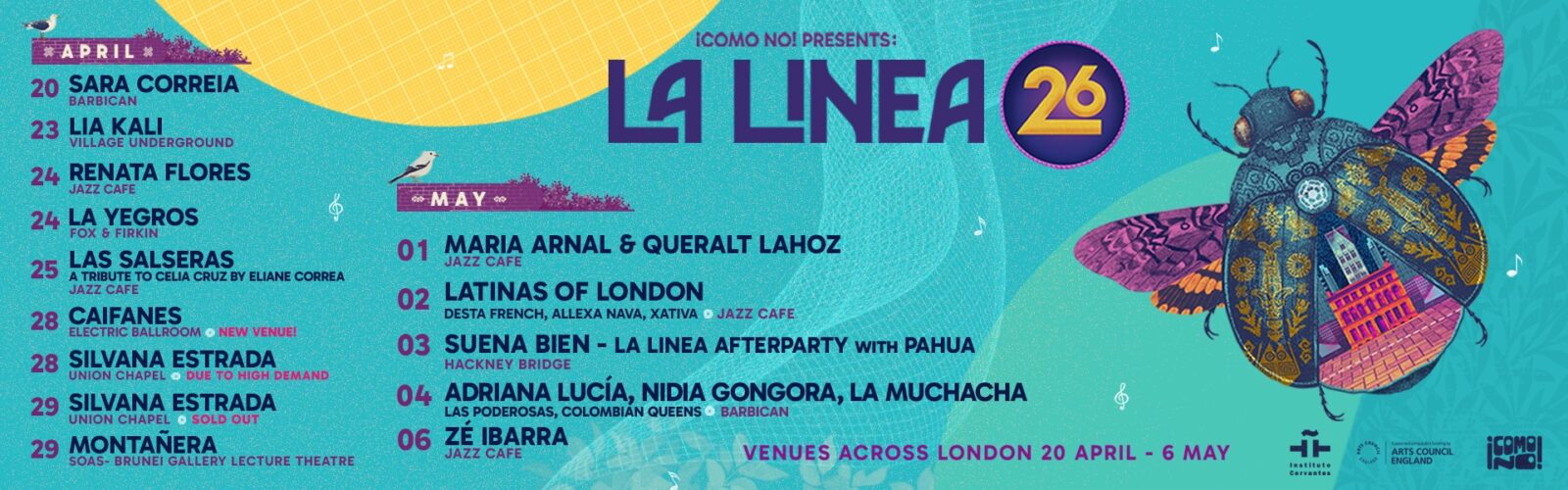
La Linea’s 26th edition opens on Monday 20 April with Sara Correia at the Barbican part of a 2026 programme that is around 90% women-led. The Lisbon singer returns to London after her La Linea debut in 2022, now touring her brand-new album Tempestade and stepping into her biggest UK show to date. Her smoky alto keeps the gravity of traditional fado, while the newer songs open into a lighter, more melodic line, with traces of chanson in the phrasing. La Linea’s 26th edition opens on Monday 20th April with Sara Correia at the Barbican. The Lisbon singer returns after her La Linea debut in 2022, now touring Tempestade and stepping into her biggest UK show to date. Her smoky alto keeps fado’s gravity in place, but the newer songs move with more melodic lift
The week that follows stretches across genres and venues. On Thursday 23rd April, Barcelona’s Lia Kali brings her soul-reggae-rap-jazz fusion to Village Underground. Since the release of Contra Todo Pronóstico, she has grown from local breakout into one of the clearest new voices in Spain’s urban music scene, carrying that blend into bigger rooms across Spain and Latin America. Thursday 24th April splits between two shows: Peruvian artist Renata Flores at The Jazz Cafe, redefining Latin pop through trap, Andean sounds and Quechua lyrics, and Argentinian nu-cumbia queen La Yegros at Fox & Firkin in Lewisham, presenting her new Electro Trío format: percussion, synth and voice channelling cumbia, chamamé and Buenos Aires club electronics. The ticket includes entry to the ¡Cumbia, Mi Amor! club night running until 3AM.
Saturday 25th April sees London-based Cuban pianist Eliane Correa direct Las Salseras at The Jazz Cafe: a ten-piece all-female salsa orchestra assembled to mark the centenary of Celia Cruz. Fronted by vocalist Juanita Euka, the group includes Madrid-based Cuban percussionists Madelin Espinosa and Lidia María Madruga alongside multi-percussion virtuosa Gala Celia from Argentina. Expect “La Vida es un Carnaval”, “Quimbara” and “Oye Cómo Va” alongside lesser-known gems from the Queen of Salsa’s vast repertoire.
The festival’s rock contingent arrives on Tuesday 28th April when Caifanes take the stage at Electric Ballroom in Camden. Formed in 1987, the band helped shape rock en español by pulling post-punk and new wave into a distinctly Mexican frame. Songs such as “La Negra Tomasa”, “Afuera” and “Viento” still carry that mix of drama, mysticism and directness, and the Electric Ballroom gives London a closer view than a band of this stature usually allows.
That same evening and the following night, Mexican singer-songwriter Silvana Estrada performs two shows at Union Chapel, both already sold out (Tuesday 28th April and Wednesday 29th April). Winner of the 2022 Latin Grammy for Best New Artist, Estrada returns with her new album Vendrán Suaves Lluvias, built around voice, cuatro venezolano and songs that trace intimacy, loss and the folk traditions of Veracruz through a contemporary lens. Her live shows are quiet, intense and completely absorbing.
Wednesday 29th April brings Montañera to the SOAS Brunei Gallery Lecture Theatre. The Colombian artist, María Mónica Gutiérrez, arrives with material from A Flor de Piel, but the evening opens with collective singing exercises at 7.30pm before the concert begins at 8pm: audience members become participants before they become listeners.
The festival’s second week opens on Friday 1st May with a rare double headline at The Jazz Cafe: Maria Arnal, one of Spain’s most acclaimed avant-pop artists blending electronics with traditional polyphonic music, shares the stage with Queralt Lahoz, whose music moves between flamenco, bolero, hip-hop, pop and dancehall. Saturday 2nd May stays at The Jazz Cafe for Latinas of London, hosted by Camden native Desta French — the first UK Latin artist supported on BBC Radio with an all-Spanish language song — alongside Peruvian saxophonist Allexa Nava and Spanish-Ecuadorian vocalist Xativa.
Then Sunday 3rd May shifts to Hackney Bridge for Suena Bien, La Linea official afterparty, staged as part of Mexico Vivo Fest and powered by the Suena Bien soundsystem. The bill is built for the dancefloor: Pahua, the solo project of Mexican singer, producer and DJ Paulina Sotomayor, brings the electronic-folk hybrid she has developed away from Sotomayor; Ritmos Cholulteka works from cumbia roots out towards electronic, Balkan and African sounds; and Monterrey DJ-producer Mao Skaay adds cumbia, perreo and guaracha to the mix, alongside Kandela Bone Machine and Disco Psicodélico.
Monday 4th May centres on the Barbican. In the afternoon, La Linea partners with Bullerengue Circle for a family workshop introducing the Afro-Colombian tradition of bullerengue: rhythm, voice, movement and community. Led by the London collective alongside traditional cantadora Darlina Sáenz Garcés, the session requires no experience, just curiosity.
That evening, the festival also presents Las Poderosas, Colombian Queens: headliner Adriana Lucía blending Caribbean cumbia, porro and vallenato with contemporary pop, co-headliner Nidia Góngora, Pacific coast guardian of Afro-Colombian heritage and lead singer of Latin Grammy-nominated Canalón de Timbiquí, and opener La Muchacha, whose guitar-led protest folk addresses justice, gender and community.
The 26th edition of the festival closes on Wednesday 6th May with Brazilian artist Zé Ibarra at The Jazz Cafe. A multi-instrumentalist, composer and producer who first gained acclaim as voice and pianist of Rio’s band Dônica, Ibarra co-founded Latin Grammy-winning group Bala Desejo before launching his solo work. His second album AFIM blends MPB, jazz and pop into cinematic, visually striking soundscapes.
Across seventeen days and a dozen venues — from the Barbican’s concert hall to a Lewisham pub, from Union Chapel’s Victorian nave to SOAS lecture theatres — La Linea 2026 maps the breadth of Latin music as it sounds right now: rooted in tradition, restless with experiment, and very much alive.
Full programme, tickets & venue details are available via the La Linea Festival website