

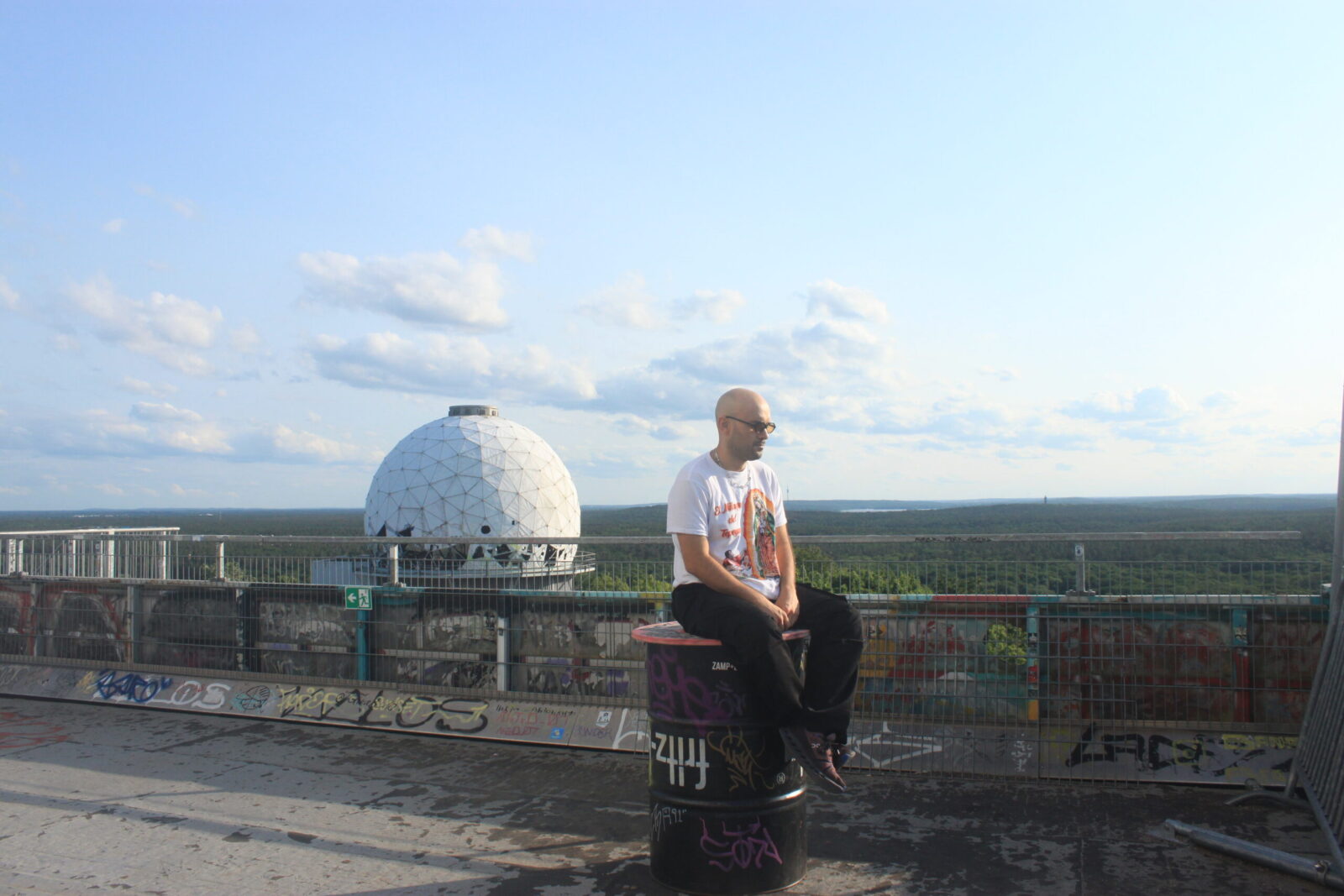
When Vitu Valera moved from Lima to Barcelona in 2019, he was looking for infrastructure. The Peruvian producer did not just need a new city, but a grid capable of sustaining the friction between Afro-Peruvian roots and global club circuits. Valera operates as a conductor of energy rather than a strict session player, prioritising the correct feeling in a room over formal academic exactness. That approach anchored his 2023 debut album, MIGRX, released through the Lima-founded label Matraca. The record took migration as both its subject and its structural rule. Across eight tracks, every featured artist lived in a city different from where they were born.
We met him outside La Plateforme in Marseille on the last day of Babel Music XP 2026, a few hours before he was due on stage to close the festival. The event had run three days across the city, drawing more than one thousand music professionals alongside a public audience. Valera was its final act. He was calm about it.
Valera grew up in Lima and spent his early years inside the city’s electronic music scene. He had been making music for around ten years, the count starting somewhere around 2015, when he was studying electronic music. “I was trying to be a DJ. I studied electronic music back in Peru. I was looking at a lot of DJs and references. Very good ones from Peru.” The names he returns to from that period are specific. Novalima, Tribilin Sound, QOQEQA, Animal Chuki. Producers and collectives working the intersection of ancestral rhythm and electronic production, often ahead of any European or North American interest in the same ground. “You’ve got plenty of examples in Peru. The electronic scene with the traditional music.”
He was trying to find his way into that field, but something about the dominant frame in Lima did not fit. The city’s electronic scene ran heavily on house and tech-house. He tried to combine the festejo rhythm, the foundational pattern of Afro-Peruvian music, with a 4/4 structure. “In Lima we have a lot of house and tech-house influence. When I was in Lima, I was trying to combine the root rhythms, the ones that are very related to Afro-Peruano, that is called festejo.” It did not hold. “House is not my thing. I love house actually, I admire it so much, but it’s not my thing. The 4/4 is kind of boring.” He still credits the discipline of house production and the DJs who work inside it. He just could not locate himself there.
The intuition to perform live as well as produce was already there in Lima, but it had not crystallised into a project. “I had this intuition. But I wasn’t so clear. It wasn’t so clear. It was just a feeling of, let’s do live music. How and what music. I think I needed to leave all the stuff that I had left.” Part of what he had to set aside was the assumption that a live show required a session musician’s training. “For me it was very difficult, because I’m not a musician. Not a proper musician anyway.” He plays guitar at a basic level, some drums, percussion. The breakthrough came when he stopped reading that as a limitation. “I don’t need to be a music session expert. I need to perform it correctly. And do it correctly. That’s music.”
Barcelona offered the reach. “I thought, ok, I want to do it professionally. I need to go out from Peru and try to expand it. And try to get involved with the global scene.” In the city he found collaborators, among them a Peruvian visual artist and drummer who performs as Chepe, and a musician named Sean Lewis. The three of them built a live band project, and in 2023 they played their first proper show, opening for Dengue Dengue Dengue. “That was my first live with a band. The band that I wanted to create.” Valera met Felipe Salmon, of Dengue Dengue Dengue, that night. “I met Felipe that night properly. It was one of the best ones in my life.”
That November, Valera released MIGRX through Matraca, an independent label founded in Lima in 2013. The collaborators on the record included Mikongo, the alias of Peruvian musician Miki González, alongside Lukrø from Mexico City, Nicole Aiff, Carla Valenti, Paulopulus, Opoku, and HNKT, spread across Latin America, Europe, and Japan. The album was mastered by Alvaro Ernesto, known in Lima’s scene as Tribilin Sound.
The sonic vocabulary of MIGRX is built around specific instruments. The cajón and the quijada, a percussion instrument made from a donkey’s jawbone used in Afro-Peruvian and Andean music, anchor the rhythmic patterns at its core. Moroccan karkabas, metal castanets from Gnawa music, are woven into the production alongside dembow, baile funk, and guaracha patterns. Valera had laid the groundwork for this approach three years earlier with “Mamakumba“, a 2020 track made with Mikongo and released on New York label Turntables on the Hudson, in which cajón, karkabas, and quijada were set against electronic production built on both sides of the Atlantic.
The manifesto Valera wrote for MIGRX is careful about what it claims. It describes migrants as people who do not identify with a single community, for whom movement is a natural condition. It does not romanticise that. “We as Latin Americans, we have a lot of mixed cultures, and a lot of global things happening in our culture. I just brought that to my music. And I try to combine and try to perform it to the stages. I try to adapt it to the crowds.”
The live performance had been a long-running ambition before it became a working project. “When I was producing, one of my dreams was to do a live performance. It’s so crazy that it’s happening. So for me it’s like a dream come true. It’s like an idea that I had in my mind. And it’s so crazy that I can do it.” The translation from studio to stage carries its own logic. The crowd is part of the work, not a passive audience for it, and the show adapts to the room rather than the other way around.
Maintaining a live band, on the other hand, turned out to carry weight beyond the music itself. Schedules, logistics, the coordination of multiple people across rehearsals and bookings. “Maintaining a band is a second job. Not only playing.” By the end of 2024 he had begun performing alone, building a solo electronic live setup. “I didn’t expect to grow with that show. I was like, let’s be free. Just by myself. Let’s see what happens…” Something did happen. The show grew through 2025, a year he describes as difficult but productive in roughly equal measure. “A lot of things happened in 2025. It was a crazy year. Good thing. A lot of difficulties also. But it’s normal.”
The visual collaboration with Chepe has continued alongside the solo work, on a per-show basis rather than as a fixed arrangement. Their rehearsal process is minimal by design. Valera plays the music, Chepe puts up the visuals, and the two find the alignment between them in the room. “When we arrive to the rehearsal, I see the visuals and I play the music, and we integrate it. It’s so crazy. That’s the thing that I love. You don’t need to talk too much. It’s just expression. And the intensity of the music makes it more.” The Marseille show was one of the occasions they performed together, and Valera’s longer-term intention is to fold the visual layer into his solo show as well.
In early 2026, Valera spent nearly two months back in Lima, played three nights there, and returned with a clearer sense of what he needed the live show to do. “I got this feeling that I need to perform and improve it.” He does not read Lima as standing still. He follows the work of Renata Flores, a singer from the Peruvian Andes who incorporates Quechua language and Andean musical forms into her recordings, and A.CHAL, a producer and singer working a combination of Andean folklore and electronic production. “I know the situation is pretty tough in Peru, but the music is still coming out. There are names coming out.” He talks about DJ collectives in Lima organising parties around invited singers, sound systems being moved between venues that do not have permanent rigs, the persistence of independent infrastructure under difficult conditions.
In Barcelona he books through Afuerenyo Music, an agency operating in the space between global rhythms and European programming, which brought him to Babel Music XP as part of a Catalan delegation. His sense of the city is layered. He learned Catalan to be able to speak with locals in their own language and treats that exchange as part of how the music gets made: “That’s the thing that I learned, also about music. That music is also a good way to express yourself. I try to adapt myself on that. To adapt to the society. To adapt to the things that are happening.” He notes the contraction in the city’s smaller electronic and roots-oriented venues, and the way the economics of room-filling pushes promoters towards broader formats. “People are hearing more 4/4 rhythms. Yeah, because they need to fill the room. That’s a problem. To make a break even they need to fill rooms.” He mentions Sofy Suars, a Barcelona-based DJ whose most recent live show built Afro-Latin rhythms into an electronic set without the two registers feeling separate. “You don’t feel there are two worlds together. It’s like a united world. You feel there is a whole language there.”
The latest iteration of this transatlantic dialogue is the single “Tansa”, released on 14 March, which serves as a precursor to a new EP due through Matraca next month. This trajectory continues into June with Alma Kreol, a separate project alongside Mauritian producer AVNEESH released via Babani Records. The connection began on SoundCloud and culminated in Valera travelling to Mauritius in September 2025 to track the shared rhythmic DNA between the two cultures. “I found just that the rhythms are very similar. We found that we have similar beats together,” he says of the collaboration. “It’s combined into electronic music and we put our influences together.”
It was this synthesis of disparate geographies that Valera brought to the final set of Babel Music XP at La Plateforme. What landed in the room was what he had already named in his own words: “This is a live music project where I combine electronic music with Peruvian influences, Latin American influences into the club.”
You can find more info about Vitu Valera and his music HERE
His latest single, “Tansa”, was released on 14 March, with Alma Kreol following in June