

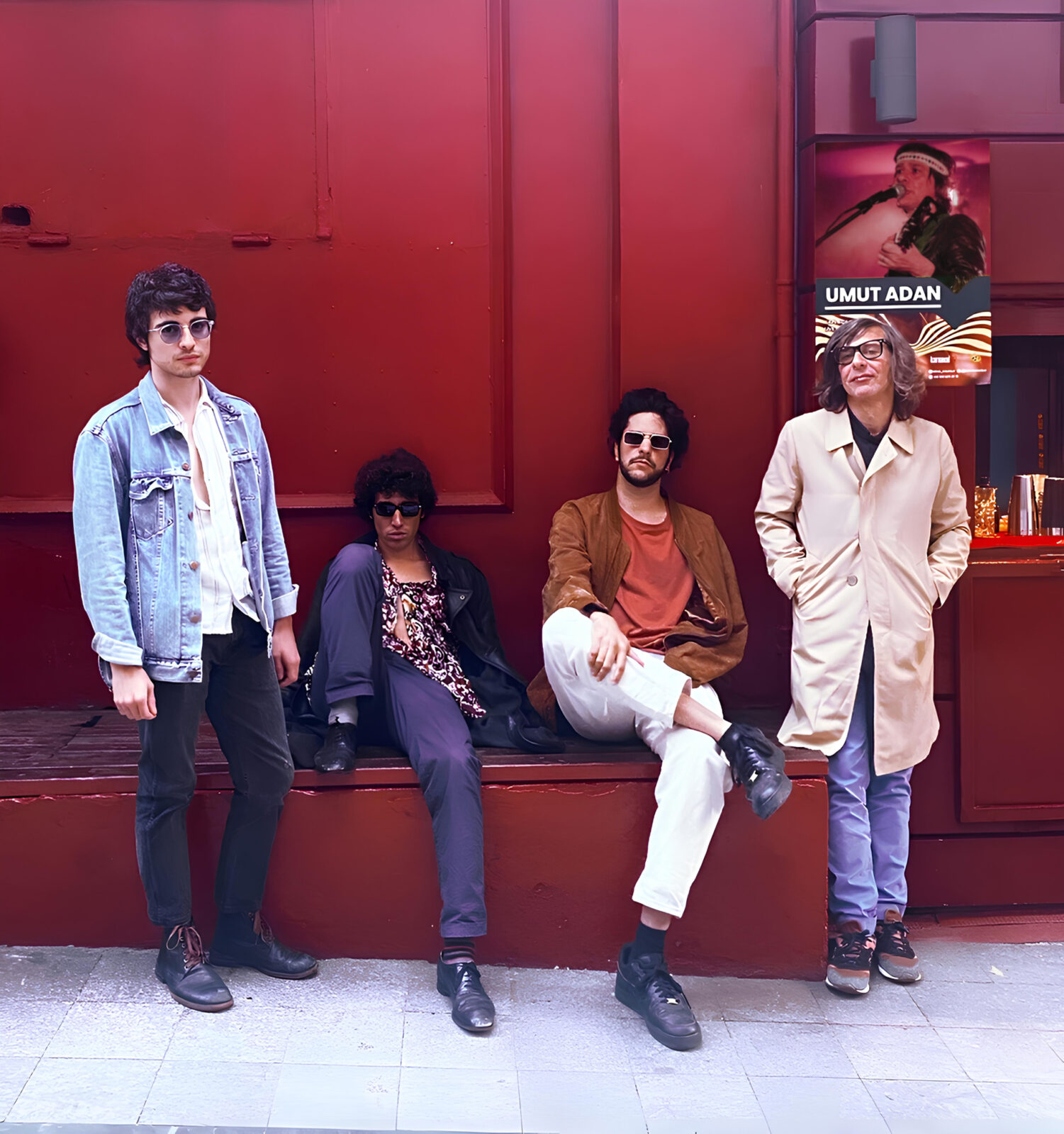
A few days before Başka Bahar / Another Spring came out, Umut Adan was speaking to us from Istanbul about a record that had already lived several lives before reaching the public. It had travelled through five years of work, across rooms in Istanbul, Turin and Brussels, through rehearsals, tours, production sessions and long stretches of selection, until the idea behind it finally held. What emerges now on Six Degrees Records is an album built as a collective, political project with Zebânis, where his Anatolian psych songwriting runs through a band rooted in Turin’s electronic underground and returns as what they call “danceable dissent”.
That shift happened in motion. Adan remembers the moment clearly: a van, a tour, four musicians already moving with unusual speed and trust. “I remember we were in the van and I said, I have something like this in mind. Since we are so attached to the sound and we work with so much efficiency and speed, we should become a band. We produce an album and see what life brings us.” They had already been playing together since 2019, but the proposal changed the terms. Zebânis, the quartet he now leads with Andrea Marazzi, Michele Bussone and Filippo Gillono, stopped being a touring line-up and became the core of the work.
For Adan, that meant changing his own habits. He had spent years writing and performing under his name, with the responsibilities that go with being the main author. Here he chose to let the others’ ideas and instincts set more of the direction. “Getting away from my artistic mentality, getting closer to that of others, fascinated me a lot, made me rest a lot. Mentally, I moved away from my ego. It gave me even more comfort of artistic well-being and also the opportunity to develop all four of us together.” He describes it as a relief as much as a challenge. “Finally in my life, once, for the first time, I listen to someone else and I say, this is really nice. It is a luxury.”
That shift met a group that was already tightly connected. All three musicians were working together in Pietra Tonale, the Turin collective focused on electronic music and improvisation, before Zebânis took shape. Adan had been in their rehearsal rooms and at their concerts, so when they began writing as a band there were already shared habits and points of reference. “When I went to their rehearsals, it was a natural thing,” he says. “They had already listened to my first album. I felt from them this great curiosity about the art, the geography from which I come. The desire to grow and to complete what they have started. Not just to look at the world of the East with an Orientalist eye and say, ah, how nice, there are the others, but wanting to understand, participate, possess and produce.”
The way Adan positions the album in his own geography is equally direct. He grew up in Istanbul, in an apartment building where five different faiths shared the same staircase, and that background runs through how he talks about both the city and the record. At the same time he refuses to file the album under a simple national tag. “This is not a Turkish album of Turkish music. We include the whole East, and we have a lot of Pakistan, Afghanistan, India in this album. We also like to know about the so little spoken realities of the South American peoples, and cumbia gives us a lot of energy. We want to embrace everyone in the artistic and political sense with this album, and we want to go with them, rather than stay here and look at them as with a mirror and a light.” In his view, Başka Bahar belongs to that mix of Eastern and South American references and to the politics that run through them.
That outward motion does not erase Istanbul. The city remains his measure for contradiction, plurality and pressure, and when he speaks about it he does so as someone shaped by that early mix of faiths, density, argument and constant negotiation. “In Istanbul’s history, no one is a foreigner and no one is its master.” Participation, in his telling, is always provisional and shared. The same thought extends from the city to the band. “I was looking for an opportunity to free myself. Not from my style of making music, but I was looking for an opportunity, perhaps in my unconscious, to enrich the music I make.”
When he turns to the city in the present, he speaks about tension and persistence in the same breath. “Istanbul has always been the capital of art, from many points of view. Politics, poverty, anti-cultural policies, yes, they affect this city a lot. But the existence here is so dynamic that you cannot stop the artistic creativity. The musical scene in Istanbul is getting smaller and smaller as a presentation of art. But from below, something is boiling to be noticed, both as spaces of art and as artists.”
That is the city Adan has in mind when he talks about Başka Bahar, and it comes through most directly in “Sale Marino”, the second advance single. Written slowly over two or three years, the song stays close to the ferry traffic between Europe and Asia that runs through daily life on the Bosphorus. Adan is explicit about its setting. “The same classic Istanbulite melancholy, but dressed in a completely poetically Istanbulite way. It is not even Anatolian, it is just Istanbul. I composed it on the ferry between the two shores of the Bosphorus.”
The lyric begins with a body under strain. “My face is full of blood, my heart is broken and I have sale marino (sea salt) coming out of my nose.” A few lines later, that damage opens into a broader statement about how people live with one another. “Anti-conformism and the vision that the world can change only if we know how to share. And without the presence of others in our lives, who nourish our minds, what we have in hand is worth almost nothing.” In “Sale Marino”, hurt, sharing and the need for others are already tied together.
That idea does not stop there. Later in the record, Adan reaches for the Dervish as another way of speaking about the present. He wanted that figure to carry a current political charge rather than remain a historical reference. “We really wanted to make a song like that, with this precise historical oriental character of Dervish. But with a more current political tone today, to be able to say, I am left alone in this world as a Dervish who does not internalise things.” He keeps returning to the ethics of that stance. “We wanted to bring a political, energetic character, certainly, but with these Dervish texts that do not offend, that he is the only one left in the world to know how not to be offended by the realities of the world so aggressive.”
Where that political language becomes most immediate is “Bogotà”, the first single taken from the album. If “Sale Marino” holds on to Istanbul and its social pressure, “Bogotà” pushes the record’s dissent into rhythm and movement. The band use the phrase “danceable dissent” for that position, and here Adan gives it its clearest form. “We, with the movement, put our human dissent in our art. Yes, it is a protest, we can say. But as you can see, artistic creation is always the first of our thoughts. The four of us will never take our eyes off the world. We will never make marginal refinements. We are here and we want the drums to start to give the rhythm.” In that sense, the album moves from the city, to the body, to shared life, and then into collective motion.
Başka Bahar / Another Spring is out now on Six Degrees Records

Umut Adan & Zebânis tour the UK in April:
The Rose Hill, Brighton (10 April)
The Cornish Bank, Falmouth (11 April)
Soup, Manchester (12 April)
The Cumberland Arms, Newcastle (13 April)
The Hug and Pint, Glasgow (14 April)
The Golden Lion, Todmorden (15 April)
The Shacklewell Arms, London (16 April)
Cover Photo ©: Bahar Adan