

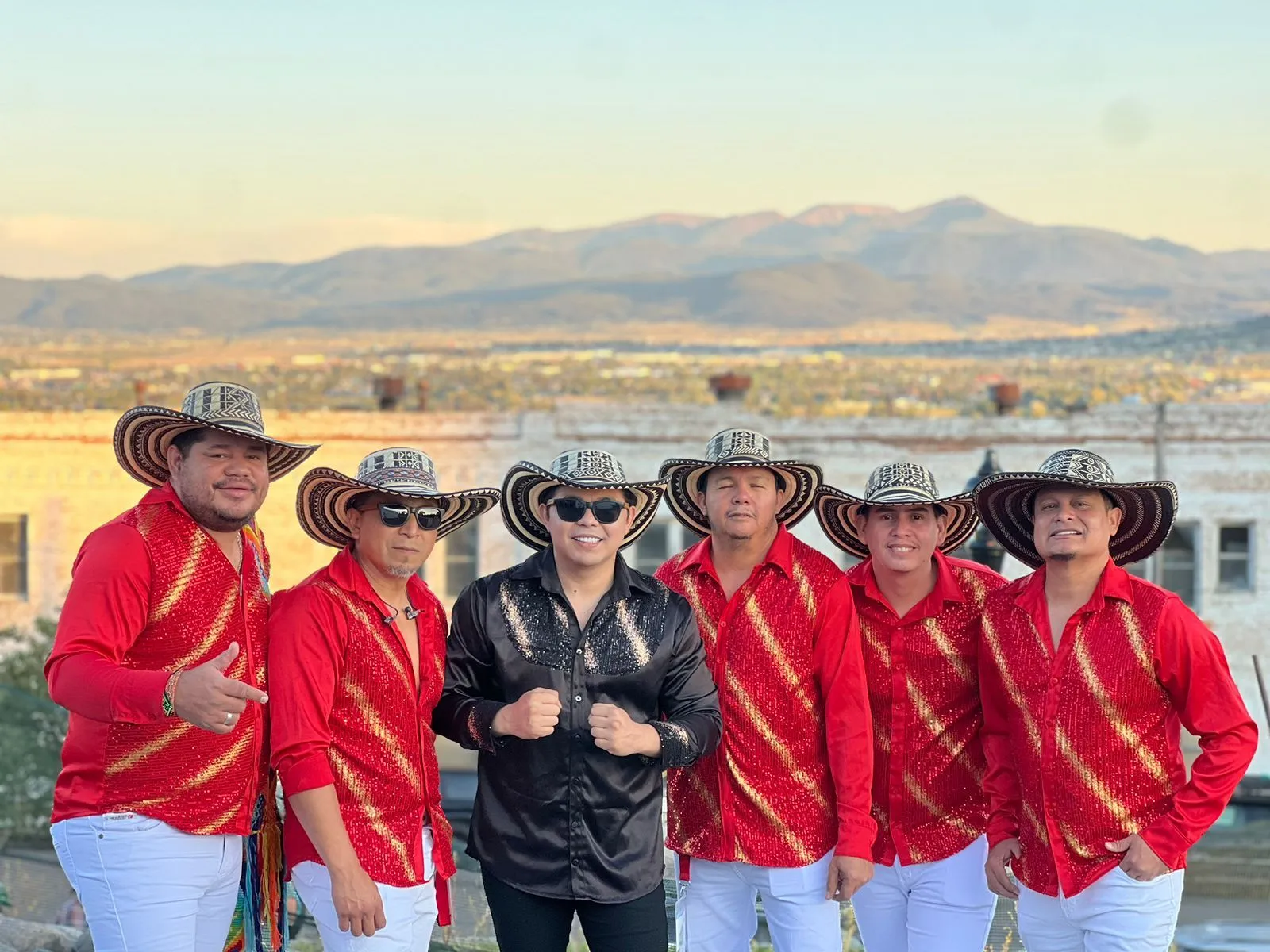
Yeison Landero still plays cumbia in the same way he learnt it as a child in San Jacinto, a small town in Colombia’s Montes de María where the diatonic accordion became central to local dance music. His grandfather Andrés Landero listened to the gaita ensembles and drum groups of the region and began adapting their repertoire. He took their rhythms, their melodies and their song structures and rewrote them for accordion. The result became known as cumbia de acordeón, and Andrés Landero became its key figure, with recordings that travelled from the Colombian Caribbean to jukeboxes in Mexico City, dance halls in Buenos Aires and, later, specialist reissue catalogues in Europe and Japan.
Yeison grew up inside that repertoire. Guacharaca patterns, tambora accents and the way accordion phrases respond to the drums were part of everyday sound in his grandfather’s house, in his uncle’s playing and at local fiestas where people already knew the choruses before the band started. When he picked up the accordion himself, taught directly by Andrés before his death in 2000, he was learning an instrument he had already heard for years at close range. Leading his own ensemble came later, along with the responsibility of carrying that music forward. By the time he and his seven-piece group arrived in Tampere for WOMEX 2025, the only Colombian act selected for a showcase at the annual world music exposition held in late October, that responsibility had already taken him a long way from San Jacinto.
We met Landero and his musicians at the conference centre the day after their performance. On stage the previous night, the Finnish winter already knocking at the door outside had stopped mattering as cumbia spread its tropical warmth throughout the venue. The set moved through classics from his grandfather and other pioneers of the genre, music that has been danced to for decades across Latin America and was now filling a concert hall in Tampere. Asked about the showcase, the accordionist and bandleader went straight to what the invitation meant. “For us, being here is not only representing ourselves, but all our teachers. To have that message of so many years of work and teaching that all our teachers have had. And in this case, the musical legacy that I represent, which is of my grandfather, Andrés Landero.”
That inheritance shapes how Landero understands his creative responsibility. “I see music as that big tree that has a root, that also blooms in different seasons,” he said. “It is very good what other groups do with the cumbia, but the specific work of us as a group is that we are strengthening that tree from the root, because it is important to keep it alive so that that great musical tree remains.”
The current ensemble represents a deliberate convergence of bloodlines and regional styles. Javier Landero, Andrés’s son and Yeison’s uncle, plays the guacharaca, the ridged wooden scraper that provides cumbia’s rhythmic spine. He recorded many of the songs the current band still performs. “I spent many years with my father in the group, a little over 20 years, I accompanied him in many recordings,” Javier said. “Now I am living the new era or the new experience. This new stage with my nephew Yeison Landero. We are carrying with great responsibility the legacy of Andrés Landero, but also with great humility, so that wherever we are, in different parts of the world, they also know about our culture, our music, our population.”
Javier recalled the musicians who visited his family home during his childhood, using the Colombian term juglares for master accordionists. “We had as a family the opportunity to have great juglares in our home, since my father was very friendly with his juglares. Alfredo Gutiérrez, Pacho Rada, Abel Antonio Villa, Luis Enrique Martínez, Enrique Díaz. Many juglares of his time, but who maintained a very great friendship, they loved each other as brothers, as compadres. Since I was born, I had the opportunity to live that, that they were in my house, and from there it also helped me to be inspired by my instrument, which is the guira or guacharaca.” He began playing at ten and joined his father’s touring group at fourteen.
Yeison expanded on the culture of distinct styles among these masters. “One of the things that my grandfather talked about a lot was style. Each juglar had a particular style. In fact, styles that were marked by rhythms. Some were great juglares that were dedicated, for example, to the rhythm of the paseo, which is another rhythm that Alfredo Gutiérrez has, or the rhythm of the guaracha, and that’s where Aníbal Velásquez comes in. And there was Andrés Landero, the father of son and chorrada.” Son and chorrada are vocal styles within Colombian accordion music, distinct from cumbia but part of the same coastal tradition. “And when we talk about cumbia, it was Landero. They respected a lot the styles of each one by musical genre, because each one stood out in a specific genre.”
Daniel Movilla, a younger musician from the same territory, joined Yeison’s first musical project at age nine, a group called Los Nietos del Maestro Andrés Landero, which featured Yeison’s sister as vocalist. “The essence is always, that is, it is something that is carried in the blood,” Movilla said. “Since I was a child, my father always instilled music in me.” He spoke of what their current work represents: “We are demonstrating that cumbia is still alive, we are carrying the legacy of Maestro Andrés Landero to the world again. Cumbia is the most beautiful thing, it is carried in the veins, and it is danced as it feels.”
Heiber Rodríguez, known as “El Tigre de la Gaita”, plays the gaita, reconnecting the ensemble to the instrument that preceded the accordion in cumbia’s development. “I believe that this fusion that Yeison is doing with the gaita was made by his grandfather with Los Gaiteros de San Jacinto, which was to transport the gaita in the accordion, the cumbia in the accordion,” Rodríguez said. “It is what Yeison is doing today, he is again living that time of his grandfather. I believe that God has given us this opportunity to represent Colombia all over the world.”
He described their approach to performance: “We do it with the satisfaction of making everyone’s heart happy, even if they do not know how to dance it, how to listen to it, how the language is, but they feel it. The cumbia is danced as it feels.”
Los Gaiteros de San Jacinto, a foundational ensemble in Colombian traditional music that won a Latin Grammy in 2007, also came from San Jacinto. The town and the surrounding Montes de María region have produced multiple generations of cumbia musicians, creating a dense network of teachers and students, compadres and collaborators.
The current Yeison Landero ensemble deliberately extends beyond the Montes de María. Andrés Ramírez, from Guadalajara, plays percussion. His path to the group illustrates the reach of the Landero legacy. “I grew up listening to cumbia,” Ramírez said. “My grandmother in the house, on Sundays when it was time to clean the house, she listened to cumbia. I remember that it sounded like ‘La Pava Congona’, but at that time I didn’t know what it was. We sang the song, but I didn’t know it was Andrés Landero. As a child, you listen to your grandmother’s music, but you don’t know the artist.”
Before joining the group, Ramírez’s understanding of Colombian cumbia came filtered through Mexican interpretations. “You have your own interpretation of Colombian music, with artists and bands like Celso Piña, Influencia, Sonora Dinamita, that play a different cumbia, or the norteño cumbia, like Chico Che. Those were our influences.”
When Yeison invited him to join, Ramírez felt apprehensive. “When Landero first hired me, I got nervous because I had to play with a Colombian band. I didn’t think that was the expectation, but he told me, no, no, no, you play as you play.“ The integration has worked, Ramírez believes, because of cumbia’s core elements. “I think the fact that we all grew up listening to cumbia makes it easier. Because at the end of the day, the root is there, the llamador, the guacharaca, it’s what connects us. It doesn’t matter how you play cumbia, or what instruments you use, anywhere in the world, there’s always going to be a llamador and a guacharaca.”
The llamador is a small drum that marks the off-beat, one of the essential components of cumbia’s rhythmic structure alongside the larger tambora and the guacharaca. These three percussion instruments, with African and indigenous origins, form the rhythmic foundation over which melody instruments play.
Jhon Morales, a more recent addition to the group, plays trombone and adds electronic effects. He observed how cumbia has adapted across territories. “I find the artistic manifestations of cumbia very interesting, how it has been transforming and appropriating in each territory as it is inhabited,” he said. “For example, in Mexico the cumbia rebajada, in Argentina the cumbia villera. I also find Yeison’s invitation very nice and the vision of adding other sounds, other elements. I am in charge of playing the trombone and also to throw a little bit of effects, a little bit of psychedelia.”
He reflected on the nature of musical work: “We are like a channel, and music always flows through us. We have that privilege, to be able to break those schemes in the society of a conventional job. In some way we are fortunate to be here, and to be able to enjoy it, to do what we like, and that it is also our job. For me it is a fortune to be here, we are really blessed.”
Aníbal Hernández, nicknamed “El Mago”, plays electronic bass and has collaborated with Yeison on musical production for several years. “We have been able to achieve a gear, a musical balance, that is both for us satisfactory, because we feel good doing the job, but we also feel that we connect a lot with people doing it this way,” he said. He described the group dynamic as “the Colombian national team, but with a Mexican adoption.”
On what makes the work meaningful, Hernández was direct: “The most important thing in music, or any art, is that manifestation that comes out of you, that is what you create in your mind, the creativity that you do, and your heart, can connect with people, but that they like it too, that you feel that they enjoy it. I think that is the most valuable thing, and what you carry in your memories.”
Landero was careful about terminology: “I don’t want to call it electronic cumbia, because it’s not. We have a very strong tradition. What we do, suddenly, are sounds that have a syntax, or electronic sounds that generate an atmosphere, but that also integrate a modernity.”
The trombone connects to an older tradition as well. “My grandfather, in his time, made songs where he introduced the bombardino, the clarinete, there are recordings of that,” Landero explained. “In Colombia, we have a rhythm that is called porro, which are pure metal bands, and they are part of the Caribbean coast. Lucho Bermúdez, Pacho Galán also did a lot for cumbia, and they are totally metal. So, being able to integrate different sounds, but that also unites, in a certain way, a territory.”
Lucho Bermúdez and Pacho Galán were mid-twentieth-century Colombian composers and bandleaders who brought cumbia and porro to big band formats, introducing brass and wind arrangements that reached international audiences.
Landero emphasised that the ensemble draws on each member’s existing experience rather than training musicians from scratch. “The important thing is that everyone also has a particular experience,” he said. “This group, God has put it on the path with very particular elements, but it hasn’t been like, hey, I want you to start studying cumbia now, because I want to record an album this year… Everyone already has a particular experience, which they bring to contribute to the group.”
For the WOMEX showcase, they planned to open with sounds that signal their intentions. “We started with very indigenous sounds, which not only represent the Colombian indigenous part, but it also mixes with the Mexican, and I think with very indigenous Latin American sounds,” Landero said. “That’s what we want to show, how to ask for permission from the ancestral, but that also allows us to be a bridge between the teachers and what is currently happening in the world.”
The goal is to establish a recognisable identity: “What we want is to create a style, that this group of Yeison Landero is a sound too, that respects, that admires, that strengthens the tradition, but that also makes a contribution to history, as something also new.”
The ensemble’s network extends across Latin America and into Europe. They have collaborated with Celso Piña, the late Monterrey-based accordionist who popularised cumbia rebajada in northern Mexico, recording “La Pava Congona” together and a tribute track called “Landero”. In central Mexico they have worked with Alberto Pedraza, and in Argentina with La Delio Valdez, a collaboration that received a Latin Grammy nomination for 2025. “We also have the opportunity to show our admiration for artists like Los Mirlos from Peru.” Landero also pointed to a younger wave of groups keeping cumbia active on world stages. “There are also other artists such as Son Rompe Pera and Kumbia Boruka, they are great brothers from here, from Europe, who visited. In fact, Tadeo [Cortés Nava, percussionist and founder of Kumbia Boruka] was in Colombia, we could not see each other, but we always have a lot of connection. And there is La Ronda Bogotá. There are many bands that are doing new things too and that connect us.”
When asked about the global spread of cumbia, which has not only reached Europe but also Japan and Asia at large, Landero expressed admiration: “To know that they’ve taken the effort to listen to cumbia. A lot of bands here tell us about their influence, and we feel the gratitude and the surprise that many times they’ve studied my grandfather’s music, with influences that are a bit more modern than other Mexican cumbias, or villeras. But the llamador is always there, in the middle of everything.”
He valued their dedication: “Here we’ve heard music from Japan, from South Korea, there’s a lot of interesting music, but they’ve also listened to cumbia, they’ve interpreted a bit of cumbia. We also value the way they do it, also the fact that they take the time, that they do a very well done task. Many have also travelled to Colombia before recording their first albums or songs, to study with teachers.”
Cumbia’s spread across continents is something Landero views as confirmation of the genre’s essential qualities. “I feel that the strength of the cumbia is that it united continents,” he said. “Because we have the very important Afro strength in the drums, but also our indigenous heritage of the Montes de María, which also gives identity. The Spanish lyrics, but above all, it is because the cumbia, in addition to a rhythm, is a feeling that from the beginning was expressed as a force of resilience. It is the way in which we express ourselves, in which we want to say the day-to-day of us, of our peoples.”
He traced cumbia’s adoption across social contexts: “It also reached many cities, also to the most rural colonies, also adopted by gang movements, we could say subcultures, who saw in the cumbia also a way of life, of getting out of those scourges of violence that were at the time. So the cumbia is still in the world, also touching those same fibres, which is a way of building community, society.”
The Montes de María region itself experienced decades of armed conflict between guerrilla groups, paramilitaries and the Colombian military, which gives that description of resilience a concrete backdrop.
Landero spoke about cumbia’s universality in emphatic terms: “Cumbia has become that universal feeling that does not need to have a language, nor Spanish, nor English, nor Portuguese, nor Mandarin, nor any of this, but because it is the force that is in the drums, in the lyrics, in the melodies, and that it is something that is not fashionable. It is not five years or ten years ago, but it is more than 300 years of an ancestrality that comes from master to master, but that has been cultivated, it has also been transformed, but that maintains an essence. I believe that it is not only something that is in the trade, but that it has a very strong ancestral magic.”
Young people’s interest has grown noticeably. “In recent years, I have noticed that young people have a very strong interest in cumbia. They want to know where it comes from. They want to enjoy it, dance to it, feel it, and they also have an interest to play it,” Landero said. “We also have the opportunity to do workshops where we teach how instruments are interpreted.”
When asked about the differences between cumbia traditions across countries and the tensions between purists and innovators, Landero offered a nuanced position: “There is a particular rhythm, there is a form, there is an essence that must always be maintained to feel that there is that blow there, the counter-tempo that carries the llamador, the way in which the instruments are interpreted, that we can determine that it is cumbia. We are also very admiring of those who are doing, for example, it does not necessarily have to be with gaita, with accordion, it can be with guitar, others with piano, others who only use the guacharaca, others who use a multi-percussion, others who use a DJ, but we feel that the rhythm is there.”
He distinguished between sincere adaptations and opportunistic ones: “We are also surprised that sometimes we see new projects that we respect, but that suddenly say, hey, I’m doing cumbia, but that really, when we listen to it, we know that there is no cumbia essence there.” Some, he noted, “only adopt it for fashion. They say, I’ve done rock all my life, or I’ve done reggae, or I’ve done something else, but wow, I think there is a movement in cumbia, let’s go there. So when you listen, there is no cumbia there.”
Still, he maintained an open stance: “We open our arms to those who say and decide to do cumbia. They are welcome because we want cumbia to stay alive, to grow.”
The group operates a foundation, Landero Vive, which runs music education programmes in San Jacinto. They also organise Cumbia Fest, a festival in San Jacinto now entering its third year in January 2026. “We receive many musicians, but also lovers of cumbia music, Mexicans, people from the United States,” Landero said. “The idea is now to invite people from Europe who are also visiting us.”
The WOMEX appearance follows previous international work. “We were at Expo Dubai 2020, and from there we developed a tour through Europe at that time as well,” Landero said. “But I think this is a new stage of the project, which would be the first time that we show this project as it comes, so new, with this new force.”
Following the WOMEX showcase, the ensemble continued to Brussels, Zurich, Vienna, Nantes and Paris before returning to Colombia in November. From there they travelled to Argentina, then to the Guadalajara International Book Fair for the launch of Yo Soy La Cumbia, a book for which Yeison Landero wrote the prologue and which includes chapters on cumbia scenes in Colombia, Mexico, Chile and Peru.
New recordings are underway. Two songs were tracked in New York and Kingston for a forthcoming LP scheduled for release in May 2026. A 45 featuring a duet with Celso Piña and a tribute to cumbia regia is also forthcoming. Landero plans to record the next full album at a studio in the Woodstock area if scheduling permits.
For his uncle and bandmate, this new phase is inseparable from the family story. Javier Landero spoke about what it means to see the project at this stage: “It is a very important meaning, as a family, as a dynasty, as an heir. The experience that is currently being lived with this bunch of guys that I have by my side, fills me with pride, it also fills me with wisdom, because I have learned a lot from them as well. It is a satisfaction, since I come from that root of cumbia, and I have always carried cumbia in my blood. We hope that God gives us a long life to continue in this, and to continue bringing cumbia to all the communities in different parts of the world.”
That sense of family is not just a matter of lineage; it also defines how the wider ensemble works. Andrés Ramírez, the Mexican percussionist, described what it feels like to be part of this group rather than a hired player: “Here it is like a family, it is comfortable to play with them. Many times in other groups I don’t even know the names of the other band members. I come to play, and I know that he is the guitarist, but I don’t even know his name, or where he is from. But here I know them, and we joke, even when we are not on tour, we are in the texts communicating, sending messages, jokes. We have created a very nice brotherhood, which for me is something new.”
He paused. “I grew up listening to cumbia, against my will, and now I play cumbia for my own will. So that is nice.”
To keep track of Yeison Landero’s tours, projects and upcoming LP,
and to listen to more of his cumbia, head to his official site